


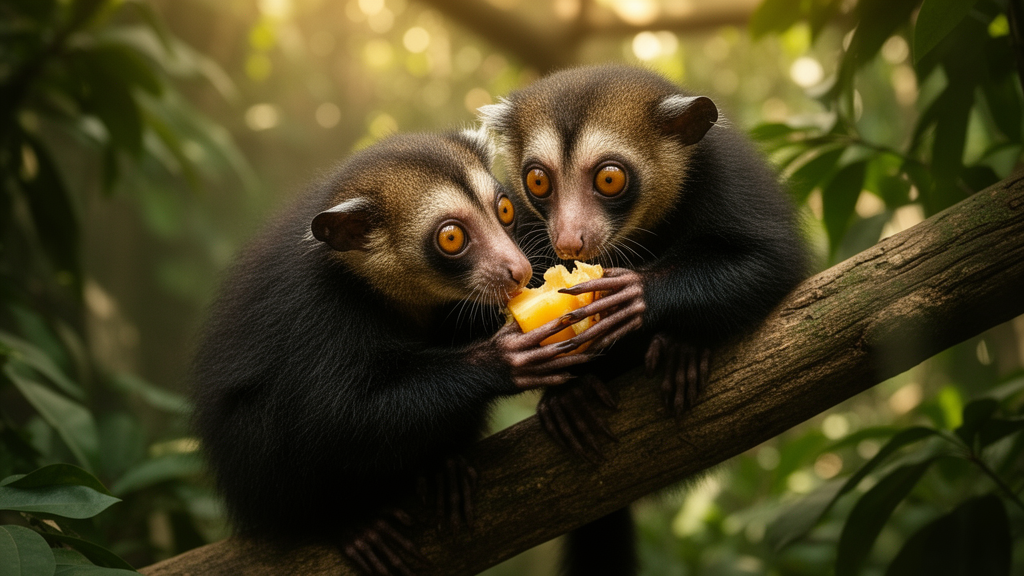
The aye-aye has long been cast as one of nature’s most committed loners. The strange-looking lemur, with its skeletal middle finger and rodent-like ever-growing incisors, is classified as a solitary forager, and zoos around the world have traditionally kept it that way, housing individuals apart except for breeding and weaning. But a new study from Bristol Zoo in the United Kingdom suggests that this rigidly solitary management may be selling the species short. When three captive-born aye-ayes were given the chance to live together, they not only tolerated one another but spent a meaningful share of their active time engaged in friendly social behaviour, with aggression remaining almost entirely absent.
The research, published in Frontiers in Ethology, was conducted by Gabriella Alisha Fraser of Harper and Keele Veterinary School and Paige Bwye of Bristol Zoological Society. Over nine weeks, from November 2021 to May 2022, the team observed an adult male, an adult female, and their juvenile male offspring under three different housing regimes: solitary, pair-based dyadic housing, and full group housing. The animals were all familiar with one another from previous short-term social periods, and the juvenile was 16 months old at the start of the study, no longer nursing. Notably, the adult female was confirmed pregnant during the first six weeks of the study, a factor the authors acknowledge as a potential confound.
The study took place in the zoo’s former nocturnal zone, Twilight World, where two adjacent forest-styled enclosures, together measuring 12.3 by 4.6 by 6 metres, could be connected or divided through internal doors. A reversed light cycle simulated nocturnal conditions, with dim moonlight-style lighting during visitor hours. Behavioural data were collected five days per week in 60-minute sessions using instantaneous scan sampling at one-minute intervals, yielding up to 60 scans per session. In total, the team amassed 49 observation hours: 24 hours of group housing, 25 hours of pair housing, and 25 hours of solitary housing.
The results were striking. All three individuals expressed social behaviour during social housing, accounting for 16.25 percent of scans in the juvenile male, 14.02 percent in the adult female, and 12.37 percent in the adult male. Affiliative interactions such as allogrooming, social play, and social foraging dominated, while agonistic behaviour such as fighting and chasing remained vanishingly rare, at less than 0.35 percent of total scans. Statistical analysis using binomial generalised linear mixed models confirmed that social behaviour was significantly higher in every social housing configuration compared with solitary housing, although the specific composition of the group did not significantly change the amount of social behaviour observed.
Beyond social behaviour itself, the researchers examined how housing conditions reshaped the animals’ broader activity budgets. Locomotion increased significantly in group housing and in the sire-juvenile dyad relative to solitary housing, while exploration rose in the sire-juvenile condition but fell in group housing. Maintenance behaviours such as resting and auto-grooming decreased in group housing, and, critically, abnormal behaviours including pacing, hair plucking, and excessive scratching also declined significantly under group conditions. Feeding and foraging, meanwhile, remained stable across all housing types, suggesting that social living did not disrupt essential foraging behaviour.
The authors then extended the experiment by maintaining continuous group housing for three consecutive weeks to assess whether behavioural changes would stabilise or intensify over time. Locomotion and maintenance behaviours remained relatively stable across the period, indicating a degree of behavioural adjustment. However, exploration increased significantly in the second week, and feeding and foraging rose significantly by the third week. Most concerning, abnormal behaviour increased significantly across the three-week period, with higher levels in both week two and week three compared to week one, particularly in the adult female during week three.
This rise in abnormal behaviour during extended group housing is the study’s most cautionary finding. The authors note that it remains unclear whether this pattern reflects a transient adjustment period or sustained stress, and they stress that unmeasured external factors such as visitor presence or noise may have contributed. The small sample size of just three individuals also limits generalisability, and the authors interpret age and sex effects cautiously, as these were confounded with individual identity. Nevertheless, the finding underscores that social housing is not a simple welfare panacea and that prolonged exposure may carry costs that shorter-term arrangements do not.
The study’s broader significance lies in what it reveals about aye-aye social organisation itself. Field observations have long hinted at more complexity than the solitary label implies: researchers have documented repeated foraging associations between adult males and females, male-male foraging units of up to three individuals, and even adult males sharing nest sites on mainland Madagascar, despite solitary nesting on Nosy Mangabe. A semi-wild male-female pair was once recorded spending an average of 26.4 percent of observation time in proximity. The new captive data align with this picture of a species whose social behaviour is flexible and context-dependent rather than rigidly asocial.
Comparative evidence from other nocturnal primates reinforces the interpretation. Pygmy slow lorises introduced into group enclosures have shown increased affiliative behaviour alongside reductions in physiological stress indicators and stereotypic behaviour, suggesting that social tolerance in strepsirrhine primates may be more widespread than traditionally assumed. The aye-aye findings are consistent with this pattern, though the authors caution that species differences must be considered and that enriched, choice-based housing conditions likely facilitate positive social outcomes.
For zoo managers, the practical implications are tentative but meaningful. The authors suggest that short-term, managed social housing between familiar individuals, particularly outside the female’s oestrus period, may offer a flexible approach to promoting affiliative behaviour while maintaining reproductive control. They emphasise that separation facilities must remain available, that spatial availability and individual history should inform decisions, and that no co-sleeping between adults was recorded, supporting the provision of at least one nest box per individual. Larger, multi-institutional studies integrating behavioural and physiological welfare measures will be needed before firm recommendations can be made, but for now, the aye-aye’s reputation as a creature of one may be due for a revision.
Subject of Research: Social housing effects on the behaviour and welfare of zoo-housed aye-ayes
Article Title: Evaluating social housing strategies in zoo-housed aye-ayes (Daubentonia madagascariensis): behavioural considerations for welfare and management
Article References: Fraser, G. A., & Bwye, P. (2026). Evaluating social housing strategies in zoo-housed aye-ayes (Daubentonia madagascariensis): behavioural considerations for welfare and management. Frontiers in Ethology, 5, Article 1819189. https://doi.org/10.3389/fetho.2026.1819189
Image Credits: AI Generated
DOI: 10.3389/fetho.2026.1819189
Keywords: aye-aye, Daubentonia madagascariensis, social housing, animal welfare, zoo management, primate behaviour, nocturnal primates, lemurs, stereotypic behaviour, affiliative behaviour, Bristol Zoo, applied ethology
Cite Scienmag News
Mark Graham. (October 17, 2026). Solitary No More: Zoo Aye-Ayes Show Hidden Social Side When Housed Together. Scienmag. https://scienmag.com/solitary-no-more-zoo-aye-ayes-show-hidden-social-side-when-housed-together/
Mark Graham. "Solitary No More: Zoo Aye-Ayes Show Hidden Social Side When Housed Together." Scienmag, 17 October 2026, https://scienmag.com/solitary-no-more-zoo-aye-ayes-show-hidden-social-side-when-housed-together/. Accessed 17 October 2026.
Mark Graham. "Solitary No More: Zoo Aye-Ayes Show Hidden Social Side When Housed Together." Scienmag. October 17, 2026. https://scienmag.com/solitary-no-more-zoo-aye-ayes-show-hidden-social-side-when-housed-together/


