


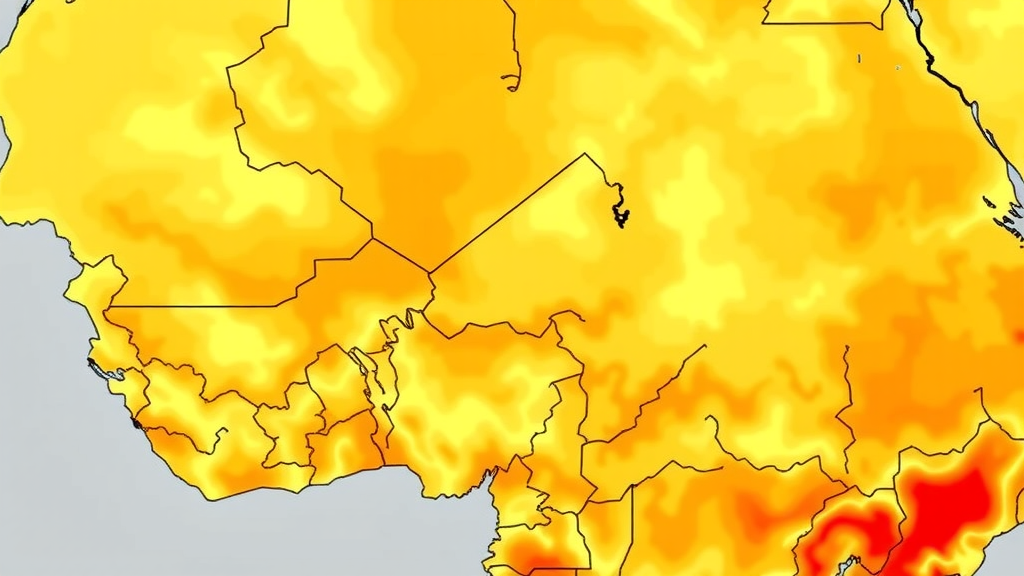
In the semi-arid heartland of northern Nigeria, a new study warns that the humid, oppressive heat that once counted as a rare anomaly is on course to become an almost permanent feature of daily life. Researchers led by Muhammad Sambo Ahmed of Kaduna State University analyzed more than a century of climate model output spanning 1981 to 2100 and found that moist heatwaves in the Sokoto Rima Basin are projected to multiply from a historical average of just 0.14 events per year to nearly seven events annually by the end of the century. Perhaps more striking is the timeline: the probability of experiencing at least one heatwave in any given year climbs from below 1 percent in 1981 to almost 100 percent by 2050 under both moderate and high emission scenarios. The findings, published in Theoretical and Applied Climatology, suggest the basin is heading toward a fundamental regime shift in which dangerous heat stress ceases to be an exception and becomes the seasonal norm.
The study focuses on the Sokoto Rima Basin, a Sudano-Sahelian region where millions of people depend on rain-fed agriculture and outdoor labor for their livelihoods. Unlike dry heatwaves, which are dangerous primarily through temperature alone, moist heatwaves combine high temperatures with elevated humidity, dramatically reducing the human body’s ability to shed excess heat through sweating. This distinction matters enormously for health outcomes, because the wet-bulb component of heat stress determines how quickly the body’s core temperature can rise toward lethal levels. In a region where irrigation, floodplain farming, and dense rural populations coincide, the combination of heat and humidity poses risks that simple air-temperature metrics systematically underestimate. The researchers argue that this is precisely why moist heatwaves in the basin have remained poorly characterized until now, despite mounting evidence that humidity-driven heat is among the fastest-growing climate hazards in West Africa.
To quantify the hazard, the team constructed daily Wet Bulb Globe Temperature, or WBGT, data from a multi-model ensemble of four global climate models participating in the Coupled Model Intercomparison Project Phase 6, known as CMIP6. WBGT is widely regarded as one of the most policy-relevant heat stress indices because it integrates temperature, humidity, radiation, and wind into a single measure that maps directly onto occupational health thresholds. Rather than relying on a single model, which can be skewed by individual model biases, the ensemble approach averages across models to produce a more robust central estimate of future conditions. The researchers then applied a hybrid heatwave definition that combines a relative threshold, the 90th percentile of local WBGT, with an absolute threshold of 30 degrees Celsius. This dual criterion is technically significant: the relative component ensures that heatwaves are identified as unusual for the local climate, while the absolute floor guarantees that only events genuinely hazardous to human physiology are counted, avoiding the trap of flagging mild anomalies in cooler periods as heatwaves.
Defining a heatwave is notoriously contentious in climate science, and the choice of threshold can materially change projected trends. A purely relative definition would identify the hottest 10 percent of days in any climate, even a cooling one, while a purely absolute definition might miss dangerous events in regions where the local baseline is already high. By anchoring their definition to both, the authors sidestepped two well-documented pitfalls. The approach also responds to growing calls in the literature for heatwave metrics that prioritize health impacts rather than purely statistical rarity, a shift that has gained momentum as studies of deadly heat events worldwide have shown that mortality often correlates better with humidity-adjusted indices than with raw temperature records.
The statistical machinery behind the projections is as notable as the climate modeling itself. The team employed a hurdle model, a composite framework that separates the question of whether a heatwave occurs at all from the question of how severe it is when it does. Linear regression captured trends in the mean characteristics of events, logistic regression estimated the annual probability of at least one heatwave occurring, Zero-truncated Poisson regression modeled the count of events in years when heatwaves do happen, and quantile regression traced how the entire distribution of heatwave intensity is shifting, not just its average. This layered design matters because heatwave data are count-heavy and zero-inflated: in the historical record, most years contained no events at all, which violates the assumptions of ordinary regression. The hurdle structure handles this sparsity explicitly, while quantile regression, a technique introduced by Koenker and Bassett in 1978, allows the researchers to ask whether the most extreme events are changing faster than typical ones.
The answer to that last question is one of the study’s most consequential findings. Under both emission scenarios, the slopes of the quantile regression at the 99th percentile were consistently steeper than at the median, meaning that the most extreme heatwave events are intensifying disproportionately faster than ordinary ones. In practical terms, the tail of the distribution is outpacing the middle: the worst heat stress episodes of the future will not simply be slightly worse than today’s worst, but dramatically so. This pattern echoes a broader theme in climate extremes research, where changes in variability and in the tails of distributions often carry greater societal risk than changes in the mean, because infrastructure, agriculture, and human physiology are all calibrated to historical worst-case conditions rather than average ones.
The scenario comparison adds a further layer of nuance. Under the moderate SSP 2-4.5 pathway, the basin is projected to experience 6.71 heatwave events per year by 2100, while under the high-emission SSP 5-8.5 pathway the figure is 6.07 events. At first glance, the higher-emission scenario appears less severe, but the authors caution against that reading. SSP 5-8.5 projects fewer events that are significantly longer and more intense than those under SSP 2-4.5. In other words, the difference between the two futures is not whether dangerous heat arrives, but whether it arrives as a series of discrete episodes or as prolonged, punishing spells that push cooling capacity, water supplies, and human endurance to their limits. Both pathways, the study concludes, point to an irreversible shift toward a permanent heat-stress regime by mid-century, a threshold at which adaptation can no longer be deferred without substantial loss of life and livelihood.
The implications for the Sokoto Rima Basin are stark. The region’s economy is dominated by informal and agricultural sectors, where workers have little protection from outdoor heat and where labor laws currently contain few, if any, provisions for heat stress. The authors argue that their findings make a case for urgently reforming labor regulations to mandate rest periods, hydration, and shade for outdoor workers during high-WBGT conditions. They also call for revising building codes to incorporate heat-reflective materials and natural ventilation, measures that can lower indoor temperatures in a region where air conditioning remains inaccessible to most households. A third recommendation centers on strengthening heat-health early warning systems, which remain rudimentary across much of the Sahel despite evidence that such systems save lives when heat events are forecast and communicated in advance.
The study also situates itself within a rapidly expanding body of West African heat research. Recent work has documented intensifying heat stress in Nigerian cities such as Kano, characterized heatwave dynamics across the Sahel using multiple thermal indices, and projected widespread increases in heatwave severity over West Africa using CMIP6 ensembles. Global analyses have further warned that combinations of heat and humidity approaching the limits of human tolerance are already emerging in parts of the world, with the Persian Gulf, South Asia, and now increasingly the Sahel identified as hotspots. What the new study adds is a basin-scale, health-anchored projection that extends to the end of the century and explicitly quantifies the probability structure of future events, from the likelihood of any heatwave occurring in a given year to the behavior of the most extreme tail of the intensity distribution.
For a region where the historical baseline was fewer than one heatwave every seven years, the projected trajectory toward near-annual, and eventually multiple, events represents a transformation with few precedents in the observational record. The authors emphasize that the window for cost-effective adaptation is narrowing: once the probability of dangerous heat approaches certainty, as their models indicate it will by 2050, reactive responses give way to structural ones, and the costs of inaction compound across health systems, agricultural output, and labor productivity. Whether the basin’s worst-case future features many moderate episodes or fewer but far more brutal ones depends on global emission choices made far beyond its borders. What the research makes clear is that in either case, the era of treating moist heatwaves in the Sokoto Rima Basin as rare emergencies is ending, and the institutions charged with protecting its people will need to treat chronic heat stress as the defining environmental challenge of the coming decades.
Subject of Research: Projected moist heatwave frequency, duration, and intensity in Nigeria's Sokoto Rima Basin using CMIP6 ensemble simulations and hybrid statistical modeling from 1981 to 2100
Article Title: A hybrid approach analysis of cmip6 multi-model ensemble simulations of moist heatwaves in Sokoto Rima Basin, Nigeria (1981–2100)
Article References: Ahmed, M. S., Abubakar, M. L., Richifa, K. I., Buba, A., Umar, A., Ahmad, M., Chobal, N. M., & Abdussalam, A. F. (2026). A hybrid approach analysis of cmip6 multi-model ensemble simulations of moist heatwaves in Sokoto Rima Basin, Nigeria (1981–2100). Theoretical and Applied Climatology, 157(10), Article 678. https://doi.org/10.1007/s00704-026-06609-w
Image Credits: AI Generated
DOI: 10.1007/s00704-026-06609-w
Keywords: moist heatwaves, Sokoto Rima Basin, CMIP6, Wet Bulb Globe Temperature, heat stress, Nigeria, climate projections, SSP scenarios, quantile regression, hurdle model, West Africa, climate adaptation
Cite Scienmag News
Sloane Callahan. (September 26, 2026). Moist Heatwaves Set to Become Near-Annual Reality in Northern Nigeria by 2050. Scienmag. https://scienmag.com/moist-heatwaves-set-to-become-near-annual-reality-in-northern-nigeria-by-2050/
Sloane Callahan. "Moist Heatwaves Set to Become Near-Annual Reality in Northern Nigeria by 2050." Scienmag, 26 September 2026, https://scienmag.com/moist-heatwaves-set-to-become-near-annual-reality-in-northern-nigeria-by-2050/. Accessed 16 October 2026.
Sloane Callahan. "Moist Heatwaves Set to Become Near-Annual Reality in Northern Nigeria by 2050." Scienmag. September 26, 2026. https://scienmag.com/moist-heatwaves-set-to-become-near-annual-reality-in-northern-nigeria-by-2050/


