


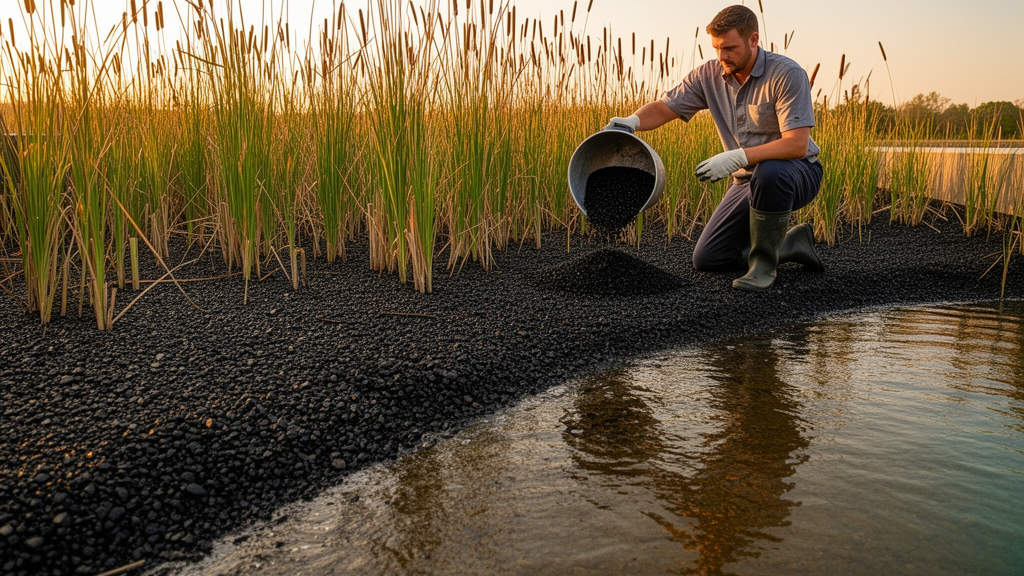
A pilot-scale constructed wetland in Morocco, boosted with a layer of biochar made from olive pruning waste, has demonstrated the ability to strip heavy metals, pharmaceutical residues and antibiotic resistance genes from municipal wastewater in a single, low-energy treatment step. The study, published in Frontiers in Environmental Chemistry, offers one of the most comprehensive pilot-scale demonstrations yet that a nature-based system can tackle several classes of emerging pollutants simultaneously, a challenge that conventional treatment plants routinely fail to meet.
The research team, led by scientists at Cadi Ayyad University in Marrakech in collaboration with partners in Switzerland, China, Germany, Tunisia and Saudi Arabia, built a vertical-flow constructed wetland fed with wastewater that had already passed through natural lagooning at the Sâada treatment plant near Marrakech. The pilot unit, a cylindrical container roughly 0.9 meters tall with a surface area of 2.17 square meters, was planted with common reed (Phragmites australis) and layered with gravel, sand and, crucially, a biochar layer produced by slow pyrolysis of olive branches at 500 degrees Celsius. The system ran continuously for four months under real-world conditions.
Biochar is the carbon-rich solid left behind when biomass is heated in a low-oxygen environment. Its appeal in water treatment lies in its enormous surface area, its porous structure and its wealth of surface functional groups that can bind pollutants. The olive-derived biochar in this study proved exceptional: elemental analysis showed a carbon content of 92.11 percent by mass, well above the 50 to 85 percent typically reported for biochars made at moderate temperatures, and an exceptionally low oxygen-to-carbon ratio of 0.086, a signature of high stability and long-term resistance to microbial degradation.
Scanning electron microscopy revealed a highly porous, heterogeneous architecture riddled with pores of varying sizes and remnants of the original plant’s vascular structure, creating an intricate network for trapping contaminants. Infrared spectroscopy identified strong signals from aromatic carbon structures and oxygenated functional groups such as hydroxyl, carboxyl and phenolic moieties. Together, these features give the biochar multiple parallel routes for capturing pollutants: hydrophobic and pi-pi interactions for aromatic drug molecules, electrostatic attraction and complexation for metal ions, and simple physical entrapment for larger particles and bacteria.
The removal figures for toxic metals were striking. Arsenic concentrations fell from 16.35 micrograms per liter at the lagoon outlet to 2.75 micrograms per liter after the wetland, a 91 percent reduction. Cadmium dropped from 0.0936 to 0.0014 micrograms per liter and lead from 0.6036 to 0.089 micrograms per liter, corresponding to removal efficiencies of 99.998 percent and 99.84 percent respectively. The authors attribute this performance to surface complexation with oxygen-containing functional groups and precipitation as insoluble metal hydroxides or carbonates in the mildly alkaline environment that the biochar helps maintain.
Pharmaceutical residues posed a tougher test because their chemistry varies widely. The system nonetheless delivered removal rates ranging from 63 percent to more than 99 percent depending on the compound. Ibuprofen and ciprofloxacin were cut by 96 to 97 percent, paracetamol was eliminated almost entirely, and even notoriously recalcitrant molecules such as carbamazepine and diclofenac were reduced by more than 60 percent. For comparison, conventional wetlands without biochar typically achieve only 40 to 60 percent removal for most pharmaceuticals, and carbamazepine removal in conventional systems often falls below 20 percent. The authors estimate that biochar addition improved performance by factors of roughly 1.3 to 3.2 depending on the drug.
Perhaps the most consequential result concerns antibiotic resistance. Using quantitative polymerase chain reaction, the team tracked genes encoding beta-lactamase enzymes, including blaTEM, blaSHV and blaCTX-M, which are major drivers of antibiotic resistance in clinical settings. Abundance of these genes, normalized to the universal 16S rRNA gene, fell by one to four orders of magnitude after treatment, with blaCTX-M showing the largest decline of roughly three to four orders of magnitude. Bacterial indicators fell in parallel: Escherichia coli dropped by 79 percent, enterococci by more than 93 percent, while Pseudomonas species, which are environmental rather than fecal organisms, proved more resistant to removal at about 47 percent.
The differential removal of resistance genes offers clues about mechanism. The authors suggest that genes carried on mobile plasmids, such as blaCTX-M, may be more vulnerable because their host bacteria are more susceptible to the wetland’s filtration and inactivation processes, whereas chromosomally encoded genes in hardier environmental bacteria persist longer. Physical retention of gene-carrying bacteria within the biochar’s porous structure, inactivation under unfavorable substrate conditions, and adsorption of extracellular DNA fragments onto positively charged biochar surfaces likely all contribute. The researchers caution that the precise mechanisms require further investigation through metagenomics and gene-tracking studies.
Conventional water quality parameters also improved markedly. Suspended solids fell by 83.7 percent, chemical oxygen demand by 75.7 percent, total phosphorus by 77.8 percent and orthophosphates by 76.7 percent, figures that meet or exceed the upper range reported in meta-analyses of standard constructed wetlands. Nitrate and nitrite removals of 68.9 and 75.4 percent point to active coupled nitrification and denitrification, aided by the oxygen gradients created by reed roots and the alternating aerobic and anaerobic zones of the layered substrate. The treated effluent met Moroccan irrigation standards for suspended solids, nutrients and heavy metals, with arsenic at just 2.75 percent of the FAO limit and cadmium and lead at fractions of a percent of their thresholds.
The study is not without caveats. The team did not run a side-by-side control wetland without biochar, relying instead on literature benchmarks, and they did not measure the biochar’s surface area by gas adsorption, leaving quantitative structure-performance relationships unestablished. One anomaly, a sharp increase in valsartan acid, a metabolite of the blood-pressure drug valsartan, suggests desorption or transformation processes that warrant further study. Residual pharmaceutical concentrations of tens to hundreds of nanograms per liter remain in the effluent, and the authors recommend additional disinfection to meet WHO criteria for unrestricted irrigation, along with long-term monitoring of crop uptake and soil health. Still, with an estimated biochar lifespan of 12 to 18 months, a feedstock that is abundant agricultural waste across the Mediterranean, and performance that rivals far more energy-intensive tertiary technologies such as ozonation, the system presents a compelling case that the solution to some of wastewater treatment’s most stubborn problems may lie in a layer of charcoal and a stand of reeds.
Subject of Research: Biochar-enhanced constructed wetlands for removing heavy metals, pharmaceuticals and antibiotic resistance genes from municipal wastewater
Article Title: Synergistic removal of various emergent pollutants in biochar-enhanced constructed wetlands: a pilot-scale nature-based solution for municipal wastewater treatment improvements
Article References: Maldou, C., El Janoussi, Y., Al Salah, D. M. M., Lahrouni, M., Ouazzani, N., Kurnaiwan, T. A., El Ghadraoui, A., Elleuch, A., Ammar, A., Poté, J., & Aziz, F. (2026). Synergistic removal of various emergent pollutants in biochar-enhanced constructed wetlands: a pilot-scale nature-based solution for municipal wastewater treatment improvements. Frontiers in Environmental Chemistry, 7, Article 1762724. https://doi.org/10.3389/fenvc.2026.1762724
Image Credits: AI Generated
DOI: 10.3389/fenvc.2026.1762724
Keywords: biochar, constructed wetland, wastewater treatment, heavy metals, pharmaceutical residues, antibiotic resistance genes, Phragmites australis, water reuse, nature-based solution, pilot scale, Morocco, olive waste
Cite Scienmag News
Juliet Wilcox. (October 16, 2026). Olive Waste Biochar Supercharges Wetlands to Strip Drugs, Metals and Resistance Genes from Wastewater. Scienmag. https://scienmag.com/olive-waste-biochar-supercharges-wetlands-to-strip-drugs-metals-and-resistance-genes-from-wastewater/
Juliet Wilcox. "Olive Waste Biochar Supercharges Wetlands to Strip Drugs, Metals and Resistance Genes from Wastewater." Scienmag, 16 October 2026, https://scienmag.com/olive-waste-biochar-supercharges-wetlands-to-strip-drugs-metals-and-resistance-genes-from-wastewater/. Accessed 16 October 2026.
Juliet Wilcox. "Olive Waste Biochar Supercharges Wetlands to Strip Drugs, Metals and Resistance Genes from Wastewater." Scienmag. October 16, 2026. https://scienmag.com/olive-waste-biochar-supercharges-wetlands-to-strip-drugs-metals-and-resistance-genes-from-wastewater/


