


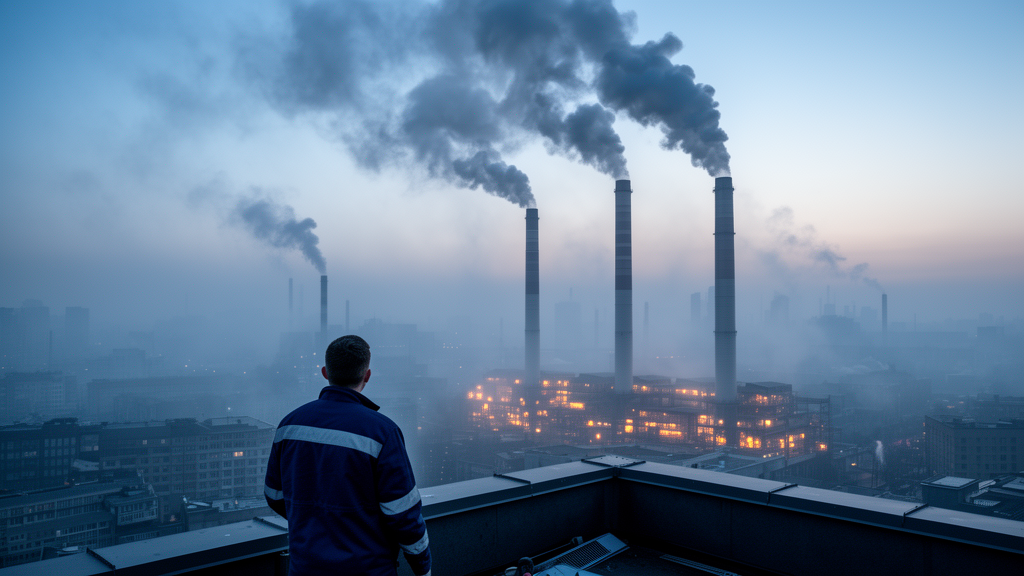
For more than a century, economists and policymakers have treated pollution as the unavoidable toll of prosperity: if you want growth, you must accept smog, contaminated rivers, and a destabilized climate. A new opinion article published in Frontiers in Environmental Economics argues that this framing is not just outdated—it is an accounting error. Writing from the School of Economics and Commerce at CMR University in Bengaluru, authors Jagadeesh K.K. and Ranjithkumar S. contend that pollution was never the price of progress at all. It was an unbilled cost, quietly transferred from the balance sheets of firms to the lungs, soils, and water systems of everyone else. The distinction matters, they argue, because it changes what pollution cleanup means: not a sacrifice of wealth, but a correction of a market that has been lying about its own costs.
The intellectual foundation of the argument stretches back to 1920, when the economist Arthur Pigou introduced the concept of externalities—costs of production that fall on parties who never agreed to bear them. When a factory releases pollutants without paying for the damage, the firm’s books look healthy precisely because society’s books absorb the difference. The authors describe this as an economy that is not telling the truth about its costs. As long as pollution remains unpriced, every ton of emissions appears free, and markets rationally overproduce it. The problem, in this view, is not that humans want prosperity and must therefore accept degradation; the problem is that the price signals guiding billions of daily economic decisions are systematically wrong.
And the bill, the authors emphasize, always comes due—it simply moves. The clearest evidence is human health. According to the Health Effects Institute’s State of Global Air 2024 report, an estimated 8.1 million people died globally in 2021 from exposure to air pollution, making it one of the top ten risk factors for death worldwide. The financial toll is equally staggering: the World Heart Federation estimates the global cost of health damage from air pollution at roughly US$8.1 trillion, approximately 6.1 percent of world GDP, alongside more than a billion lost workdays each year. The authors note that the 8.1 million death toll and the US$8.1 trillion cost figure come from two separate sources and coincidentally share the same number—a coincidence, not a duplication error. Either figure alone makes the point: pollution is slowly undermining the very growth that produced it.
The same logic applies to natural capital—the soils, forests, fisheries, and watersheds that quietly underpin entire industries. When these assets are degraded for short-term gain, national accounts record an increase in output in the year the bulldozers arrive, and register nothing when the gains are swept away by the next flood. The authors argue that conventional metrics of economic success are highly effective at measuring what we take out of nature and remarkably unable to measure what we use up. Climate change, they write, is the externality at the end of all externalities: too large, too distant, and too dispersed to be priced by market forces alone, which is precisely why it has persisted for so long without correction.
If the old trade-off story were true—that wealth and a clean environment must always pull in opposite directions—then rich economies would inevitably be dirty ones, and poor economies would have no choice but to pollute on their way up. The empirical evidence is increasingly pointing the other way. Recent studies have documented that some economies have begun to decouple economic growth from environmental pressure, driven by the shift toward renewable energy and new technologies, with significant reductions in ecological footprint in some cases—a pattern consistent with the Environmental Kuznets Curve described by Grossman and Krueger in 1995 and revisited by Smith in 2025. Comparative analysis by Cao in 2025 shows that the European Union has achieved what researchers call strong decoupling—falling emissions accompanied by continued output growth—while emerging economies, where emissions have grown faster, have not yet experienced the same effect.
Decoupling, the authors stress, is not automatic. It happens when policies, prices, and institutions decide that it is finally time to bill the unbilled costs. Which economies become cleaner and which grow dirtier is not determined by a law of nature; it is a condition, and it can be engineered. A national case study makes the point vividly. Between 2013 and 2017, under China’s Air Pollution Prevention and Control Action Plan, average PM2.5 concentrations across major Chinese cities fell from roughly 89 micrograms per cubic meter to 58 micrograms per cubic meter, even as the economy continued to expand. Pollution was not an unavoidable by-product of growth to be endured; it fell once policy made the cost of emitting visible to firms. At a local, measurable scale, the Chinese experience demonstrates exactly what the article argues in the abstract: the trade-off between economy and environment is not fixed, but a function of how honestly a system prices its externalities.
Getting an economy to tell the truth about its costs, the authors argue, requires no exotic tools. The first lever is pricing. Carbon pricing was expected to cover roughly 25 percent of global greenhouse gas emissions by 2023, with 75 schemes generating a record US$104 billion in revenues, a significant proportion of which is allocated to climate and nature programs, according to the World Bank’s State and Trends of Carbon Pricing 2024. Once a price is attached to emissions, the firm that makes the same product with less environmental damage wins in the marketplace—exactly what a well-functioning market is supposed to reward. The invisible cost becomes a visible line item, and innovation follows the money.
The second lever is circularity—reorganizing production so that waste is treated not as an inevitability but as a design failure to be engineered out of the system. Here the news is grim: the world is currently moving in reverse. The share of secondary, or recycled, materials in the global economy fell from 9.1 percent in 2018 to 7.2 percent in 2023, even as humanity consumes roughly 100 billion tons of materials per year, according to the Circularity Gap Report 2024 from Circle Economy. Yet the authors see economic opportunity buried in these numbers. Waste is often simply good business waiting to happen—reduced input costs, reduced exposure to resource shocks—meaning the circular economy can be pitched as a growth strategy as much as an environmental one.
The third lever is measurement itself. Gross domestic product, the world’s dominant economic compass, counts the money spent responding to harm as a positive contribution to output without subtracting the harm itself. Rebuilding after a flood or treating pollution-related illness adds to GDP in exactly the same way as building a new factory, even though one reflects productive activity and the other reflects a cost that was allowed to happen. Two economies can post identical growth figures while one is genuinely producing more and the other is merely cleaning up more damage. Incorporating natural capital and environmental degradation into national accounting, the authors argue, is not an academic curiosity but a fundamental change in what governments and companies optimize for.
None of this is free, and the authors are candid about that. Transitions produce winners and losers; a coal town is not comforted by the prospect of green jobs elsewhere, and a faltering or hasty transition can exacerbate inequality. That, they argue, is why the environmental problem is at heart an economic one: the question is not whether we can afford to treat the environment better, but how to do it fairly—and how to avoid simply exporting pollution to poorer nations while celebrating cleaner domestic statistics. Their conclusion is blunt. Pollution has been regarded as the cost of progress because our economy is broken—a system in which profit is privatized and harm is socialized. Environment and economy are not locked in a zero-sum trade-off; they are one system, and we have been measuring the wrong half of it. An economy that pollutes its own water, exhausts its natural resources, and destabilizes its own climate is not a robust economy paying a fair price. It is a fragile one carrying debt, and debts, sooner or later, come due.
Subject of Research: Environmental economics of pollution as an unpriced externality and the decoupling of economic growth from environmental degradation
Article Title: Is pollution the price of progress or proof that our economy is broken?
Article References: K.K, J., & S, R. (2026). Is pollution the price of progress or proof that our economy is broken?. Frontiers in Environmental Economics, 5, Article 1920207. https://doi.org/10.3389/frevc.2026.1920207
Image Credits: AI Generated
DOI: 10.3389/frevc.2026.1920207
Keywords: pollution, externalities, carbon pricing, circular economy, decoupling, economic growth, air pollution, natural capital, GDP accounting, sustainable development, environmental economics, climate change
Cite Scienmag News
Sloane Callahan. (October 16, 2026). Pollution Is Not the Price of Progress—It Is an Unpaid Bill. Scienmag. https://scienmag.com/pollution-is-not-the-price-of-progress-it-is-an-unpaid-bill/
Sloane Callahan. "Pollution Is Not the Price of Progress—It Is an Unpaid Bill." Scienmag, 16 October 2026, https://scienmag.com/pollution-is-not-the-price-of-progress-it-is-an-unpaid-bill/. Accessed 16 October 2026.
Sloane Callahan. "Pollution Is Not the Price of Progress—It Is an Unpaid Bill." Scienmag. October 16, 2026. https://scienmag.com/pollution-is-not-the-price-of-progress-it-is-an-unpaid-bill/


