


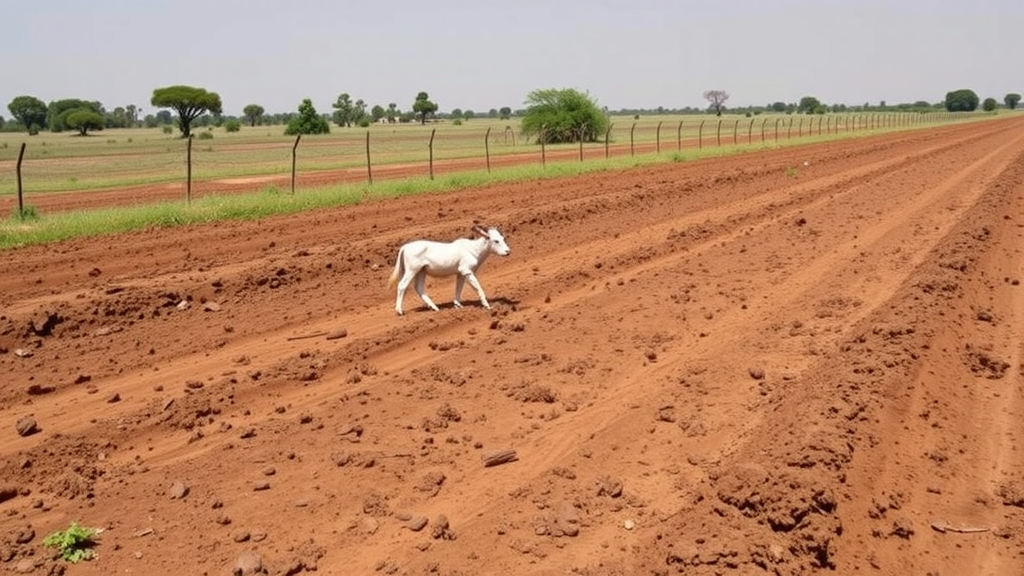
In the highlands of western Ethiopia, a simple act of restraint is quietly rebuilding the ground beneath farmers’ feet. A new study from Gida Ayana District, in the East Wollega Zone of Oromia, shows that simply closing degraded land to grazing and human interference for seven years can dramatically improve the chemical and physical health of the soil. The research, published in Discover Soil by Hirikisa Mekonnen Duguma and Tolera Megersa Gudeta of Wollega University, compared enclosed land with nearby open grazing areas and found that nearly every measured soil property fared better behind the fence.
Ethiopia’s agricultural system is overwhelmingly rain-fed, and roughly eighty percent of the population depends on it for their livelihood. Yet centuries of deforestation, overgrazing, and the relentless demand for food and firewood have left many highland landscapes severely degraded. Rapid population growth and limited arable land have intensified pressure on forests and grazing areas, prompting the government, often with support from the World Food Program, to promote large-scale rehabilitation through soil and water conservation and the establishment of area closures. By 2014/15, land under closure in Ethiopia had reached approximately 11.7 million hectares, making it one of the country’s most significant restoration strategies.
Area closure is a deceptively simple technique: a degraded parcel of land is legally protected from human interference and livestock grazing so that natural vegetation can regenerate, sometimes supplemented with vegetative and structural conservation measures. Previous studies have suggested that enclosures are among the most cost-effective and optimistic approaches to land rehabilitation in Ethiopia, restoring tree, herb, and grass species while improving soil nutrient content. The new study set out to test whether these benefits extend to the soils of Gida Ayana, a district that once carried dense vegetation cover but has been degraded since 1990 under mounting population pressure.
The researchers selected the Andode Dicho peasant association, where area closure practices had been in place for seven years. The district sits between 1454 and 2300 meters above sea level, receives a mean annual rainfall of about 1760 millimeters concentrated between May and September, and has an average annual temperature of roughly 19 degrees Celsius. Because the region practices mixed farming, with maize as the dominant crop alongside livestock production, the comparison sites were carefully matched: one hectare of seven-year-old closed land and one hectare of freely grazed land sharing similar topography, rainfall, temperature, and agroecological conditions, so that closure itself was the only meaningful difference.
Sampling followed a rigorous protocol designed to capture spatial variability. Each hectare was divided into three plots based on vegetation cover, and soil was collected in a zigzag pattern at a depth of 20 centimeters, the assumed plowing depth. Forty samples in total, twenty from each site, were gathered with an auger during the dry season in February, then combined into ten composite samples. Six core samples were also taken for bulk density analysis. All samples were air-dried, sieved to two millimeters, and analyzed at Jimma University’s laboratory, with differences between sites tested using independent sample t-tests.
The chemical results were striking. Organic carbon in the closed area averaged 5.56 percent compared with 3.16 percent in the open land, while total nitrogen reached 0.48 percent versus 0.27 percent, a difference that moved the closed soil into the very high nitrogen category while the grazed soil remained in the medium range. Organic matter followed the same pattern at 6.60 percent against 3.45 percent, and available phosphorus more than doubled, from 7.63 in the open area to 17.95 in the enclosure, shifting the soil’s phosphorus rating from low to medium. All of these differences were statistically significant.
The story continued in the exchangeable bases, the positively charged nutrients that plants draw upon. Cation exchange capacity, a measure of the soil’s ability to hold and supply nutrients, averaged 31.37 milliequivalents per 100 grams of soil in the closed area against 26.19 in the open one. Exchangeable calcium rose from 20.4 to 24.5, magnesium from 2.71 to 3.25, and potassium from 1.52 to 3.59, placing the enclosed soil’s potassium in the very high category while the grazed soil fell into the very low range. Even electrical conductivity and exchangeable sodium were slightly but significantly higher in the enclosure. Only pH defied the trend, sitting at 6.24 in the closed area versus 6.31 in the open, a statistically insignificant difference that the authors attribute to enhanced litter decomposition and infiltration under denser vegetation.
The physical properties told an equally compelling story. Soil moisture content averaged 7.3 percent in the closed area compared with just 4.3 percent in the open, a difference the researchers link to the accumulated litter layer, which stores rainfall, increases infiltration, cushions the impact of raindrops, and prevents the formation of surface crusts. Silt content was significantly higher in the enclosure, while clay content was significantly higher in the grazed land, consistent with the understanding that soil texture changes slowly and is largely resistant to conservation practices. Bulk density, an indicator of compaction, was lower in the open area in this dataset, and the authors note that conserved land generally carries lower bulk density thanks to its richer organic matter.
The mechanism behind all of these gains is straightforward: when people and livestock are excluded, vegetation regenerates, plant litter accumulates, and its decomposition returns carbon, nitrogen, phosphorus, and exchangeable cations to the soil while protecting the surface from erosion and runoff. In the open areas, continuous grazing and disturbance strip away plant material and accelerate nutrient losses. The authors conclude that area closure is an important and effective strategy for improving soil physicochemical properties and recommend extending the practice across larger areas, while calling for future research with repeated sampling across multiple locations to confirm and broaden these findings for Ethiopia’s degraded highlands.
Subject of Research: Effects of area closure on soil physicochemical properties in degraded Ethiopian highland land
Article Title: Influences of area closure on soil physicochemical properties in Gida Ayana District, East Wollega Zone, Oromia, Ethiopia
Article References: Duguma, H. M., & Gudeta, T. M. (2026). Influences of area closure on soil physicochemical properties in Gida Ayana District, East Wollega Zone, Oromia, Ethiopia. Discover Soil, 3(1), Article 141. https://doi.org/10.1007/s44378-026-00287-w
Image Credits: AI Generated
DOI: 10.1007/s44378-026-00287-w
Keywords: area closure, soil physicochemical properties, Ethiopia, land degradation, soil organic carbon, total nitrogen, available phosphorus, cation exchange capacity, grazing exclusion, land restoration, Gida Ayana, Oromia
Cite Scienmag News
William Thompson. (September 26, 2026). Fencing Off Livestock Lets Degraded Ethiopian Soils Recover Within Seven Years. Scienmag. https://scienmag.com/fencing-off-livestock-lets-degraded-ethiopian-soils-recover-within-seven-years/
William Thompson. "Fencing Off Livestock Lets Degraded Ethiopian Soils Recover Within Seven Years." Scienmag, 26 September 2026, https://scienmag.com/fencing-off-livestock-lets-degraded-ethiopian-soils-recover-within-seven-years/. Accessed 4 October 2026.
William Thompson. "Fencing Off Livestock Lets Degraded Ethiopian Soils Recover Within Seven Years." Scienmag. September 26, 2026. https://scienmag.com/fencing-off-livestock-lets-degraded-ethiopian-soils-recover-within-seven-years/


