


“[…] Weo electrolyzed water could have a positive impact on longevity and age-related diseases.”

Credit: 2024 Court-Vazquez et al.
“[…] Weo electrolyzed water could have a positive impact on longevity and age-related diseases.”
BUFFALO, NY- May 22, 2024 – A new research paper was published in Aging (listed by MEDLINE/PubMed as “Aging (Albany NY)” and “Aging-US” by Web of Science) Volume 16, Issue 9, entitled, “Cell type-dependent modulation of senescence features using Weo electrolyzed water.”
Electrolyzed-reduced water has powerful antioxidant properties with constituents that scavenge reactive oxygen species (ROS), which are known to be produced by several intrinsic and extrinsic processes. When there is an imbalance between ROS production and antioxidant defenses, oxidative stress occurs. Persistent oxidative stress leads to cellular senescence, an important hallmark of aging, and is involved in several age-related conditions and illnesses.
In this new study, researchers Brenda L. Court-Vazquez, Shirley A. Arroyo-Vizcarrondo, Jonathan A. Poli, Lara Nyman, Kelly Halderman, Anthony Ginter, and Pierre-Yves Desprez from Weo LLC and California Pacific Medical Center investigated whether Weo electrolyzed water (WEW) could modulate the phenotype of senescent cells.
“The focus of this study was to utilize two different cell types, human normal fibroblasts and human breast cancer cells, to investigate the impact of Weo electrolyzed water (WEW) on markers of cellular senescence, inflammation, and stress response genes.”
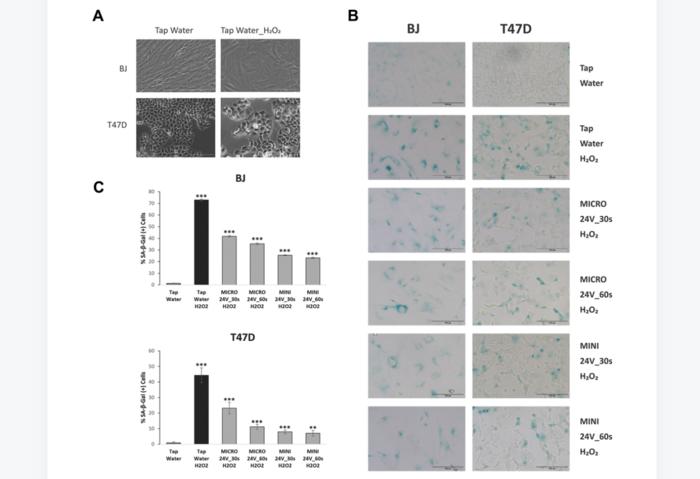
The researchers compared normal human lung fibroblasts (BJ) and breast cancer cells (T47D) treated with hydrogen peroxide (H2O2) to induce senescence. They assessed the molecular impact of WEW on markers of cellular senescence, senescence-associated secretory phenotype (SASP) factors, and stress response genes. Treatment with WEW modulated markers of cellular senescence, such as the senescence-associated β-galactosidase (SA-β-gal) activity, EdU incorporation and p21 expression, similarly in both cell types.
However, WEW modulated the expression of SASP factors and stress response genes in a cell type-dependent and opposite fashion, significantly decreasing them in BJ cells, while stimulating their expression in T47D cells. Reduction in the expression of SASP factors and stress-related genes in BJ cells suggests that WEW acts as a protective factor, thereby reducing oxidative stress in normal cells, while making cancer cells more sensitive to the effects of cellular stress, thus increasing their elimination and consequently reducing their deleterious effects.
“In conclusion, we have shown here that the new technology developed by Weo, WEW, could attenuate the overall process of cellular senescence in both normal BJ fibroblasts and cancer T47D cells.”
Read the full paper: DOI: https://doi.org/10.18632/aging.205789
Corresponding Authors: Brenda L. Court-Vazquez, Pierre-Yves Desprez
Corresponding Emails: bco@we-o.com, pydesprez@cpmcri.org
Click here to sign up for free Altmetric alerts about this article.
About Aging:
Aging publishes research papers in all fields of aging research including but not limited, aging from yeast to mammals, cellular senescence, age-related diseases such as cancer and Alzheimer’s diseases and their prevention and treatment, anti-aging strategies and drug development and especially the role of signal transduction pathways such as mTOR in aging and potential approaches to modulate these signaling pathways to extend lifespan. The journal aims to promote treatment of age-related diseases by slowing down aging, validation of anti-aging drugs by treating age-related diseases, prevention of cancer by inhibiting aging. Cancer and COVID-19 are age-related diseases.
Aging is indexed by PubMed/Medline (abbreviated as “Aging (Albany NY)”), PubMed Central, Web of Science: Science Citation Index Expanded (abbreviated as “Aging‐US” and listed in the Cell Biology and Geriatrics & Gerontology categories), Scopus (abbreviated as “Aging” and listed in the Cell Biology and Aging categories), Biological Abstracts, BIOSIS Previews, EMBASE, META (Chan Zuckerberg Initiative) (2018-2022), and Dimensions (Digital Science).
Please visit our website at www.Aging-US.com and connect with us:
- X, formerly Twitter
- YouTube
- Spotify, and available wherever you listen to podcasts
Click here to subscribe to Aging publication updates.
For media inquiries, please contact media@impactjournals.com.
Aging (Aging-US) Journal Office
6666 E. Quaker Str., Suite 1B
Orchard Park, NY 14127
Phone: 1-800-922-0957, option 1
###
Journal
Aging-US
Method of Research
Experimental study
Subject of Research
People
Article Title
Cell type-dependent modulation of senescence features using Weo electrolyzed water
Article Publication Date
30-Apr-2024
Cite Scienmag News
Beatrice Stafford. (May 22, 2024). Modulation of senescence features using weo electrolyzed water. Scienmag. https://scienmag.com/modulation-of-senescence-features-using-weo-electrolyzed-water/
Beatrice Stafford. "Modulation of senescence features using weo electrolyzed water." Scienmag, 22 May 2024, https://scienmag.com/modulation-of-senescence-features-using-weo-electrolyzed-water/. Accessed 4 September 2026.
Beatrice Stafford. "Modulation of senescence features using weo electrolyzed water." Scienmag. May 22, 2024. https://scienmag.com/modulation-of-senescence-features-using-weo-electrolyzed-water/

