


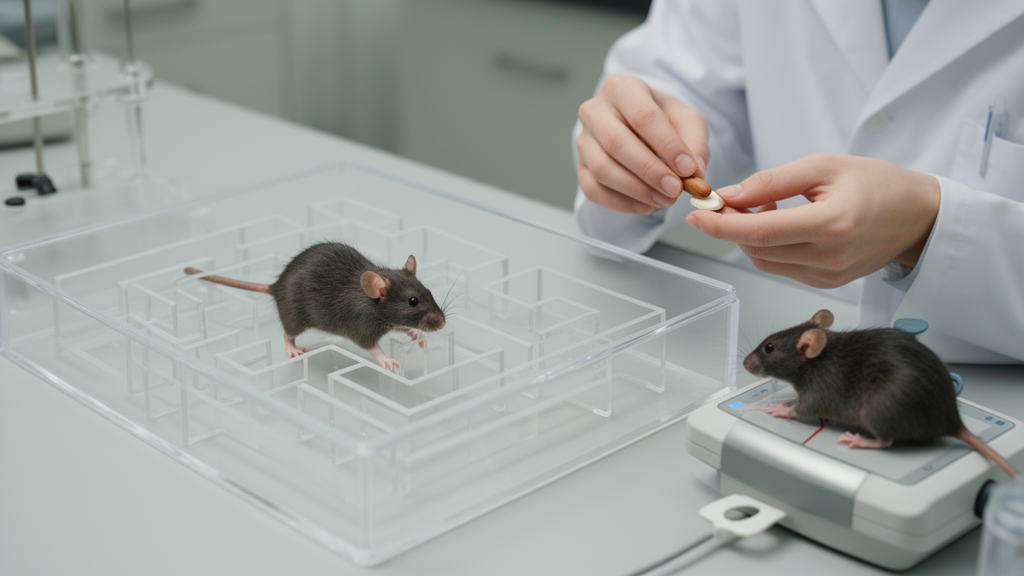
A 14-herb Chinese medicine called Modified Dioscorea Pills improved learning and memory in rats with experimentally induced chronic cerebral hypoperfusion, according to a 2026 preclinical study. Treatment was also associated with preserved hippocampal neurons and synapses, reduced markers of inflammation and apoptosis-associated signaling, and changes in molecular indicators consistent with stabilization of abnormal microvasculature. The experiment provides evidence about a possible hippocampal neurovascular target for the formula, but it does not establish that Modified Dioscorea Pills can treat dementia in humans.
The researchers used a modified bilateral common carotid artery occlusion, or BCCAO, model in young male Sprague-Dawley rats. Initially, 30 animals underwent carotid occlusion and 10 received a sham operation. Six rats died after surgery, leaving 25 hypoperfused rats that were randomly assigned to Modified Dioscorea Pills or saline. The final groups comprised nine sham-operated rats, 12 untreated model rats and 13 treated model rats. One week after surgery, researchers began administering a concentrated decoction by gavage and continued treatment for 45 consecutive days. The dose was approximately 10 grams of extract per kilogram of body weight per day, with saline given in equal volumes to the other groups. Investigators conducting behavioral assessments and histological, immunohistochemical and Western-blot analyses were blinded to group allocation.
Modified Dioscorea Pills, abbreviated MDP, is a traditional Chinese medicinal formulation containing 14 herbs. The reported prescription includes Dioscorea, prepared Rehmannia, processed Polygonum multiflorum, two forms of Codonopsis, white peony, Cinnabar, Angelica sinensis, Acorus tataricus, Astragalus, Poria, Eucommia, goji berries and Schisandra. Earlier clinical studies cited by the authors reported improvements in measures including the Mini-Mental State Examination, activities of daily living and syndrome-differentiation scores in people with vascular or Alzheimer’s dementia. Those findings provided clinical context for investigating mechanisms, but the present experiment did not enroll or treat patients and cannot independently validate those clinical observations.
The clearest behavioral finding came from the Morris water maze, in which rats learned to locate a submerged platform. During three acquisition days, all groups showed declining escape latency and swimming distance, but sham and MDP animals separated from untreated hypoperfused rats by the third day. On the fourth day, mean escape latency was 10.5 ± 2.4 seconds in the MDP group, 11.2 ± 4.7 seconds in the sham group and 35.4 ± 22.1 seconds in untreated model rats; the reported overall comparison was P = 0.015. Mean escape distance was 172.7 ± 42.5 centimeters, 166.9 ± 57.2 centimeters and 575.5 ± 367.0 centimeters, respectively, with P = 0.043. In the probe test, when the platform was removed, MDP-treated and sham rats crossed its former location more often and spent more time in the target quadrant than model animals. Platform crossings were 9.4 ± 1.5 in the MDP group and 11.6 ± 1.7 in the sham group, compared with 3.7 ± 0.8 in untreated animals. Target-quadrant time was 14.3 ± 2.8 seconds and 16.7 ± 4.3 seconds, respectively, compared with 6.2 ± 1.8 seconds. Total swimming distance and speed did not differ significantly, indicating that the spatial-learning differences were not readily explained by gross differences in motor performance.
Histology and transmission electron microscopy showed that the treatment was accompanied by structural protection in the hippocampus, a brain region central to learning and memory. Untreated hypoperfused rats had fewer and disorganized neurons in the CA1 region, nuclear pyknosis and a looser radiate layer. Electron microscopy additionally revealed fused presynaptic and postsynaptic membranes, obscured synaptic vesicles, aggregated nuclear chromatin and rupture of the nuclear membrane. In the MDP group, neurons appeared more regularly arranged and compact, while synaptic vesicles and the pre- and postsynaptic membranes were more clearly preserved. These observations support a neuroprotective and synapse-preserving effect under the experimental conditions. They do not, however, directly demonstrate that the formula generated new neurons or synapses, and transmission electron microscopy was based on only two rats per group.
Molecular measurements suggested that several injury-associated pathways changed with treatment. Compared with sham operation, BCCAO increased hippocampal Bax and NF-κB p65 expression and reduced Bcl-2. MDP reversed these shifts: Bax and NF-κB p65 decreased relative to the model group, while Bcl-2 increased. The pattern is consistent with attenuation of inflammation-associated signaling and a lower Bax/Bcl-2 ratio, an index used to assess apoptosis-related balance. The researchers did not directly quantify neuronal death with TUNEL staining or measure cleaved caspase-3, and they did not use microglial markers such as Iba1 or CD68 to confirm reduced microglial activation. The results therefore identify changes in signaling markers rather than proving that a particular cellular process was directly suppressed.
Markers of neuronal and synaptic integrity also improved after treatment. Model rats had lower hippocampal levels of MAP-2, synaptophysin and PSD-95 than sham animals. MDP raised all three above model-group levels, consistent with protection of mature neuronal structure and synaptic components. Synaptophysin is associated with presynaptic vesicles, whereas PSD-95 contributes to postsynaptic signaling and plasticity. The formula also reduced GFAP, a marker commonly used to assess astrocyte activation, and increased Olig-2, a marker associated with oligodendrocyte-lineage cells. The authors interpret this combination as reduced gliosis and improved oligodendrocyte-lineage integrity. Olig-2 alone does not prove restored myelin or remyelination; that would require myelin-specific measurements such as MBP, PLP1, MOG, MAG or Luxol fast blue staining. Histological gaps in the radiate layer were compatible with white-matter injury, but the histological observations did not independently establish the extent of demyelination.
The most technically distinctive result involved the Ang/Tie2/VEGF signaling system, which participates in vascular stability and remodeling. Untreated hypoperfused rats had elevated Ang-1, Ang-2, Tie2 and VEGF proteins, together with increased CD34 staining and microvessel density. MDP further increased Ang-1, Ang-2, Tie2 and VEGF, all at P < 0.01 versus untreated model animals, while lowering CD34 expression and microvessel density. Mean Ang-1/Ang-2 ratios were 0.779 ± 0.046 in sham animals, 1.007 ± 0.113 in model animals and 0.972 ± 0.077 after MDP treatment. Ang-1 generally supports endothelial survival and vessel stability through Tie2, while Ang-2 can destabilize vessels and promote sprouting in inflammatory or hypoxic settings. The combined pattern led the researchers to interpret treatment as supporting stabilization and remodeling of excessive immature compensatory microvasculature rather than simply increasing vessel number. CD34 expression and microvessel density remained higher in MDP-treated animals than in sham animals, and neither measure alone demonstrates the formation of new functional blood vessels.
Pearson correlation analysis added a systems-level pattern but did not establish causal interactions. NF-κB expression was positively associated with the Bax/Bcl-2 ratio and GFAP and negatively associated with MAP-2, synaptophysin, PSD-95, Olig-2 and CD34. MAP-2, synaptophysin, PSD-95 and Olig-2 were also positively associated with CD34, while MAP-2 correlated positively with synaptophysin, PSD-95 and Olig-2. The authors interpret these statistically significant associations as coordinated changes among neurons, synapses, oligodendrocyte-lineage cells and microvessels within the hippocampal neurovascular unit, with inflammation-related markers moving in the opposite direction. Because the analysis was correlational, it cannot show that inflammatory signaling caused vascular remodeling, that any particular pathway mediated the behavioral benefit, or that the measured components interacted synergistically. No pathway inhibitor or genetic manipulation was used to test those possibilities.
Several limitations constrain how far the findings can be generalized. The experiment included only 5- to 6-week-old male rats, whereas chronic cerebral hypoperfusion in humans is commonly associated with aging, atherosclerotic carotid disease and broader vascular abnormalities. BCCAO reproduces reduced blood flow but does not recreate all age-related or atherosclerotic pathology found in patients. The investigators also did not directly measure cerebral perfusion or blood–brain barrier permeability, so links between the molecular changes and actual blood flow remain indirect. Only one dose was tested, no dose-response analysis was performed, and the study did not determine whether the formula’s active constituents reach the brain. Its multi-herb chemical composition was not fully characterized, and the relative contributions of individual ingredients remain unknown. These constraints, together with the small number of animals used for electron microscopy and several tissue assays, mean the results are preliminary preclinical evidence rather than proof of clinical efficacy. The formula’s potential role in vascular dementia still requires validation in older or disease-prone models and appropriately designed human studies.
Subject of Research: Preclinical effects of Modified Dioscorea Pills on cognition and hippocampal injury in a rat chronic cerebral hypoperfusion model.
Article Title: Modified Dioscorea pills ameliorate cognitive impairment induced by chronic cerebral hypoperfusion via restoring the hippocampal neurovascular unit
Article References: Xu, Q., He, D., & Li, H. (2026). Modified Dioscorea pills ameliorate cognitive impairment induced by chronic cerebral hypoperfusion via restoring the hippocampal neurovascular unit. Frontiers in Medicine, 13, Article 1921297. https://doi.org/10.3389/fmed.2026.1921297
Image Credits: AI Generated
DOI: 10.3389/fmed.2026.1921297
Keywords: Modified Dioscorea Pills, chronic cerebral hypoperfusion, cognitive impairment, hippocampus, neurovascular unit, vascular dementia, microvascular remodeling, neuroinflammation, synaptic protection, rat model, Modified, Dioscorea
Cite Scienmag News
Cassandra Pierce. (October 20, 2026). Modified Dioscorea Pills improve cognition in rat cerebral hypoperfusion model. Scienmag. https://scienmag.com/modified-dioscorea-pills-improve-cognition-in-rat-cerebral-hypoperfusion-model/
Cassandra Pierce. "Modified Dioscorea Pills improve cognition in rat cerebral hypoperfusion model." Scienmag, 20 October 2026, https://scienmag.com/modified-dioscorea-pills-improve-cognition-in-rat-cerebral-hypoperfusion-model/. Accessed 20 October 2026.
Cassandra Pierce. "Modified Dioscorea Pills improve cognition in rat cerebral hypoperfusion model." Scienmag. October 20, 2026. https://scienmag.com/modified-dioscorea-pills-improve-cognition-in-rat-cerebral-hypoperfusion-model/


