


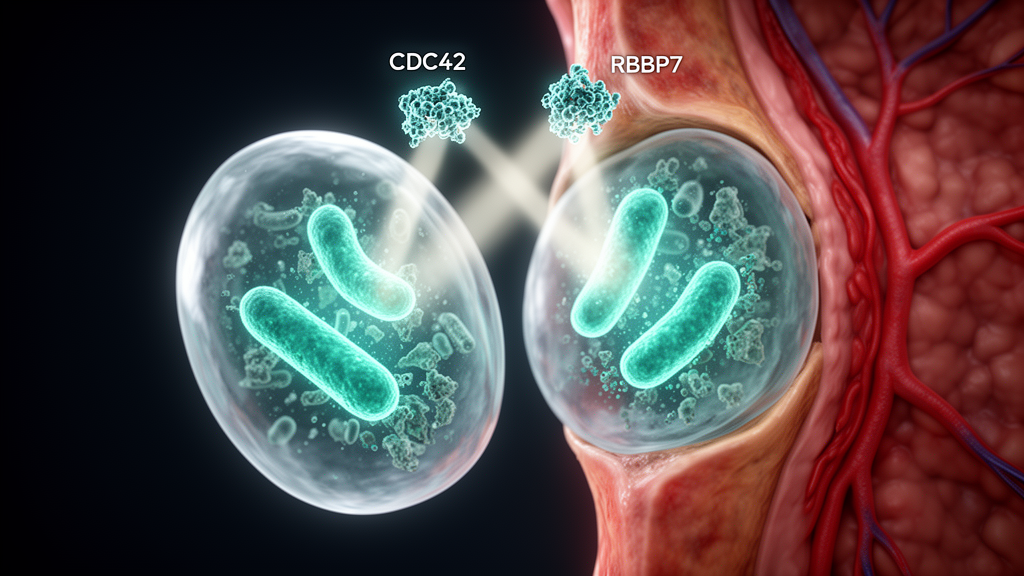
Rheumatoid arthritis has long been framed as a disease of misfiring immunity, but a new study suggests the story may begin deep inside the cell’s power plants. In research published in Scientific Reports, a team from The Second Affiliated Hospital of Chengdu Medical College in China combined bulk and single-cell RNA sequencing to identify mitochondrial quality control-related genes that behave differently in patients with rheumatoid arthritis. Two genes, CDC42 and RBBP7, emerged as the strongest candidates, each carrying a distinct signature of immune and metabolic disruption.
Mitochondrial quality control is the cell’s system for monitoring and maintaining the health of its mitochondria, the organelles that generate energy through the electron transport chain. When mitochondria are damaged, they produce excess reactive oxygen species and leak inflammatory signals, a process increasingly linked to autoimmune diseases. In rheumatoid arthritis, dysfunctional mitochondria have been implicated in the activation of fibroblast-like synoviocytes and the production of inflammatory cytokines, but the specific genes governing this quality control system in the disease had remained poorly characterized.
The research team, led by Yuting Xiao and Jing Wu, assembled an unusually broad dataset for this kind of analysis. They integrated two bulk blood transcriptomic datasets comprising 248 samples from patients with rheumatoid arthritis and 88 controls, alongside a single-cell RNA sequencing dataset of peripheral blood mononuclear cells containing 11,719 individual cells from three patients and three healthy donors. This dual approach allowed them to capture both the average gene expression patterns across whole blood and the cell-type-specific behaviour of individual immune cells.
To narrow down the candidates, the researchers used weighted gene co-expression network analysis, a computational method that groups genes into modules based on correlated expression patterns across samples. They combined this with differential expression analysis and then applied three machine-learning algorithms: least absolute shrinkage and selection operator regression, support vector machine-recursive feature elimination, and random forest classification. The convergence of these independent methods on a small set of genes gave the team confidence that the findings were not statistical artefacts.
Nine mitochondrial quality control-related candidate genes survived this gauntlet of computational filters. After further validation, CDC42 and RBBP7 stood out as the most compelling. CDC42, a gene encoding a small signalling protein involved in cell shape and movement, was upregulated in patients with rheumatoid arthritis, while RBBP7, part of a chromatin-remodelling complex, was downregulated. The team confirmed these expression patterns using reverse transcription quantitative polymerase chain reaction on independent samples.
Gene set enrichment analysis revealed that CDC42 was linked to JAK-STAT signalling, a pathway already targeted by existing rheumatoid arthritis drugs such as tofacitinib. Translation initiation, by contrast, showed opposite enrichment patterns between the two genes. The finding that CDC42 connects to a druggable pathway raises the possibility that mitochondrial quality control and established inflammatory signalling are intertwined in the disease, rather than operating as separate processes.
After correcting for multiple testing, the researchers found that 15 immune cell subsets differed significantly between patients and controls. Monocytes, a type of white blood cell that floods inflamed joints in rheumatoid arthritis, showed a positive correlation with CDC42 and a negative correlation with RBBP7. This pattern suggests that the two genes may help shape the inflammatory behaviour of monocytes, which are central players in the joint destruction characteristic of the disease.
The single-cell analysis added an unexpected layer to the story. RBBP7 showed relatively high expression in B cells, the antibody-producing cells of the immune system. This prompted the team to conduct exploratory analyses of B cell trajectories, metabolic states, and predicted communication between B cells and monocytes through the CCL5-CCR1 signalling pair. While these findings remain preliminary, they hint that mitochondrial quality control genes may influence how different immune cell populations talk to each other in the bloodstream.
The study’s strength lies in its multi-layered validation strategy, combining bulk sequencing, single-cell resolution, machine learning, immune cell deconvolution, metabolic profiling, and experimental confirmation. However, the work remains observational and correlational. The samples came from blood rather than joint tissue, and the B cell findings are explicitly exploratory. The authors note that further functional studies will be needed to determine whether CDC42 and RBBP7 drive rheumatoid arthritis pathology or simply mark its presence.
Nevertheless, the identification of two mitochondrial quality control genes with such distinct immune and metabolic signatures offers a fresh angle on a disease that affects millions worldwide. If future research confirms that these genes actively shape monocyte behaviour or B cell communication, they could become targets for new diagnostics or therapies, adding a mitochondrial dimension to the immunological understanding of rheumatoid arthritis.
The connection between mitochondrial dysfunction and rheumatoid arthritis has been building for years, but the new study adds a gene-level map to what has largely been a phenomenological picture. Mitochondria in immune cells do more than produce ATP; their permeability transition, their release of mitochondrial DNA, and their turnover through mitophagy all feed into innate immune signalling. When quality control falters, damaged organelles accumulate and can sustain the production of inflammatory mediators. The identification of CDC42 and RBBP7 as differentially expressed genes within this machinery suggests that the disease may exploit specific molecular nodes rather than a diffuse breakdown of mitochondrial housekeeping.
CDC42 is a particularly interesting candidate in this context. As a member of the Rho family of small GTPases, it orchestrates actin polymerisation, cell polarity, and migration, processes that are directly relevant to how immune cells move through tissue and form the synovial infiltrates characteristic of rheumatoid arthritis. Its established role in T cell activation and in the cytoskeletal rearrangements that accompany monocyte trafficking provides a plausible mechanistic bridge between a mitochondrial quality control signature and the immune cell behaviour observed in the study. The reported link to JAK-STAT signalling, a pathway already exploited therapeutically, raises the question of whether CDC42 sits at a junction where metabolic stress is translated into cytokine-driven transcriptional programmes.
RBBP7 presents a different kind of puzzle. As a core component of histone-binding and chromatin-remodelling complexes, it operates at the level of gene regulation rather than signalling. Its downregulation in patients, together with its relatively high expression in B cells among the single-cell data, suggests that epigenetic states may vary across immune populations in ways that intersect with mitochondrial quality control. The exploratory analyses of B cell trajectories and metabolism, while preliminary, point toward a possible axis in which altered chromatin regulation, metabolic state, and intercellular communication through CCL5-CCR1 shape how B cells and monocytes interact in peripheral blood.
The immune cell deconvolution findings deserve particular attention. Fifteen immune cell subsets differing between patients and controls after multiple-testing correction is a substantial number, reflecting the broad immunological remodelling that accompanies active disease. The specific correlation pattern, with monocytes tracking positively with CDC42 and negatively with RBBP7, is consistent with the known importance of monocytes and their derived macrophages in driving joint inflammation. Monocytes are also metabolically plastic cells, shifting between oxidative phosphorylation and glycolysis as they activate, which makes them a natural setting in which mitochondrial quality control genes might influence function.
Methodologically, the study illustrates the growing standard in computational immunology of triangulating across independent algorithms. Each machine-learning approach has distinct biases: LASSO regression favours sparse solutions, support vector machine-recursive feature elimination iteratively removes weak features, and random forest captures nonlinear interactions. Requiring convergence across all three reduces the risk that any single algorithm’s preferences drive the final gene list. Combining this with co-expression network analysis and single-cell validation adds further layers of confidence, though it cannot substitute for the functional experiments that would establish causality.
The choice of peripheral blood rather than synovial tissue is both a strength and a limitation. Blood is accessible and allows for larger sample sizes, as reflected in the 248 patient samples analysed here. But the joint is where the disease manifests, and the local immune and stromal environment, including fibroblast-like synoviocytes, may express mitochondrial quality control genes differently from circulating cells. Future studies using synovial biopsies or single-cell analysis of joint tissue would help determine whether the blood-based signatures mirror what happens at the site of pathology.
The RT-qPCR confirmation on independent samples is an important step that many bioinformatic studies omit. It demonstrates that the expression differences are not artefacts of batch effects or platform-specific noise. Still, mRNA abundance does not always track protein levels or functional activity, and CDC42 in particular is heavily regulated post-translationally. Measuring protein abundance and activity states would strengthen the case that these genes are not just correlated with disease but actively involved in it.
Looking forward, the most valuable next steps would be perturbation experiments. Knocking down or overexpressing CDC42 and RBBP7 in monocyte or B cell models, and then measuring mitochondrial membrane potential, reactive oxygen species production, mitophagy flux, and cytokine output, would clarify whether these genes are drivers or passengers. Similarly, testing whether JAK-STAT inhibitors modulate CDC42 expression or mitochondrial quality control readouts in patient cells could reveal whether existing therapies already engage this axis. Such work would move the findings from association toward mechanism and clarify whether the mitochondrial quality control signature has genuine therapeutic or prognostic value.
Subject of Research: Integrating bulk and single-cell RNA sequencing to identify mitochondrial quality control-related key genes in rheumatoid arthritis
Article Title: Integrating bulk and single-cell RNA sequencing to identify mitochondrial quality control-related key genes in rheumatoid arthritis
Article References: Xiao, Y., zhang, J., Su, J., & Wu, J. (2026). Integrating bulk and single-cell RNA sequencing to identify mitochondrial quality control-related key genes in rheumatoid arthritis. Scientific Reports. https://doi.org/10.1038/s41598-026-76389-w
Image Credits: AI Generated
DOI: 10.1038/s41598-026-76389-w
Keywords: rheumatoid arthritis, mitochondrial quality control, CDC42, RBBP7, single-cell RNA sequencing, immunology, Integrating, bulk, single-cell, sequencing, identify, mitochondrial
Cite Scienmag News
Juliet Wilcox. (October 18, 2026). Mitochondrial quality control genes CDC42 and RBBP7 emerge as key players in rheumatoid arthritis. Scienmag. https://scienmag.com/mitochondrial-quality-control-genes-cdc42-and-rbbp7-emerge-as-key-players-in-rheumatoid-arthritis/
Juliet Wilcox. "Mitochondrial quality control genes CDC42 and RBBP7 emerge as key players in rheumatoid arthritis." Scienmag, 18 October 2026, https://scienmag.com/mitochondrial-quality-control-genes-cdc42-and-rbbp7-emerge-as-key-players-in-rheumatoid-arthritis/. Accessed 18 October 2026.
Juliet Wilcox. "Mitochondrial quality control genes CDC42 and RBBP7 emerge as key players in rheumatoid arthritis." Scienmag. October 18, 2026. https://scienmag.com/mitochondrial-quality-control-genes-cdc42-and-rbbp7-emerge-as-key-players-in-rheumatoid-arthritis/


