


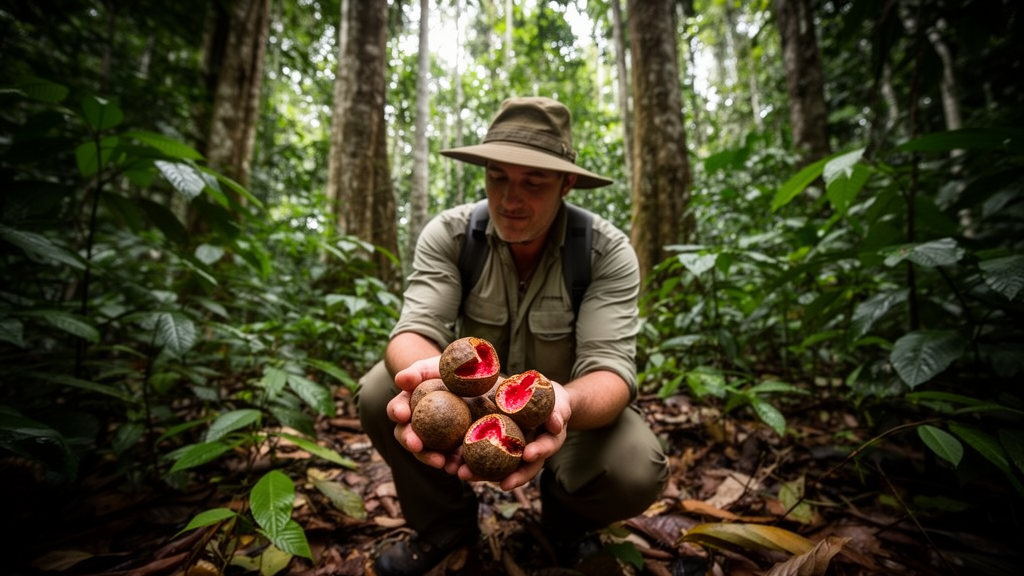
Deep in the western reaches of the Brazilian Amazon, the state of Acre has quietly emerged as a stronghold for one of the rainforest’s most ecologically important tree families. A new curatorial study has documented 34 species of Myristicaceae — the family that includes the true nutmeg — growing across Acre’s 164,000 square kilometres, a tally that represents roughly 31 percent of all Myristicaceae species known from the American continent. The finding, published in the Biodiversity Data Journal, more than doubles the 28 species recorded when the first complete catalogue of Acre’s flora appeared in 2008, and it includes nine species newly documented for the state.
Myristicaceae is the second largest family in the order Magnoliales, encompassing around 500 species in 21 genera distributed across the tropics of Africa, Asia and the Americas. In the American continent, six genera and roughly 110 species occur, and the Amazon rainforest alone harbours about 65 of them. What makes the family remarkable is its hyperdominance: 29 Amazonian species from five genera — nearly 45 percent of the species recorded in the region — have been registered as hyperdominant, meaning they dominate forest structure and dynamics despite the family accounting for only about one percent of Amazonian tree species diversity. The genera Iryanthera, with 13 hyperdominant species, and Virola, with 11, are the standouts.
The research team compiled 2,642 raw records from online databases including GBIF, speciesLink, Reflora and JABOT, then rigorously curated them down to 405 verified occurrence records. Every geographic coordinate was checked individually against Google Earth imagery and compared with the locality descriptions on specimen labels. When coordinates were missing or erroneous, the researchers inferred them using the geoLoc tool, which searches registered collections in speciesLink by locality. Misidentified specimens, duplicates and records wrongly attributed to Myristicaceae or to other states were discarded, leaving a dataset of unusual reliability for a region where herbarium records are often messy.
The five genera recorded in Acre are Compsoneura, Iryanthera, Osteophloeum, Otoba and Virola. The best documented species are Iryanthera juruensis with 75 specimens, Virola elongata with 48, V. sebifera with 35, Otoba parvifolia with 32 and V. calophylla with 25. All five are widely distributed across the state and have been collected in every decade since the 1970s. At the other extreme, 13 species have fewer than five records, and four — Iryanthera olacoides, I. tricornis, Virola marleneae and V. rugulosa — are represented by a single specimen each, underscoring how much sampling remains to be done.
One of the most striking patterns to emerge concerns the state’s two great watersheds. Acre is drained by the Juruá Basin in the west and the Purus Basin in the east, and the species split sharply between them: 16 species occur throughout the state, while 18 are restricted to just one of the two basins. Of these restricted species, 16 are confined to the Juruá Basin and only two to the Purus Basin. This watershed-linked pattern has been documented before for birds and for vines and lianas, but the new data suggest it may extend to trees and treelets as well — a finding with significant implications for how biodiversity is distributed across Amazonian landscapes.
The collection history embedded in the dataset reads like a chronicle of Amazonian botany itself. The first Myristicaceae specimen from Acre was gathered during Ernst Ule’s pioneering expedition and is now cited as the type of Iryanthera ulei, preserved in multiple herbaria across Europe and the Americas. Before 1950, only three collectors had worked on the family in the state: Ule, Boris Krukoff and Adolpho Ducke, the latter of whom studied Amazonian flora for nearly 60 years. The period from 1966 to 1987 brought large collaborative projects such as Projeto RADAMBRASIL and Projeto Flora Amazônica, which contributed 125 treated collections.
The 1990s produced the single richest decade, with 144 records, driven by the partnership between the Universidade Federal do Acre and the New York Botanical Garden for the Floristics and Economic Botany of Acre project. That collaboration grew the UFACPZ herbarium from roughly 5,000 collections to 30,000 in under 20 years. In the 2020s, collection numbers rose again thanks to a scientific expedition under the Monitora Programme of the Instituto Chico Mendes de Conservação da Biodiversidade, which visited the Parque Nacional da Serra do Divisor on the Peruvian border, and to a dedicated flora study of the family in the state.
Because most Myristicaceae species are dioecious — bearing male and female flowers on separate plants — individual specimens typically carry either an inflorescence or an infructescence, rarely both. Among the 405 curated records, the researchers counted 135 staminate inflorescences against just 20 pistillate ones, a ratio of roughly 7:1 that mirrors the male-biased flowering patterns documented in ecological studies of the family elsewhere. Yet fruiting specimens outnumbered flowering ones, 214 to 160, showing that despite the skewed inflorescence ratio, female flowers were being successfully pollinated across the landscape.
Phenological patterns also emerged from the temporal data. Specimens were collected in every month of the year, with flowering peaks in May and fruiting peaks in October. This aligns with earlier phenological studies of Osteophloeum platyspermum and Virola michelii, which found that flowering tends to occur just before the wet season, during the transitional period between dry and wet phases, while fruiting peaks during the wet season itself. The suggestion is that flowers may be favoured by lower rainfall, while fruits benefit from the abundance of water.
The spatial distribution of the collections themselves reveals the persistent challenge of Amazonian fieldwork. Nearly half of all records come from roadsides, riverbanks or urban peripheries — places that are simply easier to reach — while only 115 specimens were collected inside Conservation Units and 16 within Indigenous Territories. Large municipalities often yielded fewer records than smaller ones, a spatial bias that reflects accessibility rather than true species richness. The authors argue that continued investment in research and conservation is already paying dividends: in just the first three years of the 2020s, more Myristicaceae collections were made than in the entire previous decade, and species not collected for over a decade were rediscovered. The curated dataset, freely available online, is designed to guide future targeted sampling and to sharpen understanding of how watershed boundaries shape the distribution of life in the world’s largest rainforest.
Subject of Research: Diversity and distribution of Myristicaceae tree species in the Brazilian Amazonian state of Acre
Article Title: Diversity and distribution of Myristicaceae in the Amazonian State of Acre, Brazil
Article References: Lopes, I., Medeiros, H., & Forzza, R. (2026). Diversity and distribution of Myristicaceae in the Amazonian State of Acre, Brazil. Biodiversity Data Journal, 14, Article e196523. https://doi.org/10.3897/bdj.14.e196523
Image Credits: AI Generated
Keywords: Myristicaceae, Acre, Brazilian Amazon, biodiversity, watershed distribution, hyperdominance, Virola, Iryanthera, herbarium records, dioecy, Amazon deforestation, floristics
Cite Scienmag News
Margaret Porter. (October 18, 2026). Amazon’s Nutmeg Family Revealed: 34 Species Mapped in Brazil’s Acre State. Scienmag. https://scienmag.com/amazons-nutmeg-family-revealed-34-species-mapped-in-brazils-acre-state/
Margaret Porter. "Amazon’s Nutmeg Family Revealed: 34 Species Mapped in Brazil’s Acre State." Scienmag, 18 October 2026, https://scienmag.com/amazons-nutmeg-family-revealed-34-species-mapped-in-brazils-acre-state/. Accessed 18 October 2026.
Margaret Porter. "Amazon’s Nutmeg Family Revealed: 34 Species Mapped in Brazil’s Acre State." Scienmag. October 18, 2026. https://scienmag.com/amazons-nutmeg-family-revealed-34-species-mapped-in-brazils-acre-state/


