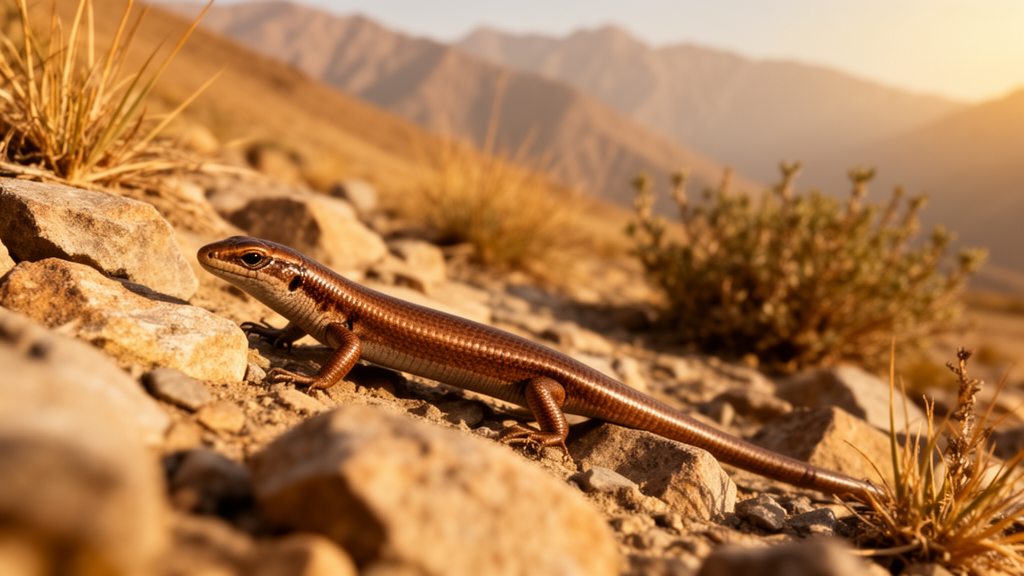
High in the foothills of the Hindu Kush, where the ranges of Western Palearctic and Oriental wildlife collide, a small striped lizard has been hiding in plain sight. A new study published in ZooKeys has formally described this enigmatic skink as Heremites afghanicus, a species so genetically distinct from its closest relatives that its lineage appears to have split from them roughly 10 million years ago, during the Late Miocene. The discovery resolves a decades-old biogeographic puzzle and adds a striking new branch to the evolutionary tree of a genus once thought to be relatively well understood.
The genus Heremites is a group of skinks in the family Scincidae that ranges from North Africa through the Middle East and Anatolia into Central Asia. Only three species were previously recognised: H. auratus, H. septemtaeniatus, and H. vittatus. Yet the taxonomy of these lizards has long been troubled by their morphological similarity and by persistent uncertainty about the status of named forms across the eastern part of the range. The easternmost populations, reported from eastern Afghanistan and northwestern Pakistan, were especially problematic. A single Afghan specimen collected in 1972 in Nangarhar Province sat in a museum collection as a biogeographic enigma, separated from the core range of the genus by the Hindu Kush mountains and intervening desert basins, with geographic gaps of roughly 700 kilometres to the nearest known occurrences.
The breakthrough came when researchers revisited a reproducing population discovered in Lower Dir District, Khyber Pakhtunkhwa Province, Pakistan, at around 1,110 metres elevation. Specimens collected there between 2013 and 2019 had been provisionally assigned to H. septemtaeniatus transcaucasicus based on morphology alone, but the same researchers noted that several traits deviated from what is typical for that subspecies and explicitly called for DNA data to test whether the isolated population represented a relict or an entirely unknown taxon. The new study answered that call with an integrative approach combining broad mitochondrial screening, a six-locus phylogeny, and comparative morphology.
The molecular work was substantial. The team first assembled a cytochrome b dataset of 209 terminals, including 195 Heremites sequences and 14 outgroups, to map the major mitochondrial lineages across the genus. They then built a concatenated matrix of 57 terminals and 238 locus sequences spanning six loci: two mitochondrial ribosomal genes (12S and 16S rRNA), two mitochondrial protein-coding genes (cytochrome b and ND2), and two nuclear genes (MC1R and RAG1). Maximum-likelihood analyses recovered four main well-supported clades corresponding to H. auratus, the H. septemtaeniatus complex, the H. vittatus complex, and the Hindu Kush lineage.
The genetic distances are remarkable. The Hindu Kush lineage differs from its western relatives by 15.2 to 15.8 percent uncorrected p-distance at cytochrome b and 17.0 to 21.0 percent at ND2, while showing lower but consistent nuclear differentiation of 1.17 to 2.59 percent at MC1R and 2.5 to 3.3 percent at RAG1. For context, the ND2 divergence between H. auratus and the H. septemtaeniatus complex is only 11.6 percent, and the maximum divergence within the H. vittatus complex is 6.8 percent. Allele networks for the nuclear markers revealed complete allelic differentiation among the sampled lineages, with the new species carrying private alleles at both RAG1 and MC1R, providing independent corroboration of the mitochondrial signal.
Divergence dating using a Bayesian framework with five secondary calibration points from a fossil-calibrated mabuyine phylogeny estimated that the lineage leading to H. afghanicus diverged from the common ancestor of H. auratus and the H. septemtaeniatus complex approximately 10.2 million years ago. This deep split predates much of the diversification within the western lineages of the genus, suggesting that the Hindu Kush population represents an old, independently evolving branch rather than a recent offshoot.
Morphological evidence reinforced the genetic picture. The researchers measured 37 characters across 27 museum specimens, including 14 individuals of the new lineage, six of H. auratus, and five representing the H. septemtaeniatus complex. Multivariate analyses using principal component analysis and multiple factor analysis separated the Hindu Kush lineage into a discrete cluster. The new species is diagnosable by a unique combination of traits: parietal shields consistently in contact (present in all 14 examined specimens, unlike the separated parietals of the H. septemtaeniatus complex), contact between the third supraocular and the frontal, 34 to 38 scales around midbody, 52 to 60 dorsal scale rows, 60 to 69 ventral scales, three-keeled dorsal scales, and a comparatively short eye-nostril distance of 2.7 to 5.1 millimetres.
The species is currently known from only two foothill localities along the southern margin of the Hindu Kush, approximately 140 kilometres apart. The type locality in Lower Dir District sits in a montane landscape of moist temperate forest, subtropical Chir pine, and broad-leaved woodland, where lizards were found on rocky slopes with boulders and crevices. The Afghan paratype locality near Dar-e-Nur in Nangarhar Province lies in a rugged, monsoon-influenced valley northeast of Jalalabad. The documented area of occupancy, calculated on a standard 2 by 2 kilometre grid, is just 8 square kilometres, corresponding to two occupied grid cells.
The name afghanicus honours not only Afghanistan in a geopolitical sense but explicitly the Pashtun-speaking people associated with the southern slopes of the Hindu Kush, reflecting the biogeographic and cultural-historical linkage of the region. The species has been suggested vernacular names in English, Pashto, and Urdu, including Afghan grass skink and Dir grass skink.
The discovery raises important questions about hidden biodiversity in one of the world’s most topographically complex regions. Whether H. afghanicus is truly restricted to these two known localities or represents a more broadly distributed species along the Hindu Kush foothills remains unknown. Substantial portions of the genus’ range, particularly in central and western Afghanistan, remain unsampled, and socio-political constraints make targeted fieldwork difficult. The authors emphasise that denser geographic sampling and higher genomic resolution will be necessary to fully delimit species boundaries and reconstruct the evolutionary history of the genus, but their findings represent a significant step toward understanding the poorly investigated biodiversity of the region between the Indus River and the Hindu Kush mountains.
Subject of Research: Discovery and integrative taxonomic description of a new skink species from the Hindu Kush foothills
Article Title: A new species of Heremites Gray, 1845 ( Squamata , Scincidae ) from the transboundary Hindu Kush foothills
Article References: Jablonski, D., Hofmann, S., Idrees, M., Khan, M. A., Jamal, Q., Böhme, W., & Masroor, R. (2026). A new species of Heremites Gray, 1845 (Squamata, Scincidae) from the transboundary Hindu Kush foothills. ZooKeys, 1291, 111-136. https://doi.org/10.3897/zookeys.1291.1863652
Image Credits: AI Generated
DOI: 10.3897/zookeys.1291.1863652
Keywords: Heremites afghanicus, skink, Hindu Kush, new species, phylogenetics, cytochrome b, Scincidae, Afghanistan, Pakistan, biogeography, mitochondrial DNA, taxonomy
Cite Scienmag News
Gavin Prescott. (October 18, 2026). Ancient Skink Survived 10 Million Years of Isolation in the Hindu Kush Foothills. Scienmag. https://scienmag.com/ancient-skink-survived-10-million-years-of-isolation-in-the-hindu-kush-foothills/
Gavin Prescott. "Ancient Skink Survived 10 Million Years of Isolation in the Hindu Kush Foothills." Scienmag, 18 October 2026, https://scienmag.com/ancient-skink-survived-10-million-years-of-isolation-in-the-hindu-kush-foothills/. Accessed 18 October 2026.
Gavin Prescott. "Ancient Skink Survived 10 Million Years of Isolation in the Hindu Kush Foothills." Scienmag. October 18, 2026. https://scienmag.com/ancient-skink-survived-10-million-years-of-isolation-in-the-hindu-kush-foothills/