


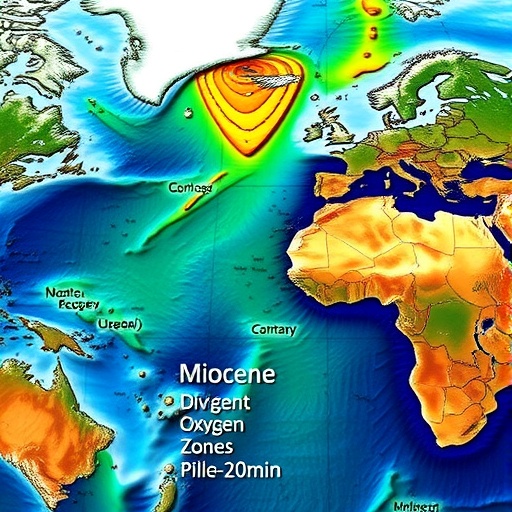
The profound dynamics of the Earth’s oceans have long captivated researchers, revealing intricate changes over geological timescales. One particularly fascinating aspect is the evolution of oxygen minimum zones (OMZs), these expansive regions in the ocean where oxygen levels are critically low, posing challenges for marine life. A recent study delves into this phenomenon, focusing on the contrasting development of the oxygen minimum zones in the Arabian Sea and the Pacific Ocean during the Miocene epoch, a period that boasts pivotal climatic shifts and ecological transformations.
The research conducted by Hess and colleagues sheds light on how these two prominent regions have developed distinct oxygen profiles throughout the Miocene, a time frame stretching from about 23 to 5 million years ago. The Miocene was marked by significant geological and climatic changes, including the uplift of the Himalayas and variations in global temperatures that consequentially influenced oceanic conditions. Understanding the dynamics of OMZs during this era not only provides insight into past oceanic environments but also serves as a critical foundation for predicting future changes in a world faced with climate change and anthropogenic effects.
In the Arabian Sea, the evolution of the OMZ is characterized by a robust expansion driven by several interconnected factors. For starters, increased organic matter supply, primarily from riverine input, has bolstered the respiration process at the seafloor, thereby depleting oxygen levels. The study highlights the role of monsoonal shifts in enhancing nutrient runoff, which stimulates phytoplankton blooms. Indeed, the seasonal dynamics of upwelling and subsequent biological productivity have contributed to the Arabian Sea’s notable hypoxic conditions.
Contrastingly, the Pacific Ocean’s OMZ has developed under markedly different influences. Here, the research suggests that the factors driving oxygen depletion include the interplay between ocean currents and thermocline dynamics. The Pacific’s expansive OMZs have been shaped more significantly by deep water oxygen consumption and stratification effects resulting from a more stable thermal structure. This stability prevents the mixing of oxygen-rich surface waters with deeper layers, allowing low-oxygen conditions to prevail.
One of the most striking revelations from Hess et al. is the timing and extent of OMZ expansion in both regions. The researchers used a combination of paleoceanographic data and advanced modeling techniques to reconstruct past oceanic conditions, revealing that the Arabian Sea’s OMZ intensified considerably earlier than that of the Pacific. This early establishment may reflect localized conditions influenced by geography and hydrology, distinguishing the Arabian Sea from its Pacific counterpart.
Further investigation into the sediment cores has unveiled a wealth of information regarding biogeochemical processes at play during the Miocene. Analyzing isotopic signatures has provided clues about the changes in organic carbon burial rates within these regions, offering a tangible connection between climatic conditions and ecological responses. This evidence is vital as it underscores the implications of low-oxygen environments on marine ecosystems, influencing species composition and biodiversity both then and now.
The research also touches upon the potential implications for modern marine environments. As contemporary OMZs expand due to climate change, understanding historical patterns becomes critical. The Arabian Sea and Pacific Ocean serve as focal points for current studies, emphasizing how regional differences affect ecological resilience. The lessons learned from the past can help inform conservation strategies aimed at mitigating the impacts of hypoxia on marine life today.
As the field of paleoclimatology continues to evolve, the work of Hess and colleagues represents a significant contribution to the body of knowledge regarding oceanic changes through time. The findings highlight the complexity of marine systems and the necessity for an integrative approach that combines geological, biological, and climatic perspectives to fully grasp the implications of oxygen dynamics in the oceans.
Moreover, the development of comprehensive models to predict future patterns of OMZs will be crucial for marine conservation. As researchers delve deeper into the relationship between climatic shifts and ocean health, their findings may influence policies aimed at safeguarding marine biodiversity against the looming threats posed by climate change.
In conclusion, the contrasting evolution of the Arabian Sea and Pacific Ocean oxygen minimum zones during the Miocene offers a captivating glimpse into the past, revealing how intricate and varied oceanic responses can be despite similar external pressures. The study marks a vital step forward in understanding these complex systems and equips scientists with the knowledge necessary to navigate the challenges posed by shifting oceanic conditions in the future.
As we look toward a future shaped by ongoing environmental change, the research conducted by Hess, Auderset, Rosenthal, and their colleagues underscores the importance of studying our planet’s history. By embracing the lessons learned from the Miocene epoch, we can better equip ourselves to address the challenges that lie ahead, fostering a deeper appreciation for the delicate balance of life within our oceans.
Cite Scienmag News
Violet Maxwell. (January 16, 2026). Miocene: Divergent Oxygen Minimum Zones in Oceans. Scienmag. https://scienmag.com/miocene-divergent-oxygen-minimum-zones-in-oceans/
Violet Maxwell. "Miocene: Divergent Oxygen Minimum Zones in Oceans." Scienmag, 16 January 2026, https://scienmag.com/miocene-divergent-oxygen-minimum-zones-in-oceans/. Accessed 7 September 2026.
Violet Maxwell. "Miocene: Divergent Oxygen Minimum Zones in Oceans." Scienmag. January 16, 2026. https://scienmag.com/miocene-divergent-oxygen-minimum-zones-in-oceans/


