


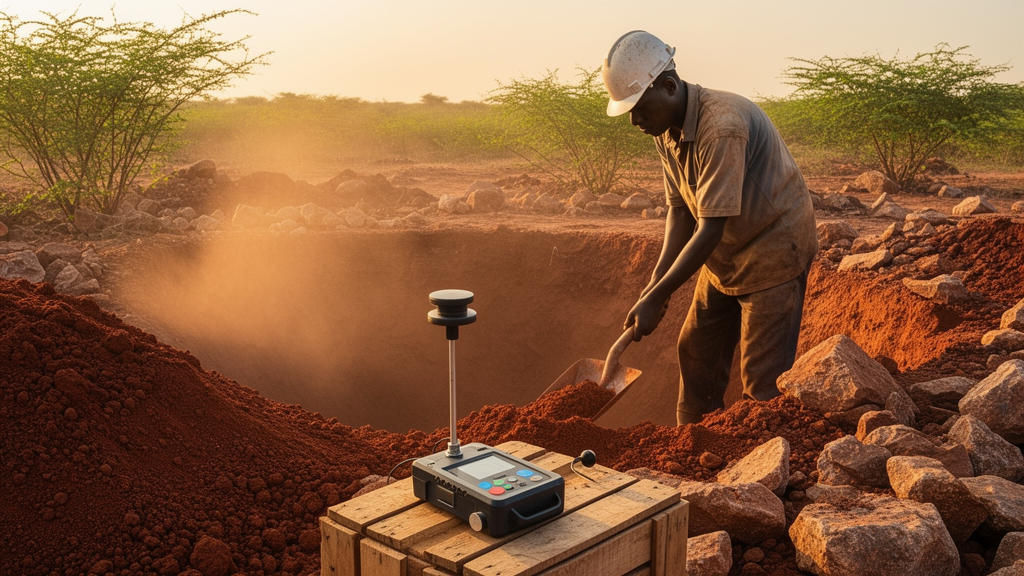
Soils from selected mining sites in northeastern Taraba State, Nigeria, contain elevated levels of thorium-232 and potassium-40, according to a radiological assessment published in Environmental Science and Pollution Research. The study, led by Ebong D. Ebong and colleagues, measured the activity concentrations of three naturally occurring radionuclides—radium-226, thorium-232 and potassium-40—in soils collected from mining locations, and then calculated a suite of radiological hazard parameters to judge whether the material poses a concern for public health or future land use.
The measurements were carried out using indirect gamma-ray spectrometry with a NaI(Tl) detector. From the measured activity concentrations, the team derived the absorbed gamma dose rate, the annual effective dose equivalent, radium equivalent activity, external and internal hazard indices, and the gamma index.
The results showed a split picture. Radium-226 concentrations were relatively low, ranging from 12 to 21 becquerels per kilogram. In contrast, thorium-232 reached 121 to 294 becquerels per kilogram and potassium-40 spanned 668 to 1225 becquerels per kilogram, both markedly elevated. The authors state that this pattern is consistent with the geological and mineralogical characteristics of the area.
The absorbed gamma dose rates calculated from these concentrations ranged from 109 to 236 nanograys per hour, exceeding the global average outdoor absorbed dose rate. However, the estimated annual effective dose equivalents, between 0.13 and 0.29 millisieverts per year, fell below the reference level commonly applied to existing exposure situations. In other words, while the radiation field at these sites is stronger than the worldwide typical value, the estimated yearly dose remains under that screening threshold.
Not every index stayed within conventional limits. Some of the radiological indices exceeded the screening criteria normally applied to building materials, which the authors say indicates a need for further assessment of the radiological significance of these soils—particularly if the material were ever considered for construction or other uses that bring it into prolonged contact with people.
The distribution of radionuclides across the sampled sites appears to be controlled largely by local geology rather than by mining activity alone. Still, the researchers note that artisanal mining may contribute to the redistribution of radionuclide-bearing materials. Distinguishing a mining signal from the natural background, however, proved impossible in this study design.
That limitation is central to how the findings should be read. Because the study did not include non-mining reference sites for comparison, the effects of mining cannot be separated from the geological influences that shape radioactivity across the region. The authors are explicit that their work provides a preliminary radiological assessment of the investigated soils rather than a quantitative estimate of mining-induced enrichment—a distinction that matters for anyone interpreting the elevated thorium and potassium values as evidence of contamination.
The study’s practical value lies in what it flags rather than what it settles. The identified pattern of elevated thorium-232 and potassium-40, combined with absorbed dose rates above the global average, marks these mining sites as candidates for targeted monitoring. The authors highlight the need for extensive spatial coverage across the region, focused surveillance of the identified hotspots, and evaluation of the relevant exposure pathways—steps they argue would strengthen environmental monitoring and public health management in mining areas.
For now, the annual effective dose estimates suggest that exposure at these sites remains below the reference level applied to existing exposure situations, while the exceedance of building-material screening criteria by some indices keeps open the question of how the soils should be handled in future land-use decisions. Follow-up work with reference sites and broader sampling would be needed to determine how much of the measured radioactivity reflects the region’s geology and how much, if any, has been redistributed by mining.
Subject of Research: Environmental radioactivity and radiological risk assessment of soils from mining sites in northeastern Taraba State, Nigeria
Article Title: Environmental radioactivity assessment and radiological risk profiling of soils from mining sites in northeastern Taraba State, Nigeria: implications for public health and land-use
Article References: Ebong, E. D., Notani, P. P., Akpan, I. O., & Udoh, J. T. (2026). Environmental radioactivity assessment and radiological risk profiling of soils from mining sites in northeastern Taraba State, Nigeria: implications for public health and land-use. Environmental Science and Pollution Research. https://doi.org/10.1007/s11356-026-38352-0
Image Credits: AI Generated
DOI: 10.1007/s11356-026-38352-0
Keywords: environmental radioactivity, gamma-ray spectrometry, thorium-232, potassium-40, radium-226, mining soils, Nigeria, radiological risk, absorbed dose rate, annual effective dose, public health, land use
Cite Scienmag News
Violet Maxwell. (October 26, 2026). Mining Soils in Nigeria Show Elevated Thorium and Potassium Radioactivity. Scienmag. https://scienmag.com/mining-soils-in-nigeria-show-elevated-thorium-and-potassium-radioactivity/
Violet Maxwell. "Mining Soils in Nigeria Show Elevated Thorium and Potassium Radioactivity." Scienmag, 26 October 2026, https://scienmag.com/mining-soils-in-nigeria-show-elevated-thorium-and-potassium-radioactivity/. Accessed 26 October 2026.
Violet Maxwell. "Mining Soils in Nigeria Show Elevated Thorium and Potassium Radioactivity." Scienmag. October 26, 2026. https://scienmag.com/mining-soils-in-nigeria-show-elevated-thorium-and-potassium-radioactivity/


