


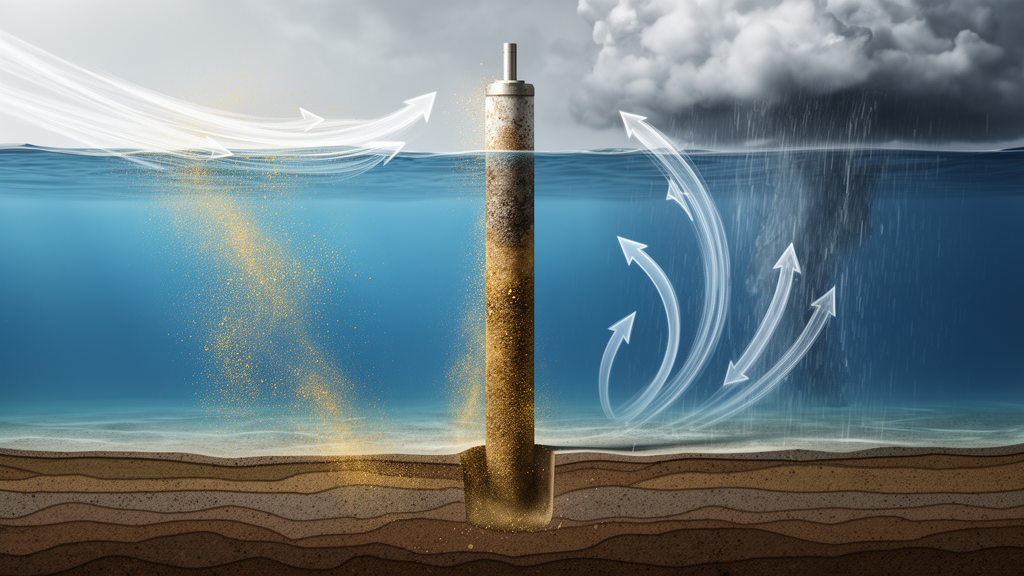
A four-million-year record of windblown dust archived in the Philippine Sea has allowed researchers to disentangle two major atmospheric pathways that carry Asian dust to the tropical Pacific Ocean: the mid-latitude Westerlies and the East Asian Winter Monsoon (EAWM). Because both systems deliver dust to the same ocean basin, their combined signal has long obscured how each responds to climate change. The team separated the two components using grain-size modeling and geochemical fingerprinting of the eolian sediments, producing a continuous record stretching back to the late Pliocene.
The analysis revealed distinct source regions for the two transport systems. The Westerlies component is derived primarily from hyper-arid deserts, while the EAWM-driven component originates from the semi-arid margins of East and Central Asia. This distinction matters because the two source types respond differently to climate forcing, meaning that past changes in dust flux to the tropical Pacific cannot be read as a single, unified signal of Asian aridity.
The two systems also responded to different controls. Westerly-driven transport showed a coherent response to global cooling and to hemispheric thermal gradients, consistent with a circulation whose strength tracks large-scale temperature contrasts. The monsoon contribution, by contrast, was mediated by vegetation cover in its source regions.
According to the study, hydroclimatic fluctuations in the EAWM marginal zones modulated how much dust was available for transport, through vegetation-induced surface roughness and pedogenic refinement of the surface material. In other words, the ecological state of the source regions determined how much material was exposed and erodible.
That vegetation control produced a pronounced non-linear relationship between dust flux and wind energetics. Stronger winds did not simply translate into more dust reaching the tropical Pacific; the availability of erodible material at the source shaped the delivery. This finding implies that the ecological conditions of dust source areas exert an influence on dust flux and, by extension, on the tropical ocean.
The authors argue that this decoupling between wind strength and dust delivery carries implications for future projections. Because vegetation dynamics and human landscape interventions can alter dust availability independently of atmospheric circulation, models that treat dust flux as a direct function of wind may misestimate both past and future dust loads.
The study concludes that dynamic vegetation impacts and anthropogenic landscape changes need to be integrated into Earth System Models to predict global carbon cycling in a warming world. Dust flux is described in the work as a fundamental regulator of global climate and marine biogeochemical cycles, so errors in its representation propagate into wider carbon-cycle projections.
The research, published in Communications Earth & Environment, demonstrates that separating the two transport systems is essential for interpreting the tropical Pacific dust archive. Rather than one blended record of Asian aridity, the sediment core preserves two distinct histories: one governed by hemispheric thermal gradients and global cooling, the other by the interplay of hydroclimate and vegetation in semi-arid source regions.
For paleoclimate scientists, the result reframes how dust records from the tropical Pacific should be read. Interpreting total dust flux without deconvolving the Westerlies and monsoon components risks attributing vegetation-driven changes in source-area erodibility to shifts in wind strength, or vice versa. The four-million-year perspective shows that these two controls have operated alongside each other since the late Pliocene, and that the ecological conditions of dust source regions must be treated as an active variable, not a static background, in understanding dust delivery to the tropical ocean.
Subject of Research: Provenance and transport of Asian dust to the tropical Pacific Ocean by the Westerlies and the East Asian Winter Monsoon over the past four million years
Article Title: Differentiating Westerly and Asian monsoon dust fluxes to the tropical Pacific Ocean since the late Pliocene
Article References: Yang, Y., Yu, F., Zhao, J., Ding, X., Li, P., Wang, S., Ruan, X., Yang, X., Algeo, T. J., Hu, B., & Xie, S. (2026). Differentiating Westerly and Asian monsoon dust fluxes to the tropical Pacific Ocean since the late Pliocene. Communications Earth & Environment. https://doi.org/10.1038/s43247-026-04172-w
Image Credits: AI Generated
DOI: 10.1038/s43247-026-04172-w
Keywords: Asian dust, Westerlies, East Asian Winter Monsoon, tropical Pacific Ocean, Philippine Sea, grain-size modeling, geochemical fingerprinting, vegetation cover, Pliocene, Earth System Models, marine biogeochemistry, global cooling
Cite Scienmag News
Violet Maxwell. (October 26, 2026). Four-million-year dust record separates Westerlies from monsoon delivery to the tropical Pacific. Scienmag. https://scienmag.com/four-million-year-dust-record-separates-westerlies-from-monsoon-delivery-to-the-tropical-pacific/
Violet Maxwell. "Four-million-year dust record separates Westerlies from monsoon delivery to the tropical Pacific." Scienmag, 26 October 2026, https://scienmag.com/four-million-year-dust-record-separates-westerlies-from-monsoon-delivery-to-the-tropical-pacific/. Accessed 26 October 2026.
Violet Maxwell. "Four-million-year dust record separates Westerlies from monsoon delivery to the tropical Pacific." Scienmag. October 26, 2026. https://scienmag.com/four-million-year-dust-record-separates-westerlies-from-monsoon-delivery-to-the-tropical-pacific/


