


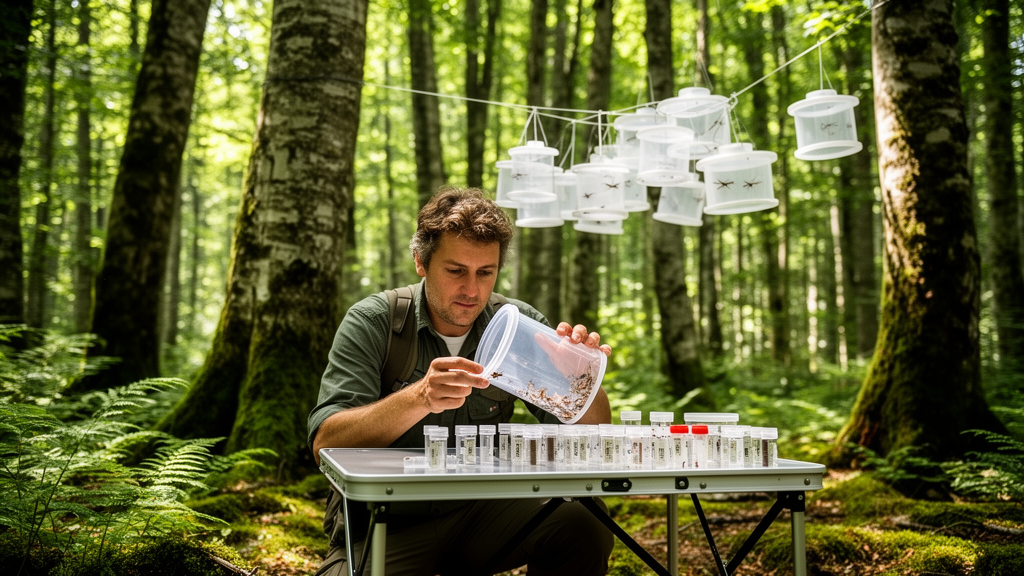
Deep in the forest reserves of the Swiss Pre-Alps, an unassuming scientific treasure trove has been sitting in storage for nearly a decade. What began as a targeted study of wood-dwelling beetles between 2015 and 2018 has now yielded remarkable discoveries from material that most researchers would have discarded. By re-examining the bycatch — the non-target species inadvertently collected alongside the intended specimens — scientists have uncovered rare parasitic wasps, threatened bees, and spiders never before recorded in eastern Switzerland. The findings, published in Alpine Entomology, demonstrate that bycatch samples from biodiversity monitoring projects can hold extraordinary scientific value long after the original research has concluded.
The original project was designed to assess the diversity of xylobiontic beetles as bioindicators of ecological integrity in three forest reserves: Weid, Seerenwald, and Amden, all located in the Canton of St.Gallen. These reserves are part of Switzerland’s ambitious plan to protect 10 percent of its forest area by 2030, with management focused on natural development without forestry intervention. Currently, 7.3 percent of the country’s total forest is already integrated into such reserves. Five different trap types were deployed across the sites: polytraps and tree crown traps (both flight interception traps), turpentine traps, beer traps, and glue rings. All traps were positioned near large stocks of deadwood, and the comprehensive sampling resulted in more than 600 different xylobiontic beetle species, including rare old-growth relict species and first records for Switzerland.
But alongside the beetles, the traps captured a vast array of non-target organisms. After sorting all Coleoptera from the bycatch, the remaining samples were preserved in an alcohol-glycerol mixture and sent to the Natural History Museum of St.Gallen, where they remained untouched for approximately eight years. In 2025, researchers re-examined these samples, specifically sorting for two taxonomic groups of fundamental ecological importance: Arachnida (spiders and harvestmen) and Hymenoptera (bees, parasitic wasps, and related groups). These organisms serve as predators, parasitoids, or pollinators, making them critical components of forest ecosystems.
The results were striking. From 1,105 bycatch individuals, the team identified 254 taxonomic units, including 55 species of Arachnida (51 spiders and four harvestmen) and 199 species of Hymenoptera. The Hymenoptera encompassed 67 bee species, four cuckoo wasp species, 85 ichneumonid wasp species, eight spider wasp species, six potter wasp species, and 29 sphecid wasp species. Most specimens were recorded in flight interception traps positioned near the herb layer or in the tree canopy, with polytraps proving especially productive for nearly all groups analysed.
Among the most remarkable discoveries was the first record for Switzerland of the ichneumonid wasp Casinaria dubia, found in the forest reserve Weid. This solitary koinobiont endoparasitoid of Lepidoptera is known from Austria, France, Germany, Hungary, Japan, and the United Kingdom, but had never been documented in Switzerland before. The discovery is not entirely surprising, as researchers estimate that over 1,200 species of the Ichneumonidae family may still be unknown in the country. More sensational, however, was the rediscovery of another ichneumonid species, Bioblapsis polita, which had not been observed in Switzerland since 1958 — a gap of 67 years. The team found 76 specimens of this Western Palaearctic species, which is a known koinobiont endoparasitoid of hoverfly larvae, particularly those of the genus Ferdinandea, whose larvae are saproxylic in the sap of over-mature trees, mostly oaks. Given that the species was previously represented in Swiss collections by only a single female, the abundance of specimens found suggests these forest reserves provide ideal habitat for its hoverfly hosts.
The spider Episinus maculipes, a rare European species of the family Theridiidae, was also recorded for the first time in eastern Switzerland. Prior to this finding, the species was known from only two other Swiss locations: Ticino around 1997 and Basel Land in 2003. The new record was accompanied by three additional first records for eastern Switzerland: the spiders Dictyna pusilla, Entelecara acuminata, and Clubiona caerulescens. Even though spiders are more thoroughly studied than some other groups in the bycatch, the findings show that the distribution of many species in Switzerland remains incompletely sampled.
Three bee species listed as near threatened in Switzerland were also identified: Osmia uncinata, which prefers sparse, pine-dominated forests, found in Weid; Megachile ligniseca, which favours moist forests and forest edges, found in Amden; and Andrena combinata, which prefers dry, warm, and sunny locations, found in Seerenwald. These records underscore the conservation value of the forest reserves and the importance of maintaining diverse forest structures for threatened pollinators.
The study also revealed important patterns in how different trap types contribute to bycatch diversity. Polytraps and tree crown traps captured the vast majority of specimens, while beer and turpentine traps contributed only a minor fraction. The researchers suggest that the broad collection range of flight interception traps, combined with the overlapping ecological niches of the identified groups and xylobiontic beetles — many of which feed on pollen and nectar as adults — explains this pattern. The yellow bands on polytraps, which mimic flowers, appear particularly attractive to bees and ichneumonid wasps. Based on these findings, the additional effort of deploying beer traps and turpentine traps may not be justified in surveys targeting the groups analysed here.
However, the researchers caution that preservation conditions can significantly affect the retrospective value of bycatch samples. The determination of harvestmen proved extremely difficult because important identification features were disrupted by the glycerol in the preservation mixture. Similarly, colour patterns on some sphecid wasps had faded over time. While morphological evaluation was still feasible, molecular analysis was significantly hampered by poor preservation, as preliminary DNA barcoding tests showed insufficient DNA quality and quantity. The team recommends that handling and curation of bycatch should be considered in accordance with group-specific requirements and incorporated into future project planning, including optimal preservation agents and careful data recording.
The findings carry broad implications for biodiversity research worldwide. Many monitoring projects have collected, or will collect, large quantities of bycatch material that often remains unexamined or is simply discarded. The current shortage of taxonomic specialists, combined with the time and cost required to sort and identify bycatch, means that vast portions of this material sit untouched in storage, sometimes for decades. Yet, as this study demonstrates, well-curated bycatch samples can provide precious insights into the ecology and distribution of rare taxa, even years after collection. With increasingly fast and cost-effective molecular methods such as DNA metabarcoding, high-resolution imaging, and AI-assisted identification, the potential value of existing collections is greater than ever. The researchers recommend prioritizing the curation of bycatch samples, collaborating with taxonomic experts, and applying molecular methods to unlock the scientific gold hidden within these overlooked specimens.
Subject of Research: Biodiversity
Article Title: Reclaiming the Unwanted: Mining Scientific Gold from multi-trap bycatch
Article References: Urfer, K., König, N., Kranz-Baltensperger, Y., Klopfstein, S., Niehuis, O., von Virag, A., & Sann, M. (2025). Reclaiming the Unwanted: Mining Scientific Gold from multi-trap bycatch. Alpine Entomology, 9, 91-102. https://doi.org/10.3897/alpento.9.168169
Image Credits: AI Generated
Keywords: bycatch, biodiversity, entomology, Switzerland, forest reserves, rare species, conservation, Reclaiming, Unwanted, Mining, Scientific, Gold
Cite Scienmag News
Margaret Porter. (October 17, 2026). Mining Scientific Gold from Multi-Trap Bycatch in Swiss Forest Reserves. Scienmag. https://scienmag.com/mining-scientific-gold-from-multi-trap-bycatch-in-swiss-forest-reserves/
Margaret Porter. "Mining Scientific Gold from Multi-Trap Bycatch in Swiss Forest Reserves." Scienmag, 17 October 2026, https://scienmag.com/mining-scientific-gold-from-multi-trap-bycatch-in-swiss-forest-reserves/. Accessed 17 October 2026.
Margaret Porter. "Mining Scientific Gold from Multi-Trap Bycatch in Swiss Forest Reserves." Scienmag. October 17, 2026. https://scienmag.com/mining-scientific-gold-from-multi-trap-bycatch-in-swiss-forest-reserves/


