


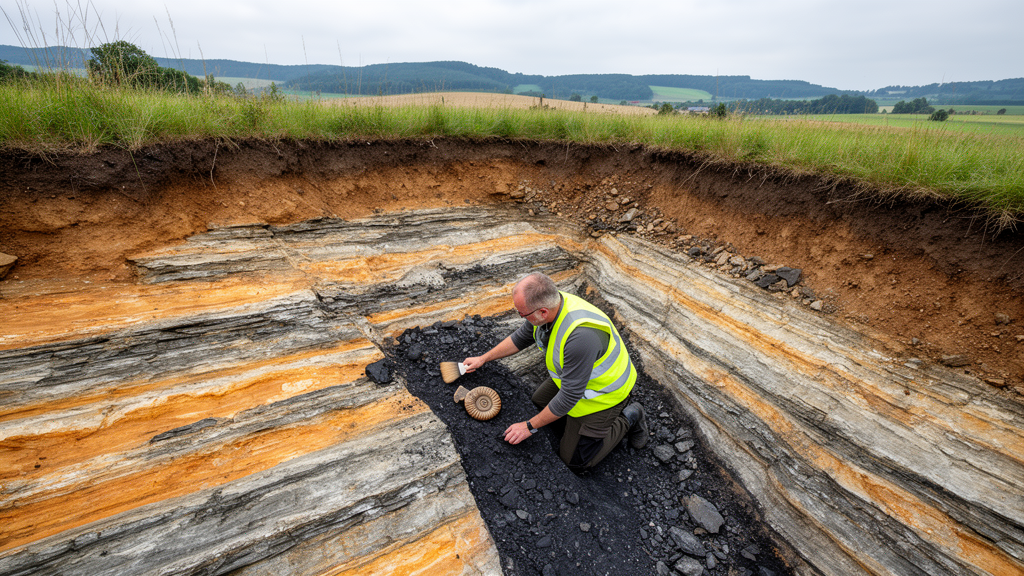
When construction crews widened the A7 motorway between Bockenem and the Salzgitter junction in September 2011, few drivers passing the foothills of the Hainberg ridge in southern Lower Saxony realized that the freshly cut slopes held a 183-million-year-old archive of one of Earth’s most dramatic environmental crises. A team of geologists seized the fleeting opportunity, spending three days sampling a 40.8-metre-thick slice of Early Jurassic rock before the cutting was covered again. The resulting study, published in the journal Zitteliana, now documents in unprecedented detail how the Toarcian stage unfolded in northern Germany, from the onset of a greenhouse climate and oceanic anoxia to the slow recovery that followed.
The section exposed at the Hainberg, roughly 18 kilometres east-southeast of Hildesheim, spans the top of the Pliensbachian Amaltheenton Formation, through the famous bituminous Posidonienschiefer and the thin Jurensismergel Formations, into the lower parts of the Opalinuston Formation. Although the outcrop was temporary and only about 350 metres long with up to four metres of exposed strata, it offered something northern Germany has long lacked: a nearly continuous, bed-by-bed record of the Toarcian at a classical locality first described by Denckmann in the late nineteenth century. The Posidonienschiefer Formation, whose type locality lies at Hildesheim in this very region, has been far better studied in southern Germany, where sections such as Dotternhausen serve as reference profiles for the Toarcian Oceanic Anoxic Event, or T-OAE.
The T-OAE is regarded as a fossil example of a climate transition from cooler conditions, with traces of glaciation, to a greenhouse state marked by elevated temperatures, restricted ocean circulation, and oxygen depletion on continental shelves. The event is recorded in the rock as a pronounced negative excursion in organic carbon isotopes and as the deposition of organic-rich, laminated bituminous shales, culminating in a marine extinction episode. Understanding the T-OAE requires documentation of many individual sections so that palaeogeography, sea-level fluctuations, and seawater current patterns can be reconstructed. Equally important is the study of the overlying Jurensismergel Formation, which records the recovery phase and the stepwise disappearance of anoxic seafloor conditions after the crisis. The Hainberg section captures both intervals, making it a valuable northern counterpart to the well-documented southern German profiles.
Sedimentologically, the succession begins with the medium-grey, well-bedded claystones of the upper Amaltheenton Formation, containing layers of quartz silt and fine-grained mica that point to prograding deltaic siliciclastics during a regressive phase of the latest Pliensbachian. The overlying Posidonienschiefer Formation opens with a 60-centimetre-thick interval of laminated but still organic-poor claystones of the Tenuicostatum Zone. A marked increase in organic carbon, marking the onset of the middle Posidonienschiefer and the T-OAE itself, appears at the horizon of the Elegantulum Concretions. From there, the middle part of the formation comprises 7.48 metres of bituminous, laminated marlstones and limestones, including the remarkable one-centimetre-thick Monotis event bed, a microcrystalline limestone composed almost entirely of the bivalve Meleagrinella substriata, and the two-centimetre-thick Commune Belemnite Battlefield, a layer crowded with current-aligned belemnite rostra.
Geochemical analyses of 50 bulk rock samples reveal the intensity of the anoxic episode. Organic carbon contents in the carbonate-free fraction reach a maximum of 24.7 weight percent in the Elegantulum and Boreale Concretion horizons, with average values of about 19 weight percent through the middle Posidonienschiefer. Total sulphur, normalized to the carbonate-free fraction, fluctuates around 1.8 to 2.1 weight percent, reflecting abundant pyrite formation under oxygen-depleted bottom waters. Calcium carbonate contents rise from less than one weight percent in the lowermost Posidonienschiefer to around 52 weight percent in the middle part, driven by limestone concretions and shell-rich intervals. Farther up, in the 18.66-metre-thick upper Posidonienschiefer, organic carbon stabilizes at lower values around 13.5 weight percent, a dilution effect caused by an increased sedimentation rate as prograding deltas delivered more clastic material to the basin, even as anoxic bottom water conditions continued unchanged.
Biostratigraphically, the section is anchored by 24 determinable ammonites recovered in situ, supplemented by belemnites and bivalve assemblages. The lowermost ammonite, a compressed Dactylioceras cf. crosbeyi from bed 9, indicates the Tenuicostatum Zone. Well-preserved uncompressed specimens in limestone concretions then pin down the Elegantulum Subzone, the basis of the Serpentinum Zone, through Eleganticeras elegantulum, while Hildaites murleyi in the Boreale Concretions marks the Exaratum Subzone and Eleganticeras elegans in the Lower Elegans Bed defines the Elegans Subzone. The boundary to the Bifrons Zone is placed at the base of bed 18, identified by the traceable interval of Monotis limestones, whose marker bed can be followed along 500 kilometres to southern Germany. Above the Monotis event bed, the upper Posidonienschiefer is essentially devoid of ammonites, but the cephalopod-free dwarf Bositra buchi biofacies, with shells reduced to a maximum of six millimetres, is considered time-equivalent to the upper Commune and Fibulatum Subzones.
The belemnite battlefield itself provides a rare glimpse into Early Jurassic seawater dynamics. Field measurements of 79 rostra in bed 23 show a dominant tip-direction maximum between 195 and 210 degrees, with an average azimuth of 156 degrees. Combined with 500 measurements from the same stratigraphic bed at Hildesheim-Itzum, which show a clear maximum at 165 degrees, the alignment confirms a bottom current directed from south-southeast to north-northwest, presumably channelling through the Hessian Seaway after the possibly tectonically triggered Monotis bed event. Current-aligned belemnites at the same bed in the former Haverlahwiese open pit mine corroborate the pattern. Such current indicators are fundamental for reconstructing the circulation patterns of a restricted epicontinental sea during and after the T-OAE, when stagnant conditions alternated with episodes of renewed bottom-water flow.
Above a sharp erosive discontinuity, the Jurensismergel Formation at Hainberg is astonishingly thin, only 45 centimetres, yet packed with information. Iron-oolitic marls with a basal belemnite accumulation are followed by the conglomeratic zeta conglomerate, containing reworked phosphoritic ammonite casts, and an echinoderm debris bed at the top. Ammonites Phlyseogrammoceras dispansiforme and Phlyseogrammoceras transiens clearly assign this condensed package to the Dispansum Zone. The Variabilis and Thouarsense Zones, as well as the Fallaciosum Subzone, are missing at the site, removed by submarine erosion that Denckmann had already recognized in 1892. A single reworked Osperleioceras cf. beauliziense likely represents a relic of the Thouarsense Zone within the condensed iron-oolitic marls. Farther east and west, the transgressive Dörnten Member preserves these missing zones, indicating that the gap is local rather than regional.
The overlying Opalinuston Formation begins with carbonate-poor claystones carrying Bositra suessi, but bed 32 stands out as a six-to-eight-centimetre-thick condensed layer with reworked phosphorite nodules, limonitic iron ooids, abundant belemnites, and, remarkably, thin stromatolitic carbonate crusts on ammonite shell fragments. These crusts, up to nine millimetres thick, are composed of alternating microcrystalline and iron-sulphide-rich laminae, and their dense lamination lacks the fenestral fabric and microbial remains typical of cyanobacterial stromatolites. Ammonites Cotteswoldia aalensis and Pleydellia subcompta assign the bed to the lowermost Aalensis Zone, marking a highstand condensation at the Pseudoradiosa to Aalensis transition. Higher up, a thin layer of reworked fossils with the belemnite Acrocoelites rostriformis still indicates Upper Toarcian age, while the Toarcian-Aalenian boundary can only be drawn on the basis of belemnite finds at another thin condensed bed. Only a few metres above, the Opalinum Zone is evident from the ammonite Leioceras cf. goetzendorfensis at the solifluction-affected top of the section.
Interpreted as a sequence stratigraphic framework, the Hainberg succession reveals three third-order transgressive-regressive cycles for the Toarcian, largely consistent with previous investigations in northern and southern Germany. After the latest Pliensbachian regression, a transgressive phase spans the Elegantulum to Falciferum Subzones, with highstand conditions and reduced sedimentation during the Commune Subzone, superimposed by the Monotis bed event and the SSE-directed bottom current. The regressive phase follows in the later Bifrons Zone, reflected by the dwarf Bositra biofacies with increasing mica and carbonaceous plant debris, signalling distant delta progradation and falling salinities. The next sequence boundary, located at the Bifrons-Variabilis transition, is not preserved at the site. For the Upper Toarcian, the Dispansum Zone iron-oolitic marls and Pseudoradiosa clays possibly form a transgressive phase of the third cycle, with highstand at the Pseudoradiosa-Aalensis transition, followed by regressive Aalensis claystones and a minor erosional boundary at their top. Minor deviations in the timing of maximum flooding and regression surfaces between studies likely reflect the higher subsidence and variable sedimentation rates of the North German Basin, where Toarcian thicknesses reach 82 to 231 metres from Usedom to Hamburg, compared with the much thinner sections of the Hainberg-Hildesheim area. Because the Opalinuston Formation is incompletely exposed at the site, further studies on complete drill core sections will be required to test and refine this emerging picture of how sea level, climate, and ocean chemistry interacted during a pivotal chapter of the Jurassic.
Subject of Research: Biostratigraphy and sedimentary sequences of the Toarcian Hainberg section, Northern Germany
Article Title: Biostratigraphy and sedimentary sequences of the Toarcian Hainberg section (Northwestern Harz foreland, Northern Germany)
Article References: Arp, G., Balmuk, Y., Seppelt, S., & Reimer, A. (2023). Biostratigraphy and sedimentary sequences of the Toarcian Hainberg section (Northwestern Harz foreland, Northern Germany). Zitteliana, 97, 1-27. https://doi.org/10.3897/zitteliana.97.110677
Image Credits: AI Generated
DOI: 10.3897/zitteliana.97.110677
Keywords: Biostratigraphy, sedimentary, sequences, Toarcian, Hainberg, section, Northwestern, Harz, foreland, Northern, Germany, scientific research
Cite Scienmag News
Violet Maxwell. (October 17, 2026). Ancient German Road Cutting Reveals 183-Million-Year-Old Ocean Crisis Record. Scienmag. https://scienmag.com/ancient-german-road-cutting-reveals-183-million-year-old-ocean-crisis-record/
Violet Maxwell. "Ancient German Road Cutting Reveals 183-Million-Year-Old Ocean Crisis Record." Scienmag, 17 October 2026, https://scienmag.com/ancient-german-road-cutting-reveals-183-million-year-old-ocean-crisis-record/. Accessed 17 October 2026.
Violet Maxwell. "Ancient German Road Cutting Reveals 183-Million-Year-Old Ocean Crisis Record." Scienmag. October 17, 2026. https://scienmag.com/ancient-german-road-cutting-reveals-183-million-year-old-ocean-crisis-record/


