


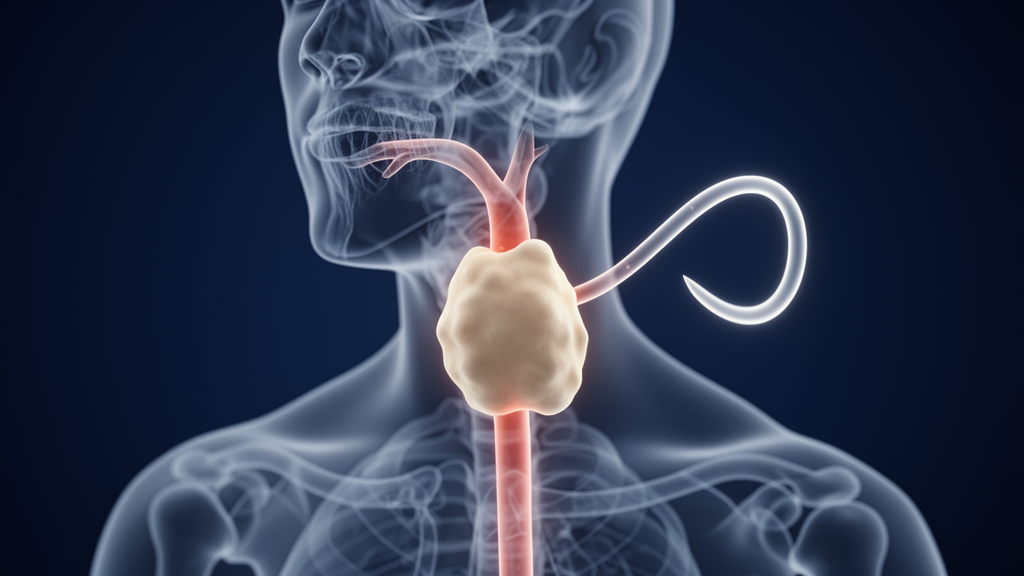
For six months, a 30-year-old technical engineer in China coughed through the night and grew progressively short of breath with any exertion. He had never smoked, had no occupational dust exposure, and carried no history of atopy, tuberculosis, or immune compromise. A primary care physician reached the most familiar diagnosis for a young adult with wheezing and dyspnea: asthma. He was prescribed inhaled budesonide/formoterol twice daily and used it faithfully for two months. Nothing improved. That failure to respond, rather than being dismissed as hard-to-treat asthma, is precisely what redirected his care—and ultimately uncovered one of the rarest malignancies in human medicine.
When he arrived at the Department of Pulmonary and Critical Care Medicine at Shenzhen Longgang District Central Hospital, physicians heard something asthma rarely produces: inspiratory stridor audible over the trachea itself. His vital signs were stable, with a respiratory rate of 18 breaths per minute and oxygen saturation of 97 percent on room air, but the stridor signaled turbulent airflow through a narrowed central airway. Laboratory workup was largely unremarkable—his white cell count, eosinophil fraction, C-reactive protein, and sedimentation rate were all within normal limits—yet Epstein–Barr virus serology told a different story. EBVCA-IgG and EBNA-IgG were strongly positive, plasma EBV DNA was detectable, and his fractional exhaled nitric oxide was elevated at 60 parts per billion, a finding that would have reinforced the asthma hypothesis had the clinical picture not already begun to fracture.
The decisive test was spirometry with flow-volume loop analysis, a technique many clinicians order routinely but whose graphical output is frequently overlooked. In a normal loop, airflow rises steeply to a sharp peak on both expiration and inspiration before declining smoothly. This patient’s loop showed a flattened plateau in both the inspiratory and expiratory limbs, with peak expiratory flow reduced to 2.03 liters per second and peak inspiratory flow to roughly 2.30 liters per second. That biphasic plateau is the physiological signature of a fixed upper airway obstruction: a lesion that narrows the airway to the same degree regardless of respiratory phase, whether the obstruction is intrathoracic or extrathoracic. Asthma, by contrast, produces a scooped expiratory curve reflecting variable, peripheral airway narrowing—and typically spares the inspiratory limb entirely.
The case carries a subtle technical lesson about bronchodilator testing. When the patient inhaled a bronchodilator, his forced expiratory volume in one second jumped from 0.91 liters (22.1 percent predicted) to 1.75 liters (42.6 percent predicted), an absolute gain of 0.84 liters—a 92 percent increase that technically qualified as positive reversibility. But the plateau on the flow-volume loop persisted after bronchodilator administration. The authors explain this apparent paradox: bronchodilators can improve FEV1 through effects on peripheral airways even in the presence of a central lesion, but the characteristic loop morphology—the biphasic plateau—remains diagnostic of fixed airway obstruction. The persistence of that pattern, not the reversibility numbers, was the observation that redirected the diagnostic workup toward imaging and bronchoscopy.
Chest computed tomography revealed a polypoid mass protruding from the anterior wall of the cervical trachea at the C3–C4 vertebral level. Bronchoscopy went further, identifying a central polypoid mass causing approximately 95 percent occlusion of the tracheal lumen—a near-complete blockage of the windpipe in a man who had been walking around with an inhaler. Surgeons electrosnared the mass endoscopically in a procedure that served two purposes: decompressing the airway to relieve the life-threatening narrowing, and obtaining tissue for pathological diagnosis. It was explicitly not intended as definitive treatment.
What the pathologists found under the microscope was a tumor of extraordinary rarity. Histopathology showed nests and sheets of malignant epithelial cells surrounded by a dense infiltrate of lymphocytes—the defining architecture of lymphoepithelioma-like carcinoma, or LELC. Immunohistochemistry demonstrated diffuse cytoplasmic positivity for CK5/6 and P40, markers of squamous differentiation, while staining for Napsin A, TTF-1, Syn, and CgA was negative, excluding lung adenocarcinoma and neuroendocrine tumors. The Ki-67 proliferative index was 70 percent, indicating a rapidly dividing malignancy. Most tellingly, in situ hybridization for EBV-encoded small RNAs (EBER) revealed strong nuclear positivity, confirming the tumor’s intimate association with Epstein–Barr virus. This immunoprofile established the diagnosis of primary tracheal LELC.
The rarity here is difficult to overstate. Primary tracheal malignancies account for less than 0.1 percent of all cancers, and roughly two-thirds of those are squamous cell carcinoma or adenoid cystic carcinoma. LELC represents less than 2 percent of tracheal tumors, and primary tracheal LELC has been documented only in isolated case reports worldwide. The subtype is characterized histologically by undifferentiated epithelial tumor cells embedded in dense lymphocytic infiltration and is strongly associated with EBV infection, particularly in Asian populations. Among previously published cases the authors could identify in their literature search, the youngest patient was a 22-year-old male—making this 30-year-old one of the youngest adults ever described with the disease.
Before declaring the tracheal tumor primary, the team had to exclude a nasopharyngeal origin, since LELC arises far more commonly in the nasopharynx. Fiberoptic laryngoscopy and nasoendoscopy found no abnormality in the upper aerodigestive tract, and 18F-FDG PET/CT demonstrated no hypermetabolic lesion in the nasopharynx or anywhere outside the trachea and regional mediastinal lymph nodes. The authors acknowledge a diagnostic limitation: dedicated nasopharyngeal biopsy was not performed because no suspicious lesion was identified. Subsequent PET/CT did detect residual mediastinal lymph node metastasis, prompting salvage video-assisted thoracoscopic surgery (VATS) tracheal resection-anastomosis with systematic lymphadenectomy. Pathology confirmed negative resection margins—the closest margin approximately 0.2 centimeters from the tumor—with 11 mediastinal lymph nodes resected, of which two were positive for metastatic carcinoma. The primary tumor measured roughly 2 by 1.2 by 0.5 centimeters and had invaded the cricoid cartilage without extending beyond the adventitia. In the absence of a validated TNM staging system specific to tracheal LELC, the tumor was classified as pT2N2M0, Stage IIIA, by reference to existing systems.
The decision to withhold adjuvant systemic therapy or radiotherapy was an individualized, multidisciplinary one, not a general recommendation. The team weighed the achievement of R0 resection with negative margins, the complete absence of established standard adjuvant therapy for this ultra-rare disease, and the significant long-term toxicities of radiotherapy and chemotherapy in a young patient. After tumor board discussion, the patient chose close surveillance. The authors are careful to note that recent evidence showing PD-1/PD-L1 inhibitor efficacy in locally advanced or metastatic pulmonary LELC cannot be extrapolated to justify routine adjuvant immunotherapy after R0 resection of tracheal LELC—that remains strictly investigational. Similarly, plasma EBV-DNA thresholds used in pulmonary LELC and nasopharyngeal carcinoma have never been validated for the tracheal subtype and should be interpreted only as exploratory surveillance tools. The patient’s postoperative plasma EBV DNA remained detectable at low levels, below 500 copies per milliliter, warranting continued monitoring but not constituting an indication for intervention.
One year after surgery, the results speak for themselves. The patient remains asymptomatic with no evidence of recurrence on imaging, and postoperative pulmonary function testing demonstrated complete normalization of the flow-volume loop morphology. FEV1 improved from 0.91 liters to 3.62 liters—a 298 percent increase reaching 89.7 percent of predicted—while peak expiratory flow rose from 2.03 to 6.76 liters per second, a 233 percent gain. The plateau pattern had resolved entirely, confirming restoration of normal airway dynamics. In his own words, he can now exercise without any shortness of breath for the first time in months, and he is grateful his doctors did not stop at the asthma diagnosis. The teaching point extends well beyond this single extraordinary case: in young, non-smoking patients with asthma-like symptoms, failure to respond to an adequate trial of inhaled corticosteroids—typically four to six weeks—should prompt reconsideration of the initial diagnosis. The flow-volume loop, a non-invasive and cost-effective tool, provides a rapid means of identifying patterns suggestive of central airway obstruction, and a biphasic plateau can unmask rare tracheal malignancies before escalating antiasthma therapy wastes precious time.
Subject of Research: A rare Epstein–Barr virus–associated tracheal cancer in a young non-smoker was misdiagnosed as asthma until a flow-volume loop revealed fixed upper airway obstruction, guiding CT, bronchoscopy, and successful surgical treatment with full lung function recovery.
Article Title: Primary tracheal lymphoepithelioma-like carcinoma in a young non-smoking male: a case report highlighting the diagnostic value of flow-volume loop
Article References: Xiao, S., Chen, S., Ou, J., & Shen, Y. (2026). Primary tracheal lymphoepithelioma-like carcinoma in a young non-smoking male: a case report highlighting the diagnostic value of flow-volume loop. Frontiers in Medicine, 13, Article 1965664. https://doi.org/10.3389/fmed.2026.1965664
Image Credits: AI Generated
DOI: 10.3389/fmed.2026.1965664
Keywords: tracheal cancer, lymphoepithelioma-like carcinoma, Epstein-Barr virus, flow-volume loop, asthma misdiagnosis, pulmonary function testing, case report, respiratory medicine, spirometry, airway obstruction, Primary, tracheal
Cite Scienmag News
Ophelia Keating. (October 17, 2026). Primary tracheal lymphoepithelioma-like carcinoma in a young non-smoking male: a case report highlighting the diagnostic value of flow-volume loop. Scienmag. https://scienmag.com/primary-tracheal-lymphoepithelioma-like-carcinoma-in-a-young-non-smoking-male-a-case-report-highlighting-the-diagnostic-value-of-flow-volume-loop/
Ophelia Keating. "Primary tracheal lymphoepithelioma-like carcinoma in a young non-smoking male: a case report highlighting the diagnostic value of flow-volume loop." Scienmag, 17 October 2026, https://scienmag.com/primary-tracheal-lymphoepithelioma-like-carcinoma-in-a-young-non-smoking-male-a-case-report-highlighting-the-diagnostic-value-of-flow-volume-loop/. Accessed 17 October 2026.
Ophelia Keating. "Primary tracheal lymphoepithelioma-like carcinoma in a young non-smoking male: a case report highlighting the diagnostic value of flow-volume loop." Scienmag. October 17, 2026. https://scienmag.com/primary-tracheal-lymphoepithelioma-like-carcinoma-in-a-young-non-smoking-male-a-case-report-highlighting-the-diagnostic-value-of-flow-volume-loop/


