


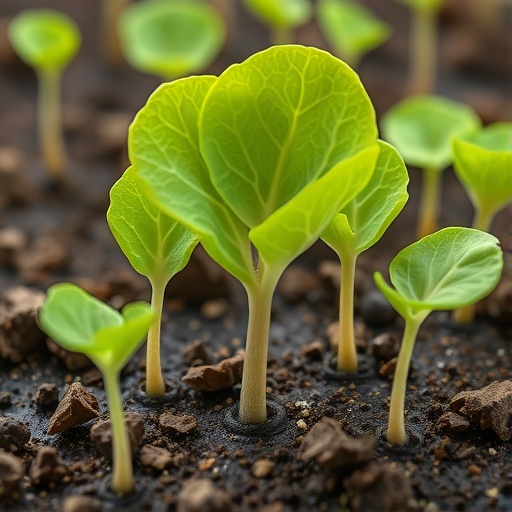
A lettuce seed does not care how much iron you put in front of it. It cares which iron. That is the startling conclusion of a study published on 12 August 2026 in the open-access Journal of Nanoparticle Research, in which researchers Maycon L. de Oliveira, Juliana Cancino-Bernardi and Márcia A. M. S. da Veiga exposed lettuce seeds to seven different suspensions of iron-based nanoparticles and watched a single chemical element produce opposite biological destinies. One mineral phase — magnetite, the magnetic mixed-valence oxide known to mineralogists as Fe3O4 — shut down germination completely, leaving seed dishes that should have erupted in sprouts standing silent. Several other iron phases did precisely the reverse: at the lowest doses tested, they coaxed the seedlings’ embryonic roots to stretch measurably farther than roots growing in clean water. As iron nanoparticles pour into agriculture, medicine and environmental cleanup at an accelerating pace, the findings expose an uncomfortable blind spot in how their ecological safety is judged.
Iron is everywhere in the nanotechnology economy, and its engineered particles are among the most heavily produced nanomaterials on the planet. Hematite pigments color everything from paints to cosmetics; magnetite carries drug-delivery payloads and sharpens analytical instruments; iron oxyhydroxides drive catalysts and water-treatment chemistry. In agriculture, iron nanomaterials are being groomed as next-generation fertilizers and as agents that lock heavy metals into immobility in contaminated soils. Every one of those applications is also an emission route: particles shed from products, wash from fields, leak from waste streams and ultimately arrive in the sediments and surface waters where seeds wait. Interactions between nanomaterials and living organisms, and their consequences at the ecosystem level, are the province of nanoecotoxicology — a specialty that has crystallized within toxicological science precisely because engineered particles have become ubiquitous. What has lagged behind, the new study argues implicitly, is the recognition that “iron nanoparticle” names not one material but a family of chemically distinct solids whose crystal architectures dictate how they behave in water, soil and tissue.
The team’s test battery captured that diversity head-on. Seven nanoparticle samples, spanning five mineral phases, went under scrutiny: two hematites (HemNPs AK and HemNPs SC), the α-Fe2O3 oxide that gives rust and red ochre their color; one goethite (GoeNPs), the α-FeOOH oxyhydroxide that paints many of the world’s soils yellow-brown; two magnetites (MagNPs red and MagNPs ppt), the Fe3O4 phase that is both magnetic and, unusually among iron oxides, rich in iron(II); one akaganeite (AkaNPs), a β-FeOOH phase distinguished by chloride ions threaded through its crystal tunnels; and one kremersite (KreNPs), an exotic chloride-bearing iron phase obtained through sequential synthesis from the residues of akaganeite production itself — a waste-to-material twist. The samples were generated by routes including thermal hydrolysis, acid-mediated thermal hydrolysis, alkaline precipitation, chemical reduction and coprecipitation. Because crystal system, morphology, primary particle size, hydrodynamic diameter, polydispersity index and zeta potential jointly determine how particles disperse, aggregate and encounter biology, each sample was characterized across all of these parameters before a single seed was touched.
The biological arena for these materials was deliberately austere. Lettuce, Lactuca sativa L. var. Mimosa Verde, is a globally accepted plant bioindicator whose seeds germinate quickly and uniformly, making inhibition measurable with brutal clarity. Ten seeds were placed in each sterile Petri dish on filter paper, with three independent dishes per treatment — thirty seeds per condition — moistened with 2.0 milliliters of exposure solution and sealed with plastic film. Every dish and utensil was either sterile-disposable or decontaminated by three days of immersion in 30 percent nitric acid, then rinsed in ultrapure water and oven-dried. The dispersion medium was reconstituted hard water, a synthetic freshwater defined by 192 mg/L sodium bicarbonate, 120 mg/L calcium sulfate, 120 mg/L magnesium sulfate and 8 mg/L potassium chloride, adjusted to pH 7.6–8.0 with a hardness of 160–180 mg CaCO3/L and alkalinity of 110–120 mg CaCO3/L — a recipe that mimics natural surface waters rather than the ultra-pure, particle-stabilizing vacuum of many laboratory experiments. The dishes then spent 120 hours — five days that decide a seedling’s future — incubating in complete darkness at 20 ± 2 °C.
Rigor was built into the dosing as well. Nanoparticle stocks were dispersed in an ultrasonic bath for twenty minutes without heating to homogenize the suspensions and curb agglomeration, and the actual total iron concentration of each stock was verified by flame atomic absorption spectrometry before dilution. Exposure levels ran from 0.05 to 50 mg Fe/L — the ceiling set by the maximum stable dispersion of the synthesized particles — in tenfold serial steps of 50, 5, 0.5 and 0.05 mg/L, sharpened by intermediate doses of 10, 15, 20, 25, 30, 35, 40 and 45 mg Fe/L to trace dose–response curves finely. Crucially, every dose was expressed as total iron rather than particle mass, anchoring the study to standardized plant bioassays and steering clear of the unrealistically high loadings that pollute many exploratory nanotoxicology screenings. Negative controls received reconstituted hard water alone; positive controls received 0.2 mol/L zinc sulfate, a proven germination inhibitor; any plate showing fungal contamination was discarded and repeated, and control germination had to exceed 90 percent for an assay to count as valid.
After five days, the seeds were scored on a battery of endpoints. Relative seed germination compared sprouted seeds in treated dishes against the positive control; relative radicle growth and relative hypocotyl growth benchmarked root and shoot elongation against the negative control; and a germination index folded the two together, multiplying relative germination by relative root growth so that a treatment could not look benign merely because it quietly stunted one process. Normalized residual elongation indices then re-anchored root and shoot lengths against the positive control to isolate growth inhibition. Statistical hygiene followed: Shapiro–Wilk tests checked normality, Levene’s test checked variance homogeneity, one-way ANOVA probed differences among treatments and controls, and Tukey’s honestly significant difference test resolved pairwise comparisons at p < 0.05. The analysis then climbed a level of sophistication with benchmark dose (BMD) modeling — the modern regulatory statistic that fits mathematical dose–response curves to the full dataset and estimates the dose producing a predefined magnitude of effect, complete with a conservative lower confidence bound. Unlike the legacy NOEC approach, which depends arbitrarily on which doses happened to be tested, BMD extracts thresholds from the entire shape of the response.
The results delivered a split screen. Magnetite nanoparticles did something no other phase did: they completely inhibited germination, an unambiguous, dish-clearing verdict against the seed itself. The other phases told a gentler, stranger story. Rather than poisoning seedlings at low doses, they acted as stimulants: radicles — the embryonic roots that break through the seed coat first — elongated more in dilute nanoparticle suspensions than in clean water. Toxicologists have a name for this kind of biphasic, low-dose-beneficial pattern: hormesis, the phenomenon in which a stressor provokes biology below a threshold and suppresses it above one. Whatever its microscopic mechanism — gentle nutrient-like iron delivery, mild signaling stress, or shifts in the local chemistry of the exposure medium — the effect’s dependence on mineral phase is what makes the finding consequential. The same element, at the same nominal concentration, was behaving differently depending on which crystal lattice carried it into the water.
Part of the explanation lies in physics and surface chemistry rather than elemental identity alone. Two iron oxides with identical composition can differ in crystal system, surface hydroxyl density, surface charge and aggregation behavior, and the team’s characterization data — hydrodynamic diameter, polydispersity index, zeta potential — capture exactly the parameters that decide whether nanoparticles travel freely to a root surface, clump into inert sediment, or dissolve into ions on the way. The radicle, by the design of the assay, is the seedling’s frontline tissue: the first organ to contact the exposure medium, built from rapidly dividing, thin-walled cells with no protective barrier to speak of. By running benchmark dose modeling on each endpoint separately, the researchers quantified tissue-specific sensitivity directly, comparing how sharply root and shoot responses turned with dose for every mineral phase — a level of resolution that simple percent-inhibition summaries cannot deliver.
For regulators, manufacturers and agronomists, the message is uncomfortable but actionable: risk assessments that tabulate “total iron” or lump all iron oxides into a single category may be measuring the wrong variable. A fertilizer carrier, a remediation agent and a pigment precursor can share an element yet diverge wildly in ecological behavior, so material identity — mineral phase, crystal system, surface charge, colloidal stability — needs to sit at the center of nanoecotoxicological hazard profiles alongside exposure concentration. The study’s insistence on realistic dose expression in mg Fe/L, on validated negative and positive controls, and on benchmark-dose statistics offers a template for making plant bioassays comparable across laboratories and defensible in regulatory settings. And as iron nanomaterials edge closer to deliberate, large-scale deployment in soils and waterways, the image from the assay plates is hard to shake: in one dish, seeds nudged by traces of one iron mineral into growing longer roots; in the next, seeds silenced entirely by another. The dose, as the toxicologists’ old adage insists, makes the poison. This study adds a newer clause to the proverb: so does the crystal.
Cite Scienmag News
Alan Morgan. (August 30, 2026). Mineral phase of iron nanoparticles dictates toxicity to lettuce germination and growth. Scienmag. https://scienmag.com/mineral-phase-of-iron-nanoparticles-dictates-toxicity-to-lettuce-germination-and-growth/
Alan Morgan. "Mineral phase of iron nanoparticles dictates toxicity to lettuce germination and growth." Scienmag, 30 August 2026, https://scienmag.com/mineral-phase-of-iron-nanoparticles-dictates-toxicity-to-lettuce-germination-and-growth/. Accessed 4 September 2026.
Alan Morgan. "Mineral phase of iron nanoparticles dictates toxicity to lettuce germination and growth." Scienmag. August 30, 2026. https://scienmag.com/mineral-phase-of-iron-nanoparticles-dictates-toxicity-to-lettuce-germination-and-growth/


