


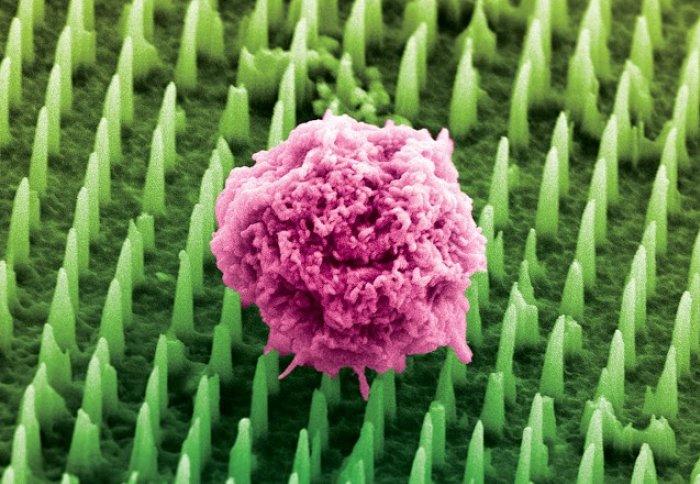
A revolutionary innovation in medical diagnostics is on the horizon, poised to transform the way diseases such as cancer and neurodegenerative disorders are detected and monitored. Scientists at King’s College London have developed a groundbreaking nanoneedle patch, a device embedded with tens of millions of microscopic needles, each thousands of times thinner than a human hair. This technology offers a truly painless and minimally invasive alternative to traditional biopsies, which typically involve discomfort, risk, and limited frequency of monitoring.
Traditional biopsy procedures, despite being among the most common diagnostic tools globally, have significant shortcomings. These procedures require the physical removal of tissue samples from the body, a process that can be painful, carries the risk of complications, and often deters patients from adhering to recommended diagnostic or follow-up schedules. Moreover, once tissue is removed, the invasiveness and tissue damage limit repeated sampling from the same site, constraining clinicians’ ability to comprehensively track disease progression in fine detail over time.
The innovative nanoneedle patch counters these challenges by enabling the extraction of vital molecular information from living tissues without causing damage or pain. These nanoneedles gently penetrate the tissue surface to acquire a spectrum of molecular data — including lipids, proteins, and mRNA — creating a high-resolution, multidimensional fingerprint of the tissue’s biochemical environment. Because the nanoneedles do not remove tissue, patients benefit from a near-painless experience and the possibility of frequent, longitudinal monitoring, offering unprecedented insight into disease dynamics.
A key advantage of the nanoneedle technology lies in its spatiotemporal precision. Unlike conventional biopsies that provide limited static snapshots, this device facilitates real-time molecular analysis across different cell types within the same tissue area, allowing scientists and clinicians to observe how diseases evolve at a cellular and molecular level. The method preserves the integrity of the tissue, making it possible to repeatedly sample the same site—a feat previously unattainable with traditional biopsy methods.
The design and manufacture of the patch leverage advanced semiconductor fabrication techniques, the same that underpin the production of computer microchips. This not only ensures scalability and cost-effectiveness but also enables easy integration of nanoneedles into a range of existing medical tools like bandages, endoscopes, and contact lenses. Such versatility broadens the potential applications of this technology across various clinical scenarios, from surgical environments to routine outpatient care.
In preclinical evaluations, the research team applied the nanoneedle patch to brain cancer tissues harvested from human patients and animal models. The device successfully extracted detailed molecular information without compromising tissue viability. This molecular fingerprint is then subjected to mass spectrometry analysis enhanced by artificial intelligence algorithms. By interpreting this complex data, healthcare providers can determine tumor presence, assess its response to treatment, and monitor changes at the cellular level with a precision that outclasses conventional diagnostics.
Dr. Ciro Chiappini, whose team spearheaded this effort, highlights the transformative potential of the technology. He emphasizes that after over a decade of research on nanoneedles, this development marks the most significant breakthrough to date. “Our device opens unprecedented possibilities for patients dealing with brain cancer, Alzheimer’s disease, and many other conditions,” says Dr. Chiappini. “It will enable clinicians and researchers to study diseases dynamically, unlocking a new era in personalized medicine.”
The speed at which the nanoneedle patch can deliver results is another game-changing aspect. In surgical settings, applying the patch to suspicious tissue areas could yield molecular diagnostic information in as little as twenty minutes. This rapid turnaround provides surgeons with critical data to guide real-time decisions about tissue removal, potentially improving surgical outcomes and preserving healthy tissue.
The broader implications of this technology extend beyond cancer diagnosis. Its painless, tissue-preserving approach could encourage more patients to undergo early and frequent testing, leading to enhanced disease management and timely therapeutic interventions. For neurodegenerative diseases like Alzheimer’s, where monitoring disease evolution is crucial yet challenging, this technology could provide clinicians with objective molecular insights previously inaccessible without invasive procedures.
Development of the nanoneedle patch required interdisciplinary collaboration spanning nanoengineering, oncology, cell biology, and artificial intelligence. This fusion of fields allowed the team to tackle complex challenges—from precise nanoscale fabrication to the interpretation of voluminous molecular data—culminating in a novel diagnostic platform poised to reshape clinical practice.
The project received significant funding from leading institutions, notably the European Research Council’s Starting Grant scheme, Wellcome Leap, and UK Research and Innovation bodies including EPSRC and MRC. These investments facilitated access to the advanced analytical instrumentation essential for validating the technology’s capabilities.
As this research progresses towards clinical trials, the prospect of replacing painful biopsies with a painless, rapid, and richly informative testing method offers a beacon of hope for millions worldwide. Should this nanoneedle patch enter mainstream use, it could not only enhance diagnosis but also fundamentally transform how physicians and patients approach disease monitoring and personalized treatment.
Cite Scienmag News
Nathaniel Bowman. (June 16, 2025). Millions of Nanoneedles Poised to Replace Painful Cancer Biopsies. Scienmag. https://scienmag.com/millions-of-nanoneedles-poised-to-replace-painful-cancer-biopsies/
Nathaniel Bowman. "Millions of Nanoneedles Poised to Replace Painful Cancer Biopsies." Scienmag, 16 June 2025, https://scienmag.com/millions-of-nanoneedles-poised-to-replace-painful-cancer-biopsies/. Accessed 3 September 2026.
Nathaniel Bowman. "Millions of Nanoneedles Poised to Replace Painful Cancer Biopsies." Scienmag. June 16, 2025. https://scienmag.com/millions-of-nanoneedles-poised-to-replace-painful-cancer-biopsies/


