


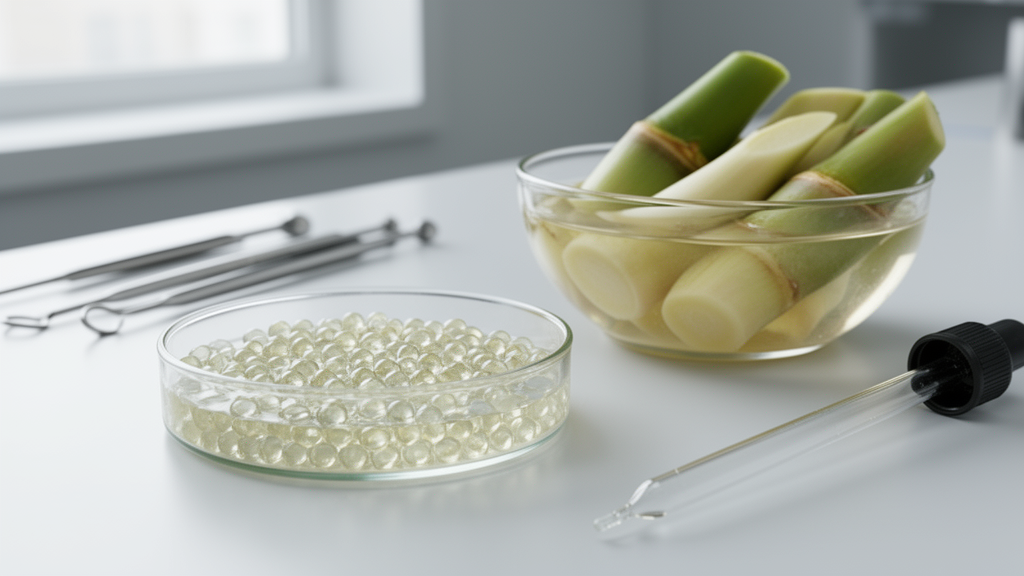
Salted bamboo shoots, prized across southwest China for their crunchy texture and savory umami flavor, have long battled a stubborn enemy: microbes. Now, a research team writing in Food Chemistry: X reports a promising natural solution—tiny capsules built from soy protein isolate and chitosan that wrap around ε-polylysine hydrochloride, a food-approved antimicrobial peptide, and release it slowly over time. The approach cut total bacterial counts in stored shoots by 96.1 percent compared with untreated controls after 13 days at room temperature, while preserving color and firmness far better than either free antimicrobial or conventional chemical preservatives.
Square bamboo shoots (Phyllostachys glauca) are nutritionally attractive—high in protein and fiber, low in fat—but their high water content and vigorous enzymatic activity make them notoriously perishable. Salting helps, yet salt alone does not stop microbial growth, and producers have traditionally leaned on synthetic preservatives such as sorbate and dehydroacetate to extend shelf life. With consumers increasingly demanding clean-label products, food scientists have been hunting for natural alternatives that actually work in difficult, wet, salty matrices.
ε-Polylysine hydrochloride, already approved under China’s GB 2760–2024 food additive standard, is a strong candidate: it shows broad-spectrum antimicrobial activity, thermal stability, and particular potency under acidic conditions. But adding it directly to food has drawbacks. The compound interacts with hydrolases and anionic molecules, losing activity quickly; it is strongly hygroscopic, making it prone to caking during processing; and it dissolves so fast that its antimicrobial effect fades before storage ends. Encapsulation was the obvious fix, but no one had systematically tested ε-polylysine hydrochloride microcapsules in salted bamboo shoots or measured their effects on texture and browning.
The team, led by Xianfen Cai and Yang Ye, used complex coacervation—a technique where oppositely charged biopolymers self-assemble around a core—to build their capsules. They mixed a 5 mg/mL solution of ε-polylysine hydrochloride with 12 percent soy protein isolate, added 3 percent chitosan, adjusted the pH to 6.5, and let electrostatic interactions knit the two wall materials into a dense shell around the antimicrobial payload. After centrifugation and freeze-drying, the result was a fine powder of microcapsules ready for characterization.
Optimization was rigorous. Single-factor experiments probed four variables—core-to-wall ratio, wall concentration, antimicrobial concentration, and the chitosan-to-soy-protein ratio—before an L9(3⁴) orthogonal array refined the recipe. Range analysis revealed that the chitosan-to-soy-protein ratio mattered most, followed by antimicrobial concentration. The predicted optimum, confirmed in a follow-up run, achieved an encapsulation efficiency of 98.63 percent, meaning nearly all the ε-polylysine hydrochloride ended up inside the capsules rather than floating free in solution.
Characterization confirmed the capsules’ quality. Laser particle sizing showed an average diameter of about 167 micrometers with a narrow, monodisperse distribution—far smaller than chitosan alone, which aggregates to roughly 400 micrometers. Scanning electron microscopy revealed wrinkled, porous sheet-like surfaces typical of SPI/CS matrices, with no visible free antimicrobial particles clinging to the outside. X-ray diffraction showed an amorphous structure, and thermogravimetric analysis demonstrated that encapsulation raised the thermal decomposition temperature by 25 to 30 °C compared with the free compound, a meaningful gain for industrial handling.
Release kinetics told the most important story. Free ε-polylysine hydrochloride dumped more than 99 percent of its payload within 10 hours in water—a burst that offers little lasting protection. The microcapsules, by contrast, released only about 30 percent in the first 10 hours, then slowed into a plateau, with cumulative release staying below 40 percent even at 72 hours. This sustained behavior likely stems from the chitosan matrix’s pH-responsive swelling and the dense protein-polysaccharide network restricting diffusion. Hygroscopicity tests added another win: the capsules absorbed just 3.4 percent moisture over 12 hours at 25 °C and 60 percent relative humidity, well below the 4.3 percent of the free compound and the 6.8 percent of empty capsules, reducing caking risk during storage and transport.
Agar diffusion assays against Escherichia coli and Staphylococcus aureus—chosen as representative Gram-negative and Gram-positive models rather than the actual spoilage flora—showed inhibition zones of 7.6 mm and 6.2 mm respectively for the loaded capsules, while empty capsules produced negligible zones. This confirms that ε-polylysine hydrochloride, not the wall material itself, drives the antibacterial effect, with the SPI/CS matrix acting primarily as a delivery vehicle. The larger zone against E. coli likely reflects differences in cell-envelope structure between the two bacterial types.
The real test came in salted bamboo shoots stored at 25 °C for 13 days across five treatment groups. Untreated controls and empty-capsule groups rocketed to roughly 1 × 10⁸ CFU/g by day 13. Chemical preservatives—a 1:1 mix of potassium sorbate and sodium dehydroacetate—helped initially but faded, reaching 5 × 10⁸ CFU/g. Free ε-polylysine hydrochloride showed strong early inhibition but weakened later, likely due to interactions with food components. The microencapsulated version, applied at an equivalent dose of 0.3 g/kg, kept counts below 1 × 10⁷ CFU/g throughout—a 96.1 percent reduction versus controls at day 13.
Quality metrics followed suit. By day 13, control shoots had faded to a b* yellowness value of 20.3 and softened to 98.3 N in hardness, while microcapsule-treated shoots retained 27.5 and 300 N respectively—dramatically better texture and color retention. pH stayed above 4.45 in the microcapsule group versus 3.9 in controls, and total acid accumulation was limited to 0.52 g/100 g compared with 0.85 g/100 g in untreated samples, indicating slower microbial acid production. The authors caution that safety and regulatory compliance of the complete SPI/CS formulation still need independent evaluation, and that release behavior in the complex, salty food matrix may differ from the distilled-water model. Still, the results mark a significant step toward clean-label preservation of one of China’s most beloved fermented vegetables.
Subject of Research: Microencapsulated ε-polylysine hydrochloride for preservation of salted bamboo shoots
Article Title: Effects of microencapsulated ε-Polylysine hydrochloride on quality and microbial indicators of salted bamboo shoots
Article References: Cai, X., Du, H., Wang, Y., Fei, S., Xu, S., Li, Y., & Ye, Y. (2026). Effects of microencapsulated ε-Polylysine hydrochloride on quality and microbial indicators of salted bamboo shoots. Food Chemistry: X, Article 104651. https://doi.org/10.1016/j.fochx.2026.104651
Image Credits: AI Generated
DOI: 10.1016/j.fochx.2026.104651
Keywords: ε-polylysine hydrochloride, microencapsulation, salted bamboo shoots, complex coacervation, chitosan, soy protein isolate, food preservation, natural antimicrobials, sustained release, clean label, food microbiology, Phyllostachys glauca
Cite Scienmag News
Morgan Morrow. (October 17, 2026). Microcapsules Made of Soy Protein and Chitosan Keep Salted Bamboo Shoots Fresh Longer. Scienmag. https://scienmag.com/microcapsules-made-of-soy-protein-and-chitosan-keep-salted-bamboo-shoots-fresh-longer/
Morgan Morrow. "Microcapsules Made of Soy Protein and Chitosan Keep Salted Bamboo Shoots Fresh Longer." Scienmag, 17 October 2026, https://scienmag.com/microcapsules-made-of-soy-protein-and-chitosan-keep-salted-bamboo-shoots-fresh-longer/. Accessed 17 October 2026.
Morgan Morrow. "Microcapsules Made of Soy Protein and Chitosan Keep Salted Bamboo Shoots Fresh Longer." Scienmag. October 17, 2026. https://scienmag.com/microcapsules-made-of-soy-protein-and-chitosan-keep-salted-bamboo-shoots-fresh-longer/


