


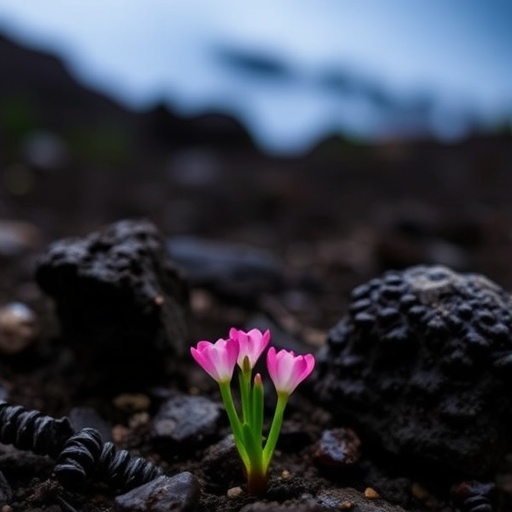
In the unforgiving environment of the alpine soil, life endures against the odds, adapting to one of the harshest climatic phenomena on Earth—freeze–thaw cycling. Recent research spearheaded by Qi, Wang, Zhou, and their colleagues unveils a fascinating mechanism by which microbial communities survive and regulate the soil’s response to warming, a finding that carries immense implications for understanding climate change effects on mountainous ecosystems.
Alpine soils, often considered negligible in global biogeochemical cycles, are in fact hotspots of microbial activity and biodiversity. These soils are subject to repeated freeze–thaw cycles—daily or seasonal fluctuations where temperatures dip below freezing and then thaw. This cycling profoundly affects soil structure, moisture content, and microbial metabolism. The research team’s investigation sheds light on microbial dormancy—an adaptive strategy that microbes deploy to endure adverse conditions.
Microbial dormancy refers to a reversible state of significantly reduced metabolic activity. During freeze phases, microbial life essentially ‘shuts down,’ surviving in a latent state until environmental conditions improve. The study reveals that dormancy under freeze–thaw cycling is not merely a passive survival tactic but a dynamic regulator influencing the alpine soil’s carbon and nutrient cycles during warming periods.
The team utilized a combination of field experiments across alpine regions and controlled laboratory simulations to track microbial community changes through freeze–thaw events. They employed advanced metagenomic sequencing and isotopic tracing to measure shifts in microbial population dynamics and activity rates. Results consistently pointed to a heightened state of dormancy during freeze periods, followed by selective awakening when soils warmed.
One groundbreaking discovery is that the dormancy period allows the microbial community to resist stressors triggered by warming. Typically, warming accelerates microbial respiration, leading to increased carbon dioxide emissions from soils—a feedback loop exacerbating global warming. However, freeze–thaw induced dormancy tempers this acceleration by limiting microbial activity spikes, thus modulating greenhouse gas fluxes during seasonal warming phases.
The study also underscores that this dormancy mechanism helps maintain microbial diversity under fluctuating temperature regimes. By temporarily suspending activity, certain microbial groups can avoid competitive exclusion, preserving a broader genetic reservoir that is crucial for ecosystem resilience and function. This insight revises prior assumptions that freeze–thaw cycles predominantly impoverish microbial diversity.
Furthermore, the authors highlight that alpine soil microbes are not homogeneous in their dormancy responses. Different species and functional groups exhibit varied timing and thresholds for entering and exiting dormancy. This heterogeneity is critical for stabilizing soil processes, as it prevents synchronized bursts of activity that could destabilize nutrient availability or soil organic matter turnover.
The implications for predicting ecosystem responses to climate change are profound. Models integrating microbial dormancy dynamics under freeze–thaw regimes predict a more buffered soil feedback to warming than previously estimated. These models provide a more nuanced understanding of carbon cycling in cold regions, emphasizing the importance of microbial ecology in global climate projections.
Researchers also explored the biochemical pathways involved in dormancy induction and termination. Freeze-induced stress responses include the upregulation of protective proteins and antifreeze compounds that stabilize cellular structures during ice formation. Upon thawing, signaling molecules trigger reactivation of metabolic pathways, allowing microbes to resume growth efficiently in soil warmed by sunlight and seasonal change.
The findings have broader ecological ramifications. Alpine soils contribute significantly to regional water quality and vegetation health, with microbial communities playing pivotal roles in nutrient mineralization and organic matter decomposition. By regulating microbial dormancy, freeze–thaw cycling indirectly influences plant productivity and the overall stability of alpine ecosystems, which are particularly vulnerable to climate perturbations.
Moreover, human-induced climate warming threatens to alter the frequency and intensity of freeze–thaw cycles. The study warns that disruptions to these natural cycles could undermine microbial dormancy patterns, potentially accelerating soil carbon losses and shifting nutrient dynamics with cascading effects on mountain biodiversity and downstream ecosystems.
Beyond the immediate alpine context, this research provides a template for understanding microbial resilience in other extreme environments, such as polar soils and high-latitude permafrost regions. By decoding dormancy strategies, scientists can better anticipate the biogeochemical consequences of thawing soils worldwide, critical for global carbon budgeting and mitigation efforts.
Collaborative cross-disciplinary approaches, integrating microbiology, soil science, climate modeling, and bioinformatics, were central to the study’s success. This comprehensive methodology sets a precedent for future research looking to untangle the complex interplay between microbial life cycles and environmental stressors on a planetary scale.
The research team emphasizes the need for long-term monitoring of alpine soils, combining continuous sensor data with molecular analyses to capture real-time responses of microbial dormancy to varying climate scenarios. Such data are essential for refining ecosystem models and informing conservation strategies aimed at preserving alpine biodiversity and ecosystem services under changing climatic conditions.
In closing, the insights gleaned from Qi, Wang, Zhou, and colleagues’ seminal work fundamentally transform our understanding of how microscopic life mediates alpine soil responses to warming. Microbial dormancy under freeze–thaw cycling emerges not simply as a survival mechanism but as a powerful modulator of ecosystem stability and global climate interactions in high-mountain environments.
This pioneering research invites a reevaluation of soil microbial dynamics in climate science narratives, highlighting the critical role of hidden microbial processes in buffering the Earth’s biosphere against the accelerating impacts of anthropogenic warming. The alpine soil microbiome, once overlooked, now takes center stage as an unsung regulator of our planet’s carbon future.
Cite Scienmag News
Morgan Morrow. (March 30, 2026). Microbial Dormancy Controls Alpine Soil Warming Response. Scienmag. https://scienmag.com/microbial-dormancy-controls-alpine-soil-warming-response/
Morgan Morrow. "Microbial Dormancy Controls Alpine Soil Warming Response." Scienmag, 30 March 2026, https://scienmag.com/microbial-dormancy-controls-alpine-soil-warming-response/. Accessed 3 September 2026.
Morgan Morrow. "Microbial Dormancy Controls Alpine Soil Warming Response." Scienmag. March 30, 2026. https://scienmag.com/microbial-dormancy-controls-alpine-soil-warming-response/


