


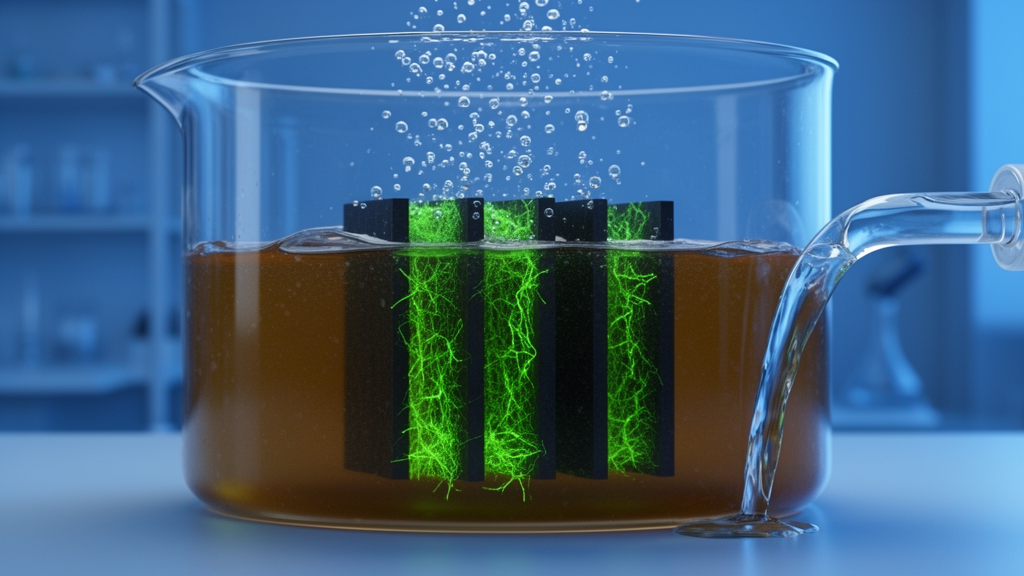
A sweeping new review published in Frontiers in Environmental Chemistry argues that the future of wastewater treatment may lie not in energy-hungry aeration tanks but in billions of bacteria wired directly to electrodes. The work, led by Amjid Khan and colleagues at the UNESCO-UNISA Africa Chair in Nanoscience and Nanotechnology, synthesizes two decades of research on microbial electrochemical technologies, or METs, a family of devices in which electroactive microorganisms oxidize organic waste and shuttle the liberated electrons to solid-state electrodes. In doing so, the authors contend, these systems can simultaneously remediate polluted water, recover energy carriers such as electricity and hydrogen, and reclaim nutrients and metals, all while sidestepping the greenhouse gas burden of conventional treatment.
The underlying physics and biology are elegantly simple in principle. Inside a typical MET, exoelectrogenic bacteria colonize an anode, oxidizing organic substrates and releasing electrons and protons. Electrons flow through an external circuit to the cathode, generating current, while protons migrate through the electrolyte to complete the redox reaction. Electron transfer occurs either directly, via outer-membrane cytochromes and conductive pili known as nanowires, or indirectly through soluble redox mediators. Depending on the configuration, the same microbial chemistry can yield electricity in microbial fuel cells, hydrogen in microbial electrolysis cells, desalinated water in microbial desalination cells, or valuable chemicals such as acetate and ethanol in microbial electrosynthesis platforms fed with carbon dioxide.
Star performers in the microbial cast include Geobacter sulfurreducens, which builds thick, conductive biofilms using pili and cytochromes, and Shewanella oneidensis, which can dispatch electrons directly or via secreted flavins. Pseudomonas species contribute by degrading recalcitrant waste components and moving electrons extracellularly. In real-world reactors treating complex waste, mixed communities matter more than any single species: fermentative and hydrolytic bacteria break down complicated organics into substrates the exoelectrogens can metabolize. The stability of these collaborations, the review stresses, ultimately determines whether a bioelectrochemical system stays productive for years or collapses under competition and community shifts.
The review catalogues seven major MET configurations with strikingly different value propositions. Microbial fuel cells produce power densities ranging from 0.1 to 23 watts per square meter and can achieve chemical oxygen demand removal of up to 97 percent in optimized systems, without any external energy input, a sharp contrast to activated sludge plants that consume roughly 0.4 kilowatt-hours per cubic meter of treated water, mostly for aeration. Microbial electrolysis cells apply a modest external voltage of 0.6 to 1.0 volts to drive hydrogen evolution, with cathodic hydrogen recovery exceeding 80 percent when fed acetate, producing a storable fuel at an estimated cost of 3.01 to 4.51 dollars per kilogram against a merchant value near 6 dollars. Microbial desalination cells couple ion migration with power generation, while resource-recovery variants can harvest phosphorus, nitrogen, copper and zinc from wastewater streams.
What these systems can eat is nearly as varied as what they can produce. The authors organize feedstocks into practical tiers: high-priority substrates such as dairy effluent and brewery wastewater combine high organic strength with low toxicity and minimal pretreatment, and consistently deliver the best energy recoveries. Medium-priority streams, including lignocellulosic biomass and municipal solid waste, promise abundant energy but demand hydrolysis or community adaptation. At the bottom sit pharmaceutical and textile wastewaters, whose inhibitory dyes and complex compounds can poison electroactive biofilms unless operators dilute the feed or deploy specialized microbial consortia. Landfill leachate, slaughterhouse waste, palm oil mill effluent and paper mill liquor all fall somewhere in between, each with its own trade-off between energy potential and operational headache.
Nanotechnology emerges as the review’s most dynamic frontier. Carbon nanotubes, graphene oxide, metal-organic frameworks and quantum dots are being engineered into three-dimensional electrode architectures that multiply surface area, accelerate extracellular electron transfer and encourage microbial attachment. Green-synthesized nanomaterials and conductive polymer coatings such as polypyrrole and PEDOT:PSS improve biofilm conductivity and longevity, while antifouling nanocoatings extend electrode life. Hybrid biochar-carbon nanotube electrodes promise scalable performance at lower cost, and nanocatalysts are helping electrosynthesis systems convert carbon dioxide and methane into acetate more efficiently. The authors are careful, however, to flag the environmental fate and safety of engineered nanomaterials in water reuse as an unresolved question requiring robust risk assessment and regulatory frameworks.
Perhaps the most futuristic section concerns artificial intelligence and digital twins. Machine learning models, particularly tree-based ensembles such as CatBoost and XGBoost, have proven adept at predicting power density and pollutant removal from operational variables. In one worked example, a CatBoost model applied to microbial fuel cells treating landfill leachate achieved a predictive R-squared of 0.999, identifying an optimal power density of 283.38 milliwatts per square meter and a Coulombic efficiency of nearly 25 percent at specific ammonium, COD and pH conditions, and singling out COD concentration as the dominant driver of output. Digital twin frameworks, combining real-time sensor streams with calibrated mechanistic models, could then predict fouling, simulate scenarios and auto-tune reactors, although the authors note that data scarcity and model interpretability remain genuine bottlenecks.
Honesty about limits pervades the analysis. Power densities reported across the literature span nearly four orders of magnitude, from roughly 0.04 milliwatts per cubic meter to over 6,000, largely because of inconsistent inocula, electrode spacing, testing protocols and reporting conventions rather than true technological differences. Absolute power outputs remain one to two orders of magnitude below what grid-scale energy export would require, and anaerobic digestion still outperforms fuel cells in energy recovered per unit of COD where a digester already exists. Polymeric membranes alone account for an estimated 40 percent of fuel cell fabrication capital cost, and legacy platinum catalysts inflate expenses further, even though platinum-group-metal-free cathodes have delivered comparable performance. The authors also acknowledge that no standardized land-footprint comparison with conventional plants is yet possible from published data.
The geopolitical calculus, though, may favor METs sooner than wealthy nations expect. While about 52 percent of global wastewater is treated, coverage falls to roughly 26 percent in lower-middle-income countries and as low as 4 to 8 percent in low-income countries. In those settings the counterfactual is untreated discharge, not an aerated incumbent, which tilts the economics toward modular, low-energy bioelectrochemical units that can be deployed incrementally and that recover fertilizer nutrients otherwise imported. The review proposes a portfolio view in which METs complement rather than replace anaerobic digestion and thermal conversion, excelling precisely on the dilute aqueous streams that combustion routes find energetically worthless.
The authors close with a strategic roadmap that reads as a call for interdisciplinary convergence: CRISPR-engineered Geobacter strains, designer synthetic consortia stabilized through quorum sensing manipulation, biodegradable conductive polymers, and integration with microalgae photobioreactors for combined carbon capture and biofuel production. Policy support, they argue, may matter more than laboratory breakthroughs; feed-in tariffs extended to bioelectroelectricity, carbon credit eligibility with standardized measurement protocols, and capital grants for demonstration plants could all shorten the commercialization timeline. If the scaling bottleneck from technology readiness level 3 to 7 can be bridged, nano-enhanced METs could anchor a circular bioeconomy in which every sewage pipe doubles as a power plant, a hydrogen source and a mine of recovered metals, turning one of civilization’s oldest nuisances into one of its newest assets.
Subject of Research: Engineering microbial electrochemical technologies for sustainable waste-to-energy conversion and water recovery
Article Title: From waste to resource: engineering microbial electrochemical technologies for a sustainable water-energy nexus
Article References: Khan, A., Khan, R. A., Hassan, D., Qadri, T. A., Ashiq, B., Sani, A., Shinwari, Z. K., & Maaza, M. (2026). From waste to resource: engineering microbial electrochemical technologies for a sustainable water-energy nexus. Frontiers in Environmental Chemistry, 7, Article 1884425. https://doi.org/10.3389/fenvc.2026.1884425
Image Credits: AI Generated
DOI: 10.3389/fenvc.2026.1884425
Keywords: microbial electrochemical technologies, microbial fuel cells, wastewater treatment, extracellular electron transfer, nanostructured electrodes, microbial electrolysis, hydrogen production, circular bioeconomy, artificial intelligence, digital twins, resource recovery, water-energy nexus
Cite Scienmag News
Violet Maxwell. (October 15, 2026). Microbes That Turn Wastewater Into Electricity, Hydrogen and Clean Water. Scienmag. https://scienmag.com/microbes-that-turn-wastewater-into-electricity-hydrogen-and-clean-water/
Violet Maxwell. "Microbes That Turn Wastewater Into Electricity, Hydrogen and Clean Water." Scienmag, 15 October 2026, https://scienmag.com/microbes-that-turn-wastewater-into-electricity-hydrogen-and-clean-water/. Accessed 15 October 2026.
Violet Maxwell. "Microbes That Turn Wastewater Into Electricity, Hydrogen and Clean Water." Scienmag. October 15, 2026. https://scienmag.com/microbes-that-turn-wastewater-into-electricity-hydrogen-and-clean-water/


