


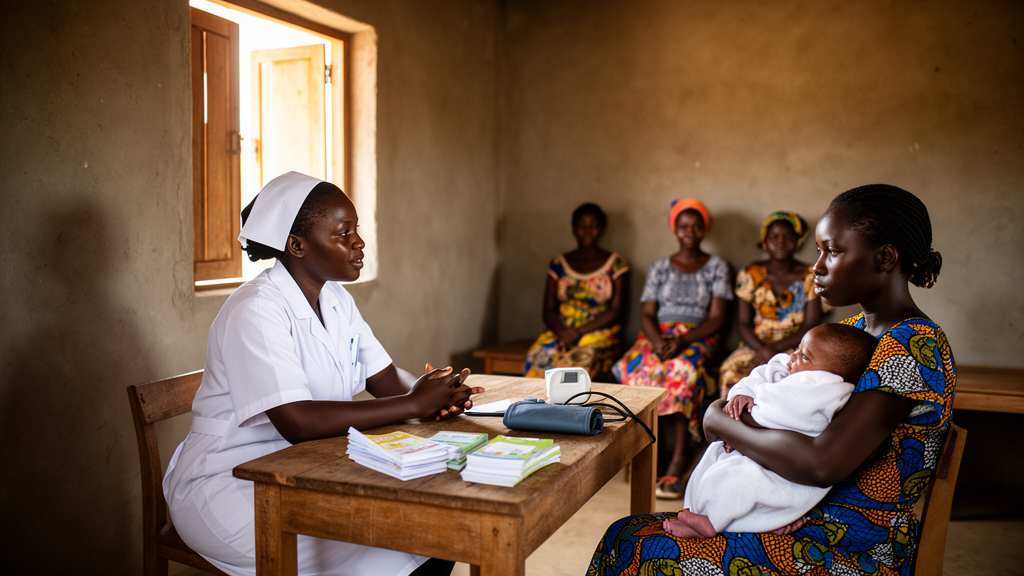
Tanzania has spent decades building one of the more supportive policy environments for family planning in sub-Saharan Africa, formally embedding postpartum family planning in national strategies since the 1970s and naming it a high-impact practice for maternal and child health. Yet a new mixed-methods assessment published in Frontiers in Global Women’s Health reveals a stubborn disconnect between what the country’s policies promise and what women actually receive after childbirth. The study, led by researchers at the National Institute for Medical Research in Dodoma and funded by the World Health Organization, finds that rising counselling coverage has not translated into contraceptive uptake, and it pinpoints the health-system bottlenecks responsible.
The stakes are considerable. Postpartum family planning, or PPFP, refers to the prevention of unintended and closely spaced pregnancies during the year after a birth, when the risks of short birth intervals are greatest. Children conceived less than 24 months after a previous delivery face elevated risks of preterm birth, low birth weight, small-for-gestational-age status, chronic undernutrition, stunting and death, with infants born after intervals shorter than two years showing roughly a 60 percent higher risk of infant mortality. Globally, more than 90 percent of women say they want to delay or avoid pregnancy for at least a year after childbirth, and effective PPFP has been credited with the potential to reduce maternal deaths by 30 percent and child deaths by 10 percent. Despite this, an analysis of Demographic and Health Surveys across 21 low- and middle-income countries found that 61 percent of postpartum women had an unmet need for family planning.
To diagnose why Tanzania’s numbers fall short, the research team deployed a participatory cross-sectional design built around an adapted WHO bottleneck assessment tool. They scored 37 items across eight health-system domains using five-point Likert scales, complemented the survey with 34 in-depth interviews, and mined DHIS2 routine health data from 2020 to 2023 alongside the 2022 Tanzania Demographic and Health Survey. A desk review examined national policies and guidelines against WHO recommendations. Of 477 invited stakeholders, 424 responded, an 88.9 percent response rate dominated by public-sector health professionals working at council and community levels. Findings from all sources were triangulated and then taken to a Ministry of Health-convened consensus meeting, where stakeholders ranked bottlenecks and matched each one to concrete actions.
The data told a story of widening gap between contact and conversion. Routine DHIS2 records showed a substantial increase in the number of postpartum women receiving family planning counselling within six weeks of birth, and the mid-term assessment of the National Family Planning Costed Implementation Plan II reported PPFP use rising from 14.9 percent in 2019 to 45.8 percent in 2023. But the 2022 DHS found that only 3.3 percent of women were using a modern method at one month postpartum and 19 percent at six months, despite more than 80 percent of births occurring in health facilities. Regional variation was striking: PPFP use reached 73.6 percent in Mara and 72 percent in Iringa, yet hovered at 8.4 percent in Ruvuma and under 22 percent in Mtwara, Pwani and Njombe. No region in Zanzibar qualified as a high-uptake area at all.
The interviews explained the arithmetic behind those figures. Long-acting and permanent methods such as intrauterine devices were available at only a limited number of facilities, and too few providers were trained to insert them, forcing services to lean on short-term methods and a handful of implants. In one facility in Songea, only two staff members had ever been trained in PPFP. Consensus participants scored provider capacity as an important bottleneck with a mean of 3.27, referral systems at 3.45, and service organization and scheduling at 3.18. As one health worker from Iringa observed, counselling is offered to many delivering women, but the decision to use a particular method rests with the woman herself, a choice that collapses when her preferred method is not actually on offer.
Policy itself emerged as both strength and weakness. Tanzania’s national guidance requires family planning integration into antenatal care, postnatal care, immunization and post-abortion care, and the current One Plan III explicitly prioritizes scaling up PPFP. But the document review uncovered misalignment with WHO recommendations: family planning information is only initiated at the fourth antenatal visit under national guidelines, whereas WHO advises discussing methods at every visit, and national standards have yet to clarify immediate postpartum options such as progestin-only methods and implants. Dissemination was uneven, particularly in Zanzibar, where providers described guidelines that had been updated but rarely explained, with one participant complaining that the guideline book was simply too big and that flyers, posters and visual job aids would be more effective. Communication, knowledge and awareness scored 4.00 in the consensus meeting, a very important bottleneck, while guidelines and tools scored 3.45.
Financing and motivation ranked highest of all. Stakeholders rated low provider motivation at 4.27, the top-ranked bottleneck, and inadequate budgets at 4.09. National-level respondents flagged budgeting, insurance and spending as the most severe constraints, while regional respondents emphasized budgeting, spending and motivation, a divergence the authors interpret as a disconnect between macro-level resource concerns and frontline realities dominated by staffing shortages and supervision gaps. In Zanzibar, one regional participant reported that government financing was essentially absent, leaving donor contributions to carry the provision and dissemination of PPFP information. The study also notes that the assessment was conducted before the 2025 changes to United States foreign assistance, and that subsequent disruptions to USAID-supported programming such as Boresha Afya could jeopardize the sustainability of partner-funded services, sharpening the case for domestic financing.
Beyond the health system, sociocultural forces shape what happens in counselling rooms. Providers described misconceptions about contraceptive safety and side effects, beliefs that sexual activity and therefore contraception can wait until menstruation returns, and patriarchal decision-making in which husbands and mothers-in-law hold effective veto power over a woman’s choices. One participant in Kilimanjaro recounted women saying they were afraid of their mothers-in-law. The authors stress that male involvement, which national policy promotes, must support informed and voluntary contraceptive choice rather than become a precondition for access, and that providers need counselling skills to engage partners constructively while safeguarding women’s autonomy.
The consensus process distilled the evidence into seven prioritized actions: monetary and non-monetary incentives such as recognition certificates and incorporating PPFP into providers’ work packages to address motivation; advocacy for adequate domestic funding and inclusion of postpartum and post-abortion family planning in the Global Financing Facility Investment Case; dissemination of updated policies, guidelines and job aids through clear communication channels; incorporation of PPFP referral guidance into general referral protocols; regular data review for equitable budget allocation; use of locally generated evidence to mobilize political commitment for scaling innovations; and training health workers, embedding PPFP in pre-service curricula and equipping facilities with necessary supplies. Where NGOs invested in training and demand creation, as in Kilimanjaro, scale-up moved faster, but the authors caution that partner-supported gains must be absorbed into routine government systems to endure.
The study’s conclusions carry lessons well beyond Tanzania. Supportive policies and increased contact with the health system, the authors write, do not by themselves produce effective implementation; the persistent gap lies between policy intent, service delivery and utilization, a pattern echoed across sub-Saharan Africa. The findings also carry caveats: women themselves were not directly surveyed, so demand-side factors rest on stakeholder perceptions, purposive sampling limits generalizability, and DHIS2 lacks indicators tracking transitions from lactational amenorrhoea to other methods. Even so, the central message is unambiguous. Closing the policy-practice gap will require coordinated investment in financing, provider capacity and motivation, guideline dissemination, referral systems, equitable access and innovation scale-up, so that the moments when women are most motivated to space their births become moments when effective contraception is genuinely within reach.
Subject of Research: Implementation bottlenecks to postpartum family planning scale-up in Tanzania
Article Title: Policy-practice gaps and bottlenecks to postpartum family planning scale-up in the United Republic of Tanzania
Article References: Kafaiya, C. B., Kilima, S. P., Mayige, M. T., & Mashoto, K. O. (2026). Policy-practice gaps and bottlenecks to postpartum family planning scale-up in the United Republic of Tanzania. Frontiers in Global Women's Health, 7, Article 1875076. https://doi.org/10.3389/fgwh.2026.1875076
Image Credits: AI Generated
DOI: 10.3389/fgwh.2026.1875076
Keywords: postpartum family planning, Tanzania, contraception, health systems, maternal health, WHO, policy implementation, bottlenecks, family planning counselling, health financing, sub-Saharan Africa, birth spacing
Cite Scienmag News
Harold Sullivan. (October 15, 2026). Tanzania’s Postpartum Family Planning Promise Stalls at the Frontline. Scienmag. https://scienmag.com/tanzanias-postpartum-family-planning-promise-stalls-at-the-frontline/
Harold Sullivan. "Tanzania’s Postpartum Family Planning Promise Stalls at the Frontline." Scienmag, 15 October 2026, https://scienmag.com/tanzanias-postpartum-family-planning-promise-stalls-at-the-frontline/. Accessed 15 October 2026.
Harold Sullivan. "Tanzania’s Postpartum Family Planning Promise Stalls at the Frontline." Scienmag. October 15, 2026. https://scienmag.com/tanzanias-postpartum-family-planning-promise-stalls-at-the-frontline/


