


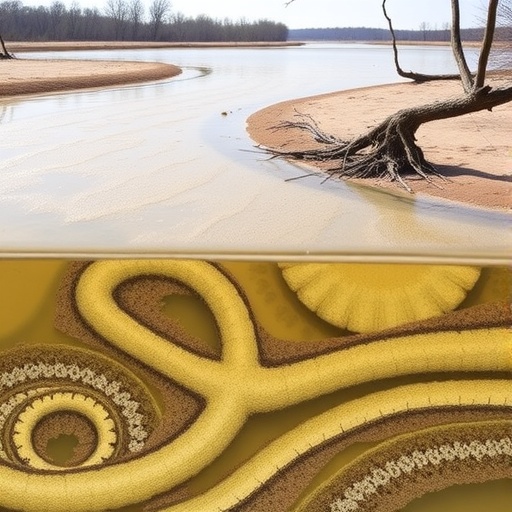
In a groundbreaking study recently published in Nature Communications, researchers have unveiled the intricate microbial mechanisms responsible for ammonium accumulation in the Holocene sediments of the Pearl River Delta. This discovery not only sheds light on the complex biogeochemical processes shaping one of the world’s most dynamic estuarine environments but also opens new avenues for understanding nitrogen cycling in sedimentary ecosystems on a global scale. The research team, led by Lu M., Jiao J.J., and Luo X., employed cutting-edge metagenomic and geochemical analyses to unravel the microbial interactions underlying ammonium buildup over thousands of years.
The Pearl River Delta, a sprawling sedimentary basin formed during the Holocene epoch, is renowned for its diverse microbial communities and significant influence on regional nitrogen budgets. Historically, ammonium accumulation in these sediments has been attributed primarily to abiotic factors such as organic matter degradation. However, the novel approach applied by Lu and colleagues challenges this paradigm by identifying specific microbial taxa and metabolic pathways that actively contribute to ammonium enrichment.
Central to the study is the identification of ammonia-oxidizing archaea (AOA) and bacteria (AOB) populations that exhibit altered metabolic activity linked with sediment depth and age. Through high-throughput sequencing paired with stable isotope probing, the researchers demonstrated that these microorganisms modulate nitrogen transformations differently across stratified sediment layers. This stratification drives the spatial heterogeneity of ammonium concentrations, revealing a complex interplay between microbial ecology and geochemical gradients.
Furthermore, the research highlights the pivotal role of anaerobic ammonium oxidation (anammox) bacteria, which typically mediate nitrogen loss by converting ammonium and nitrite to nitrogen gas. Intriguingly, in the Pearl River Delta sediments, anammox bacteria coexist with ammonium-producing microbes in a delicate balance that regulates net ammonium accumulation rather than depletion. Such coexistence underscores the dynamic equilibrium maintained in sedimentary nitrogen cycles and suggests that shifts in microbial community composition could have outsized effects on nitrogen fluxes.
Another notable finding concerns the influence of organic matter quality and sedimentation rates on microbial nitrogen metabolism. The team’s geochemical profiling revealed that labile organic substrates serve as electron donors facilitating ammonium-producing metabolic pathways such as dissimilatory nitrate reduction to ammonium (DNRA). This contrasts with denitrification pathways that consume nitrate but result in nitrogen loss as gaseous forms. By dissecting these competing pathways, the authors provide a comprehensive framework linking organic carbon availability to ammonium retention.
The implications of this study extend beyond the Pearl River Delta. Sedimentary ammonium accumulation impacts nutrient availability in overlying waters, influencing primary productivity and potentially exacerbating eutrophication and hypoxia in coastal zones. Understanding microbial drivers behind these processes is critical for predicting ecosystem responses to environmental change, including anthropogenic nutrient loading and climate-induced alterations in sedimentation patterns.
To achieve these insights, Lu et al. utilized metagenomic sequencing complemented by quantitative PCR assays targeting nitrogen cycling genes. This molecular toolkit enabled pinpointing functional gene abundance and expression profiles, correlating them with measured ammonium concentrations across spatial and temporal gradients. The integration of molecular microbiology with sediment geochemistry exemplifies the interdisciplinary approach necessary for disentangling complex environmental biogeochemistry.
Importantly, the study also maps the evolutionary adaptation of microbial communities to sedimentary conditions through the Holocene, offering a temporal perspective on how microbial nitrogen processing has evolved in response to environmental shifts. This temporal dimension adds depth to understanding not only contemporary nitrogen cycles but also their historical trajectories under changing climate and sea-level regimes.
The authors emphasize that future research should focus on isolating key microbial players in pure cultures to experimentally validate their metabolic capabilities. Further exploration of microbial interactions, such as syntrophic partnerships and competition dynamics, could elucidate mechanisms underpinning nitrogen retention or loss in sediments. Advances in single-cell genomics and transcriptomics hold promise for resolving microbial functions at unprecedented resolution.
Moreover, this research underscores the critical need to integrate sediment microbial ecology into predictive models of coastal nutrient cycling. As human activities continue to alter sediment inputs and nutrient regimes, accurate modeling informed by microbial processes becomes indispensable for managing estuarine health and mitigating harmful algal blooms driven by excess nitrogen.
In conclusion, the study by Lu, Jiao, Luo, and colleagues represents a landmark advancement in marine microbial ecology and biogeochemistry. By revealing the microbial determinants of ammonium accumulation in Holocene sediments, it challenges existing assumptions and provides a robust mechanistic understanding of nitrogen transformations in a key global estuary. This knowledge lays the groundwork for targeted interventions to preserve coastal ecosystem function amidst the twin pressures of anthropogenic change and global environmental variability.
Cite Scienmag News
Violet Maxwell. (May 5, 2026). Microbes Behind Ammonium Build-Up in Pearl River Sediments. Scienmag. https://scienmag.com/microbes-behind-ammonium-build-up-in-pearl-river-sediments/
Violet Maxwell. "Microbes Behind Ammonium Build-Up in Pearl River Sediments." Scienmag, 5 May 2026, https://scienmag.com/microbes-behind-ammonium-build-up-in-pearl-river-sediments/. Accessed 3 September 2026.
Violet Maxwell. "Microbes Behind Ammonium Build-Up in Pearl River Sediments." Scienmag. May 5, 2026. https://scienmag.com/microbes-behind-ammonium-build-up-in-pearl-river-sediments/


