


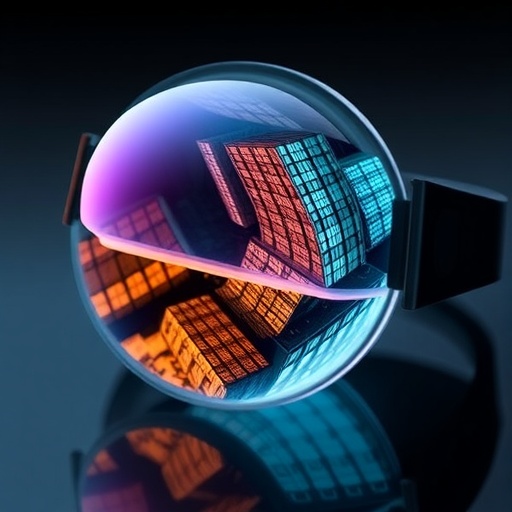
In a breakthrough poised to redefine the future of display technologies, researchers have unveiled a pioneering 2D–3D switchable light-field display leveraged by an innovative metasurface lenticular lens (MLL). This advancement addresses one of the most persistent challenges in immersive visual technology: merging seamless and high-resolution two-dimensional imagery with dynamic three-dimensional experiences within a single compact device. The novel system provides a groundbreaking solution that promises expansive applications across consumer electronics, media, and next-generation interactive platforms.
Central to this leap in display technology is the ingeniously engineered metasurface lenticular lens that lies at the heart of the device. Unlike conventional lenticular lenses, which typically suffer bulkiness and field of view limitations, this MLL employs a metasurface design that manipulates light based on polarization states. Specifically, the focal properties of the lens switch responsively when exposed to different polarization angles of incident light. This polarization-dependent focal control mechanism enables the display to toggle effortlessly between sharp two-dimensional and immersive three-dimensional modes, offering users unprecedented flexibility in visual experience without any mechanical adjustments.
The researchers’ design notably advances the field by incorporating a high numerical aperture (NA) into the metasurface lenticular lens. This attribute is critical as it governs the lens’s ability to collect and focus light, directly influencing image resolution and viewing angles. Achieving a numerical aperture sufficiently large enough allowed the display to realize an exceptionally wide field of view of approximately 100 degrees, a scale rarely attained in flat-panel light-field displays to date. Such a broad field of view enables viewers to enjoy expansive and naturalistic 3D visuals from multiple viewing angles, dramatically enhancing realism and immersion.
One of the most remarkable features of the MLL display lies in its slim profile, delivering powerful optical performance while maintaining an ultrathin thickness of just 1.2 millimeters. This thinness addresses a critical practical limitation in existing 3D displays, which are often bulky and unsuitable for integration into slim consumer devices such as smartphones, tablets, and wearable displays. The ultrathin form factor achieved through metasurface engineering signifies a major step toward widespread commercialization by fitting within sleek device frameworks without compromising optical functionality.
To prove the concept’s viability, the research team fabricated a large-area metasurface lenticular lens with an active area of 25 square centimeters. This scalable fabrication was achieved through advanced nanofabrication techniques capable of producing complex metasurface patterns over wide surfaces without loss of precision or performance. The large-area device was seamlessly integrated with an organic light-emitting diode (OLED) panel, a state-of-the-art display technology known for its superior contrast, colour accuracy, and energy efficiency, thus demonstrating the hybrid system’s ability to handle full-colour images with sharp fidelity.
In practical operation, the assembled device successfully showcased crisp and vibrant two-dimensional images when the metasurface lenticular lens was set to the 2D mode, characterized by a uniform focal plane that preserves classic high-resolution display quality. Upon switching polarization conditions — accomplished simply by applying a voltage — the system seamlessly transitioned into the three-dimensional light-field mode. This mode projected layered images providing stereoscopic depth cues without curtains of blurring or color fringing, marking a significant accomplishment in 3D display technology that customarily grapples with image artifacts.
The electrical switching mechanism embedded within the metasurface lenticular lens stands out due to its simplicity and effectiveness. By modulating the incident light’s polarization through voltage-controlled liquid crystal layers integrated with the MLL, the system circumvents mechanical or multi-layered optical elements traditionally used in switchable 2D/3D displays. This innovation not only improves device durability by eliminating moving parts but also enhances switching speed and energy efficiency — two key metrics for portable electronic devices.
Beyond technical specifications, the device’s large field of view mitigates common issues such as limited viewing angles, which often restrict the realism and utility of current 3D displays. Viewers can freely observe the 3D effect from wider positions, enhancing its appeal for multi-user environments, gaming, and interactive media installations. This wide field of view is achieved without sacrificing image resolution, a feat made possible through meticulous optimization of the MLL’s metasurface pattern and the underlying optical design principles.
The integration of the metasurface lenticular lens technique into standard OLED displays signifies an important intersection of emerging nanophotonic technologies with mature electronic hardware. This synergy allows retailers and manufacturers to envision plug-and-play upgrades for existing devices or entirely new platforms that seamlessly alternate between immersive 3D content and standard 2D applications such as reading, browsing, and watching video. The adaptability of the technology broadens its market potential dramatically.
From a manufacturing standpoint, the researchers demonstrated that the metasurface lenticular lenses can be produced at scale without significant increases in cost or complexity compared to traditional optical components. This scalable fabrication is crucial for commercial viability, especially in industries constrained by cost pressures and demand for mass production. The design’s compatibility with current semiconductor manufacturing approaches hints at potential for rapid adoption and integration into consumer supply chains.
The demonstrated technology also raises fascinating prospects for future customization and personalization of display hardware. By further refining the metasurface lens structure and materials, it is conceivable to tailor focal properties, polarization responses, or aperture sizes to adapt to unique user preferences or specialized applications. Such tunability could revolutionize not only entertainment but also fields including medical imaging, remote collaboration, and augmented reality.
Ultimately, this innovation in 2D–3D switchable light-field displays through metasurface lenticular lenses marks a milestone in immersive imaging science. It strategically addresses the longstanding trade-offs between image quality, device thickness, field of view, and mode flexibility. By harnessing advanced metasurface optics integrated with established OLED technologies along with elegant polarization control, the research ushers in a new era of versatile, compact, and high-performance displays capable of revolutionizing user experiences across countless domains.
As the technology moves forward, challenges related to further improving brightness, energy consumption, and environmental robustness remain essential targets for optimization. Nevertheless, this research sets a clear vision of how nanoscale engineering and photonic innovation will converge to enhance everyday devices, transforming fundamental ways humans interface with digital content in three dimensions. The work paves the way for future consumer gadgets that effortlessly switch from high-definition 2D presentations to compelling and naturalistic 3D realms without bulky attachments or complex optics.
The implications for the entertainment industry are particularly exciting. The ability for consumers to switch instantly between modes without sacrificing resolution or comfort holds promise for next-generation gaming consoles, cinematic displays, and virtual reality headsets where immersive depth cues dramatically enrich storytelling and interaction. Moreover, commercial sectors including advertising, education, and healthcare stand to benefit from this dynamic display capability offering richer visualizations with minimal hardware footprint.
This research underscores the power of marrying emergent metasurface technologies with practical applications, pushing the boundaries of what is achievable in consumer electronics and interactive displays. The meticulous design, scalable fabrication, and impressive optical performance demonstrated by the metasurface lenticular lens herald a new paradigm in the evolution of flat panel displays. The future landscape of digital visualization is undoubtedly set for transformation inspired by these exciting scientific advances.
Cite Scienmag News
Denise Maddox. (April 22, 2026). Metasurface Lens Enables Switchable 2D-3D Display. Scienmag. https://scienmag.com/metasurface-lens-enables-switchable-2d-3d-display/
Denise Maddox. "Metasurface Lens Enables Switchable 2D-3D Display." Scienmag, 22 April 2026, https://scienmag.com/metasurface-lens-enables-switchable-2d-3d-display/. Accessed 4 September 2026.
Denise Maddox. "Metasurface Lens Enables Switchable 2D-3D Display." Scienmag. April 22, 2026. https://scienmag.com/metasurface-lens-enables-switchable-2d-3d-display/


