


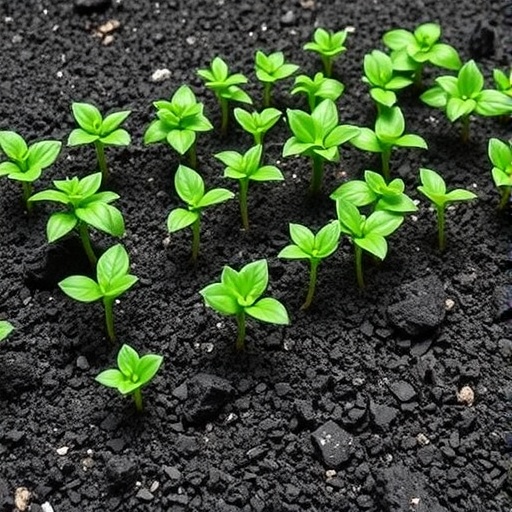
In the relentless pursuit of sustainable agricultural practices, researchers have long grappled with the challenge of rehabilitating soda saline-alkaline soils—vast stretches of farmland rendered infertile due to high salinity and alkalinity. These soils present formidable barriers to crop productivity, threatening food security in vulnerable regions worldwide. Now, a pioneering study led by Zhou, H., Xu, H., Zhao, L., and their colleagues, published in Nature Communications in 2026, unveils a groundbreaking solution: mineralization-based biochar. This innovative approach not only revitalizes degraded lands but also offers a promising pathway toward sustainable soil management.
Soda saline-alkaline soils are characterized by excessive sodium ions and high pH levels, conditions that disrupt soil structure, impair water retention, and stunt plant growth. Historically, remediation techniques have been costly, labor-intensive, and often environmentally unsustainable, involving heavy chemical amendments or extensive irrigation. The study in question breaks new ground by integrating biochar— a carbon-rich material derived from biomass pyrolysis—with targeted mineral additives, creating a synergistic effect that transforms hazardous soils into fertile terrains.
At the heart of this innovation lies the process of mineralization, wherein essential minerals are introduced and anchored within biochar’s porous matrix. This mineralized biochar acts as a multifaceted soil amendment. Its porous nature improves soil aeration and moisture retention, while the mineral components actively bind sodium ions and adjust soil pH to optimal levels. This dual action not only mitigates the toxic effects of salinity and alkalinity but also reinstates
Cite Scienmag News
Alan Morgan. (April 22, 2026). Biochar Mineralization Enables Sustainable Soda Saline-Alkali Restoration. Scienmag. https://scienmag.com/biochar-mineralization-enables-sustainable-soda-saline-alkali-restoration/
Alan Morgan. "Biochar Mineralization Enables Sustainable Soda Saline-Alkali Restoration." Scienmag, 22 April 2026, https://scienmag.com/biochar-mineralization-enables-sustainable-soda-saline-alkali-restoration/. Accessed 4 September 2026.
Alan Morgan. "Biochar Mineralization Enables Sustainable Soda Saline-Alkali Restoration." Scienmag. April 22, 2026. https://scienmag.com/biochar-mineralization-enables-sustainable-soda-saline-alkali-restoration/


