


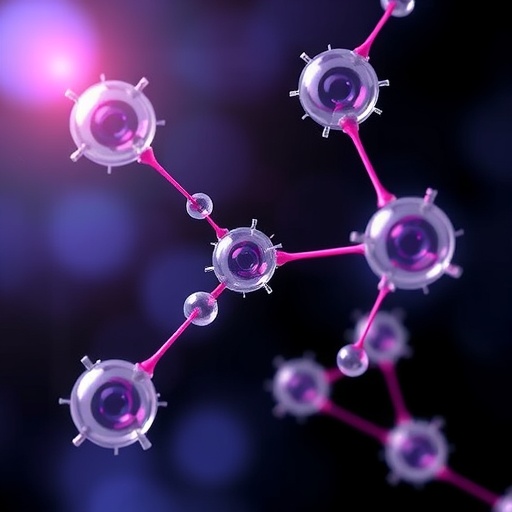
In a groundbreaking advancement within the realm of bioconjugation, researchers have unveiled a step-by-step protocol that significantly enhances the precision of monoclonal antibody conjugation to polymersome nanoparticles. This innovative methodology utilizes metal-free click chemistry for directional conjugation, focusing on the antibody’s Fc region while preserving its antigen-binding capabilities. As antibodies continue to play a pivotal role in diagnostics and therapeutics, this protocol invites attention for its potential to refine antibody-based applications and improve treatment specificity.
The protocol is meticulously designed with three principal stages that facilitate a seamless conjugation process. The first stage involves a mild oxidation of the glycosyl moiety unique to the Fc segment of the antibody, resulting in the formation of functional aldehyde groups. This crucial transformation sets the stage for subsequent reactions and is performed under conditions that minimize disruption to the antibody’s structural integrity. This careful handling is essential, as it ensures that the subsequent functionalization steps do not compromise the antibody’s essential properties.
Following the oxidation step, the second stage introduces a heterobifunctional linker—specifically, aminooxy-PEG-dibenzocyclooctyne—to the newly formed aldehyde groups in the Fc region. This linker is critical as it acts as a bridge for the final conjugation to the nanoparticles. The use of a heterobifunctional linker allows for selective attachment, which is key in achieving the desired orientation and spatial arrangement of the antibodies on the nanoparticle surface. This orientation is vital for preserving the binding efficiency of the antibody, which is often compromised in traditional conjugation methods that rely on amine groups.
The third and final stage of the protocol involves the click conjugation of the linker-modified antibodies to nanoparticles that possess azide functional groups. This step leverages the efficiency of click chemistry to form a covalent bond that securely attaches the antibodies to the nanoparticles. The resulting conjugates are expected to exhibit robust molecular specificity toward their target epitopes, thanks to the directed nature of the conjugation process. The strategic design of click chemistry in this context not only enhances specificity but also promotes stability, an essential factor in therapeutic applications.
As the entire conjugation protocol is estimated to take around 18 hours, it stands out as a relatively straightforward process that does not demand specialized expertise beyond basic laboratory skills. This accessibility broadens the potential use of this protocol in various laboratories, facilitating its adoption in both research and clinical settings.
Moreover, the significance of this protocol extends beyond just the technical details of conjugation; it reflects a paradigm shift in how researchers approach antibody-nanoparticle conjugation. By eliminating the reliance on traditional methods, which often lead to high variability and unpredictable results due to random orientations, this alternative ensures that the antibody’s functional site remains fully available for interaction with its antigen. Such improvements could have far-reaching implications in the development of more effective antibody-drug conjugates.
In addition to its technical merits, the robustness of the nanoparticle-antibody conjugates synthesized using this method offers fresh avenues for exploration in targeted drug delivery and imaging applications. The retained physicochemical properties of the core nanoparticles suggest that they can be utilized in various therapeutic contexts without the risk of losing functionality, thus enhancing their clinical utility.
Overall, this protocol is expected to foster a new generation of advanced therapeutic options. By streamlining the conjugation process while effectively preserving antibody function, researchers are provided with an essential tool that can be adapted to numerous therapeutic contexts, potentially leading to improved outcomes in patient care.
The extensive research behind this protocol stands as a formidable example of how innovation in chemical biology can translate into practical applications in medicine. As scientists continue to explore the intricacies of biomolecule interactions, this work lays the groundwork for future advancements in the design and utilization of smart therapeutic agents that can navigate complex biological environments with high specificity and efficacy.
Ultimately, the potential applications of this work are vast, including not only cancer therapy but also diagnostics, vaccine development, and regenerative medicine. The ability to tailor antibody conjugation for precise targeting presents a formidable opportunity to enhance the effectiveness of treatments across these fields.
In conclusion, the protocol outlined for directional conjugation of monoclonal antibodies to polymersome nanoparticles offers a significant improvement over conventional methods. It paves the way for innovative research and clinical applications that demand precision, specificity, and reliability in antibody-based therapeutics.
Jeevarathinam, A.S., Kawelah, M.R., Han, S. et al. Directional conjugation of monoclonal antibodies to nanoparticles using metal-free click chemistry. Nat Protoc (2025). https://doi.org/10.1038/s41596-025-01272-3
Cite Scienmag News
Bethany Barker. (November 20, 2025). Metal-Free Click Chemistry for Targeted Antibody-Nanoparticle Conjugation. Scienmag. https://scienmag.com/metal-free-click-chemistry-for-targeted-antibody-nanoparticle-conjugation/
Bethany Barker. "Metal-Free Click Chemistry for Targeted Antibody-Nanoparticle Conjugation." Scienmag, 20 November 2025, https://scienmag.com/metal-free-click-chemistry-for-targeted-antibody-nanoparticle-conjugation/. Accessed 3 September 2026.
Bethany Barker. "Metal-Free Click Chemistry for Targeted Antibody-Nanoparticle Conjugation." Scienmag. November 20, 2025. https://scienmag.com/metal-free-click-chemistry-for-targeted-antibody-nanoparticle-conjugation/


