


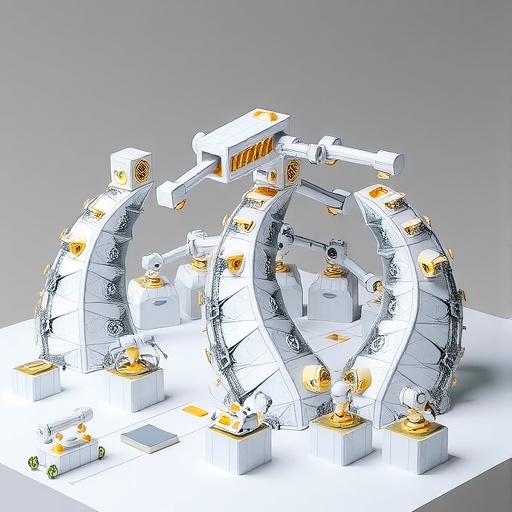
Researchers have recently introduced a groundbreaking class of robots known as “metabots,” which are innovative creations crafted from thin sheets of material. What sets these metabots apart is their ability to morph into hundreds of stable shapes, allowing them to perform a diverse array of functions without the need for motors. This unique characteristic enables these robots to operate effectively while being composed of a single, flat material, resembling animated sheets of plastic.
This new form of robotics challenges the traditional paradigms by demonstrating that mechanical action does not necessarily rely on intricate motor systems. Instead, these metabots leverage the physical properties of specially designed polymer sheets, which are engineered to snap into various configurations. Each configuration allows the robot to execute different actions, broadening the scope of tasks these devices can undertake in practical applications.
At the heart of this innovative technology is Jie Yin, a professor of mechanical and aerospace engineering at North Carolina State University and the corresponding author of a recent study. Yin explains that the process begins with simple polymer sheets that have holes punched into them. By applying thin films to the surface of these polymer sheets, researchers introduce materials that react to electric currents or magnetic fields. This application transforms the sheets into actuators that can change shape remotely, which is a significant leap in the field of soft robotics.
The flexibility of these metabots is further enhanced by their construction, which allows multiple sheets to be combined. When four sheets are interconnected, the resulting metabot can lie perfectly flat like a sheet of paper yet possess the capability to bend and transform into 256 different stable forms. This versatility could revolutionize how robots interact with their surroundings and carry out designated tasks.
The research team has found that these metabots are not limited to mere aesthetic changes; they display various modes of locomotion. Capable of jumping or crawling, these robots can adjust their speed and movement patterns depending on the terrain. This adaptability marks a significant evolution in robotic design, emphasizing not just the importance of functionality, but also flexibility in movement that mirrors natural organisms.
In addition to basic movement, the research explores more sophisticated functionalities. As Zhou, the first author of the paper and a Ph.D. student, explains, the robots’ ability to alter their shape and gait enables them to navigate diverse terrains and execute multiple functions such as gripping and lifting objects. The integration of piezoelectric materials into the thin films further enhances control over the metabots, allowing for precise vibrations that can be modulated by varying voltage and frequency.
This capability introduces an unprecedented degree of control over movement; for instance, a metabot can be programmed to rotate in place while maintaining its position, an essential feature for operations that require delicate manipulation. This development offers exciting prospects for various industries, including healthcare, logistics, and search-and-rescue operations, where such robots could provide unparalleled assistance.
An important aspect of the research highlights the importance of cost-effectiveness. Yin emphasizes that this technology is not only promising in terms of functionality but also economically viable. The simplicity of the materials used could pave the way for widespread adoption of these metabots across numerous applications, from manufacturing to consumer goods. The research represents an important step toward merging metamaterials and robotics, suggesting that the cross-disciplinary approach can yield innovative solutions to complex challenges.
The results of this pioneering work are particularly timely as the need for advanced yet economically feasible robotics solutions becomes more pressing in our rapidly evolving technological landscape. The team’s commitment to exploring the full potential of these metabots signifies a significant advancement in robotic technology, setting the stage for future innovation.
This research breakthrough has been documented in the paper entitled “Multistable thin-shell metastructures for multiresponsive reconfigurable metabots,” set to be published in the renowned journal Science Advances. The upcoming publication will provide more comprehensive insights into the methodologies and experimental frameworks employed by the researchers, offering a deeper understanding of how these metabots function and their future applications.
In conclusion, the emergence of these metabots not only marks progress in the field of robotics but also symbolizes a shift toward designing more responsive and adaptive machines. As research continues, the potential for developing robots that can intuitively respond to their environments opens new avenues for exploration and innovation in engineering and technology. The implications of this work are wide-ranging, and as the field evolves, it invites further inquiry into how we can harness such technologies for the betterment of society.
Keywords
Robotics, Metabots, Polymer Sheets, Soft Robotics, Morphing Structures, Piezoelectric Materials, Automation, Adaptability, Engineering Innovation, Cost-effective Robotics, Multistable Structures, Responsive Design.
Cite Scienmag News
Denise Maddox. (October 15, 2025). Metabots Transform from Flat Sheets into a Multitude of Structures. Scienmag. https://scienmag.com/metabots-transform-from-flat-sheets-into-a-multitude-of-structures/
Denise Maddox. "Metabots Transform from Flat Sheets into a Multitude of Structures." Scienmag, 15 October 2025, https://scienmag.com/metabots-transform-from-flat-sheets-into-a-multitude-of-structures/. Accessed 3 September 2026.
Denise Maddox. "Metabots Transform from Flat Sheets into a Multitude of Structures." Scienmag. October 15, 2025. https://scienmag.com/metabots-transform-from-flat-sheets-into-a-multitude-of-structures/


