


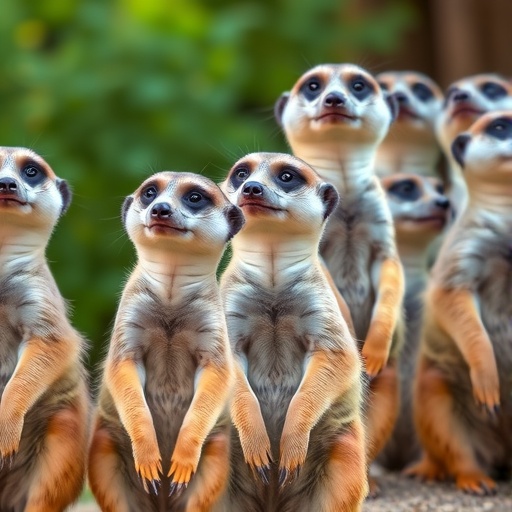
In a groundbreaking study published in the Journal of Animal Ecology, researchers have unveiled the profound impact of social interactions on the health and survival of meerkats in their harsh desert environment, attributing this largely to the sharing and composition of beneficial gut bacteria within social groups. This investigation sheds new light on the microbiome’s role in animal ecology, emphasizing social living as a critical component influencing microbial diversity more strongly than age, sex, or even genetics. The findings bring a fresh perspective to understanding how social behaviors may be integral to maintaining health and resilience in wild animal populations.
This research was led by Dr. Krishna Balasubramaniam of Anglia Ruskin University, who together with his team conducted an extensive analysis of over 500 fecal samples collected from 146 wild meerkats across eight distinct social groups at the Kalahari Research Centre in South Africa. By employing genomic sequencing techniques, the team identified 119 distinct bacterial taxa, revealing that each meerkat’s microbiome composition is predominantly shaped by its social group affiliation rather than by individual or environmental factors. These results underscore the pivotal role that sociality plays in the horizontal transmission of microbes among individuals.
Microbiomes, complex communities of microorganisms residing in the gut, are known to confer numerous health benefits, including enhancing immunity, influencing behavior, and improving overall physiological fitness. Meerkats, which inhabit rugged and arid landscapes, survive in environments where maintaining a robust microbiome might represent an adaptive advantage. The social structures of meerkat mobs or clans facilitate frequent physical contact and communal activities such as grooming, enabling the exchange and homogenization of beneficial bacterial communities, which may fortify their ability to withstand ecological stressors.
One of the most striking discoveries of this study is the extent to which social group membership overshadows genetic relatedness in determining microbiome similarity among meerkats. While inherited microbes from parents certainly contribute to microbial inheritance, the research highlights that bacterial sharing through social contact—termed “horizontal transmission”—has a far greater influence. This challenges prior assumptions about the predominance of vertical inheritance and confirms that the social environment is a dynamic and powerful force shaping microbial ecosystems within wild mammal populations.
Moreover, the study revealed remarkable plasticity in the gut microbiome of individuals who migrated between groups. Newcomer meerkats rapidly adopted the microbial community characteristic of their new social group, indicating a shared “core” microbiome unique to each clan. Such rapid adjustment suggests that social integration extends beyond behavioral assimilation and includes microbiological restructuring, which may be crucial to maintaining group cohesion and individual health in fluctuating environmental conditions.
The research team also identified stable co-occurrence networks—complex, interdependent assemblages of bacterial species—that persist within individual hosts. These microbial networks likely play a vital role in maintaining gut homeostasis and protecting the host against pathogens, especially in environments prone to drought and disease outbreaks. Maintaining these microbial consortia through social behavior might therefore be essential for the meerkats’ adaptive success in the unforgiving Kalahari desert.
Dr. Balasubramaniam stated, “Our findings demonstrate that the communal lifestyle of meerkats significantly influences their gut microbiome, surpassing other factors previously thought to be dominant. This underscores the health benefits of social living, which extends beyond traditional advantages such as predation avoidance and cooperative rearing.” He further noted how the intersection of sociality and microbial ecology provides a fertile ground for future exploration into the evolutionary benefits that microbiome sharing might confer to animal populations.
This study contributes increasingly to the understanding that animal social behavior cannot be fully appreciated without considering the microbiomes of individuals within social groups. By elucidating how social dynamics influence the assembly and maintenance of gut microbial communities, the research adds a new dimension to ecological and evolutionary biology. It posits that the transmission and sharing of microbes might be an underappreciated but crucial factor in the survival strategies of social animals.
The collaborative project included contributions from experts at Ulm University’s Institute of Evolutionary Ecology and Conservation Genomics, and benefited from long-term ecological observations at the Kalahari Research Centre. These interdisciplinary efforts, combining field biology with cutting-edge molecular techniques, have provided unprecedented insight into the microbiome as a component of sociality and survival in wild vertebrates.
Beyond meerkats, these findings provoke broader questions about the role of social microbiomes in other species, particularly those inhabiting extreme or variable environments. The emerging concept that microbial sharing through social behavior can enhance population resilience suggests new avenues for conservation biology, where managing social structures might improve species’ health and adaptation.
In conclusion, the study redefines social living in mammals as not merely a behavioral or ecological trait but as an intricate, microbiologically mediated phenomenon that confers substantial adaptive advantages. These revelations deepen our understanding of how sociality shapes evolutionary trajectories by integrating microbiome science, behavioral ecology, and health ecology, positioning microbial sharing as a vital component in the sustainability and resilience of animal populations.
News Publication Date: Not specified.
Web References:
DOI link to article
Cite Scienmag News
Morgan Morrow. (October 30, 2025). Meerkats Gain Health Benefits Through Group Membership. Scienmag. https://scienmag.com/meerkats-gain-health-benefits-through-group-membership/
Morgan Morrow. "Meerkats Gain Health Benefits Through Group Membership." Scienmag, 30 October 2025, https://scienmag.com/meerkats-gain-health-benefits-through-group-membership/. Accessed 4 September 2026.
Morgan Morrow. "Meerkats Gain Health Benefits Through Group Membership." Scienmag. October 30, 2025. https://scienmag.com/meerkats-gain-health-benefits-through-group-membership/


