


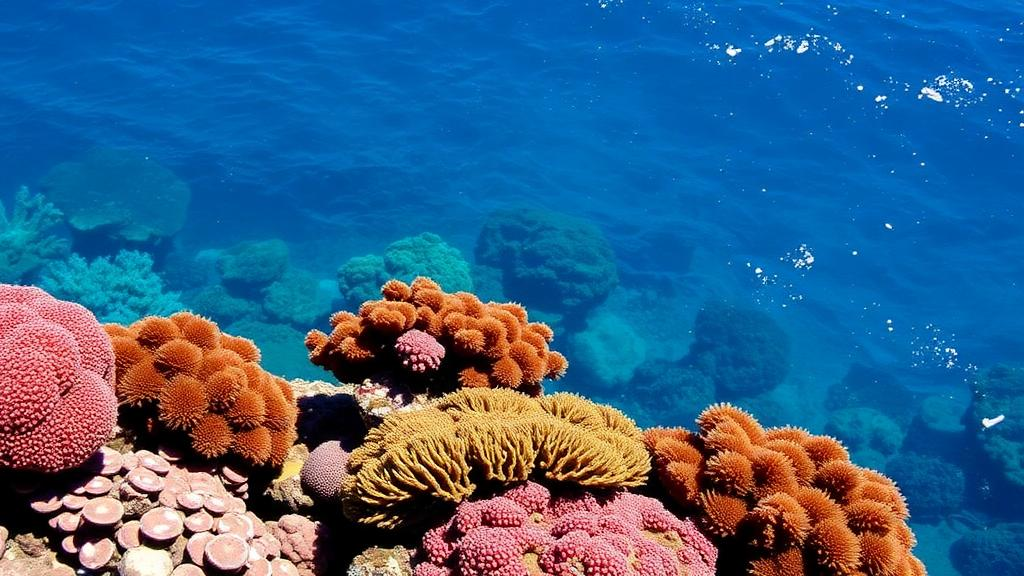
The Mediterranean Sea has been warming steadily for decades, and its southern reaches now bask in temperatures that would look perfectly familiar to a coral growing on a reef in Bermuda or southern Japan. More than a thousand species have already slipped into the basin from warmer waters, including at least a hundred tropical fish and a pair of Red Sea soft corals. And yet, despite this apparent tropicalization, not a single true coral reef has taken hold anywhere in the sea. A new open-access review published in the journal Coral Reefs tackles this paradox head-on, and its answer is a story of ancient geological catastrophe, unlucky ocean plumbing, muddy river plumes, and the relentless physics of winter light.
The research team, led by Andrea Grottoli of The Ohio State University together with colleagues from Sorbonne Université, Arizona State University’s Bermuda Institute of Ocean Sciences, and the Stazione Zoologica Anton Dohrn, set out to test a long-standing hypothesis: that environmental conditions in the Mediterranean are simply too variable or too limited for reef-building corals to re-establish. To do this, they compiled seawater temperature, salinity, pH, alkalinity, chlorophyll, and photosynthetically available radiation, or PAR, from 22 tropical and subtropical reef sites around the world and compared them with 10 Mediterranean sites. The reef sites were deliberately chosen to span the full range of environments where reef-building corals thrive today, from mangroves and seagrass beds to volcanic vents, tide pools, upwelling zones, and high-latitude reefs.
The historical backdrop is essential to understanding the mystery. Reef-building, symbiotic corals flourished across the Mediterranean region until the late Miocene, between roughly 11.65 and 5.33 million years ago, building reefs that included Acropora species whose relatives still live in the Caribbean today. Then the region’s fortunes collapsed in stages. Around 13 million years ago, the open marine seaway connecting the Mediterranean to Middle Eastern seas through the Tethys closed, cutting off the westward supply of tropical coral larvae. At the same time, tectonic drift pushed the Mediterranean northward out of the subtropics, cooling its waters. The final blow came with the Messinian Salinity Crisis about 5.95 million years ago, when the basin nearly dried out and eliminated virtually all remaining reef-building corals.
Two survivors linger as relics of that lost world. The endangered Cladocora caespitosa is the only potential reef-builder left in the basin, and it still forms substantial carbonate banks at the Columbretes Islands in the western Mediterranean and in Croatia’s Mljet National Park in the Adriatic, making it a living link to the Miocene reefs. Oculina patagonica persists at low densities throughout much of the sea. Both species tolerate seawater temperatures as low as 10 degrees Celsius, and O. patagonica has actually shifted into deeper, cooler waters as the surface has warmed. A single Indo-Pacific coral, Oulastrea crispata, was documented once in 2012, but none of these hardy stragglers has managed to build anything resembling a tropical reef.
The new analysis produced a strikingly split verdict. Using nonparametric multivariate statistics, including multidimensional scaling and analysis of similarity, the researchers found that the environmental conditions of the southern Mediterranean are statistically indistinguishable from those of high-latitude coral reef sites such as Bermuda and Japan. Even the carbonate chemistry works in the corals’ favor: the Mediterranean’s high alkalinity and pH keep seawater strongly supersaturated with aragonite, the calcium carbonate mineral corals use to build their skeletons, with saturation states of 3.0 to 3.8 in the western basin and 3.6 to 4.2 in the eastern basin. In an era when ocean acidification is eroding reef-building capacity elsewhere, the Mediterranean’s chemistry would actively encourage coral calcification. Chemistry, in other words, is not the culprit.
If the southern sea is habitable, why have no reef corals arrived? The team examined four possible introduction pathways. From the Atlantic through the Strait of Gibraltar, the prevailing currents are cool, nutrient-rich extensions of the North Atlantic Current, and notably, the subtropical Azores, which sit directly in their path, host no reef-building corals at all. The Canary Islands do have tropical corals but lie too far south to serve as a natural larval source. The Suez Canal, opened in 1869, offers the most direct route from the Red Sea, yet only two soft coral species have completed the crossing. The canal’s flow dynamics may be the bottleneck: north of the hypersaline Great Bitter Lake, which averages a salinity of 41, water flows southward in summer, precisely when Red Sea corals spawn in spring, pushing larvae away from the Mediterranean rather than toward it.
Intriguingly, the authors argue that the salinity barrier itself may not be insurmountable. Red Sea corals routinely live at salinities of 38 to 41 and have been found at 45; the coral Fungia granulosa tolerates up to 50 for nearly a month, and Acropora and Stylophora pistillata showed no significant physiological harm at 44 in a week-long experiment. Modeling suggests a Red Sea to Mediterranean transit takes 11 to 39 days, well within the 40-to-70-day larval competency documented for many Australian corals. The seasonal timing of canal flow, rather than the brine of the Bitter Lakes, appears to be the decisive obstacle, though hitchhiking on ship hulls, rafting on debris, or aquarium cast-offs remain possible routes for future introductions.
Even if larvae did arrive in the southeastern Mediterranean, they might find the real estate wanting. Coral larvae need clean, hard substrate to settle on, but the major southern Mediterranean currents sweep past the Nile outflow, dragging a sediment plume along the Israeli coast and into the Levantine basin. High sedimentation blankets suitable surfaces and smothers settling larvae, and archaeological evidence suggests extreme sedimentation buried Cladocora corals in Israel’s Haifa Bay more than 2,000 years ago. Oceanographic fronts within the basin would then trap any newly established populations in the Levantine Sea, preventing them from spreading westward.
The northern Mediterranean faces a more fundamental constraint: winter. The analysis showed that northern sites are distinguished from all tropical and subtropical reef sites by cooler mean monthly maximum and minimum temperatures and lower surface PAR, the light that fuels the photosynthetic symbionts living inside coral tissue. Many northern sites sit at or above 40 degrees north latitude, and geological research has shown that even during past warm climates, reduced winter light intensity and day length stopped reef corals from expanding poleward beyond that line, regardless of how warm the water was. Sustained cool winters, possibly combined with winter light levels at the low end of what high-latitude reefs experience, make large tropical-style reef development in the north extremely unlikely, even under continued warming.
The net picture is one of a sea that is almost, but not quite, ready for reefs. In the south, the water chemistry, temperature, and light are all suitable, yet the delivery of coral larvae is throttled by canal hydrodynamics and their settlement is compromised by Nile sediment. In the north, the environment itself remains the barrier. The authors conclude that reef-building corals may yet establish populations in parts of the southern Mediterranean over time, whether through the Suez Canal, shipping, or the aquarium trade, but that dim winter light and long cool seasons will probably prevent the northern Mediterranean from tropicalizing with coral reefs in the near future. For now, the Mediterranean’s only reef-builder remains a small, endangered relic of a vanished Miocene world, waiting for conditions, and arrivals, that have not yet aligned.
Subject of Research: Environmental and historical factors limiting reef-building coral establishment in the Mediterranean Sea
Article Title: Why are coral reefs not found in the Mediterranean today?
Article References: Grottoli, A. G., Carbonne, C., Teixidó, N., Comeau, S., Smith, A., & Gattuso, J.-P. (2026). Why are coral reefs not found in the Mediterranean today?. Coral Reefs. https://doi.org/10.1007/s00338-026-02971-3
Image Credits: AI Generated
DOI: 10.1007/s00338-026-02971-3
Keywords: coral reefs, Mediterranean Sea, reef-building corals, Messinian Salinity Crisis, Suez Canal, photosynthetically available radiation, aragonite saturation, Cladocora caespitosa, species introductions, sedimentation, ocean warming, larval dispersal
Cite Scienmag News
Violet Maxwell. (October 1, 2026). Mediterranean Waters Are Warm Enough for Coral Reefs, So Why Are There None? Scienmag. https://scienmag.com/mediterranean-waters-are-warm-enough-for-coral-reefs-so-why-are-there-none/
Violet Maxwell. "Mediterranean Waters Are Warm Enough for Coral Reefs, So Why Are There None?" Scienmag, 1 October 2026, https://scienmag.com/mediterranean-waters-are-warm-enough-for-coral-reefs-so-why-are-there-none/. Accessed 5 October 2026.
Violet Maxwell. "Mediterranean Waters Are Warm Enough for Coral Reefs, So Why Are There None?" Scienmag. October 1, 2026. https://scienmag.com/mediterranean-waters-are-warm-enough-for-coral-reefs-so-why-are-there-none/


