


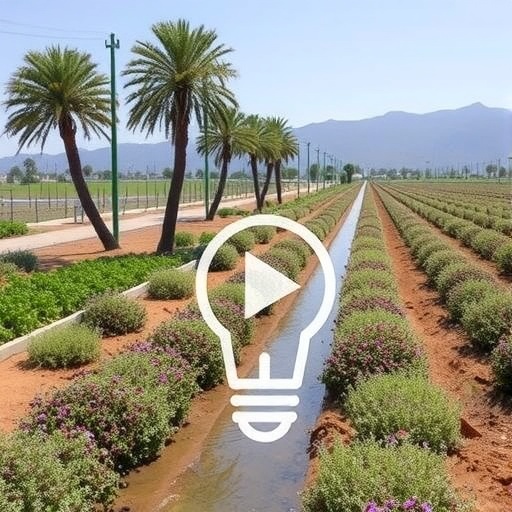
A new study in Scientific Reports is placing an urgent question at the center of Mediterranean agriculture: when freshwater supplies are under pressure, how safely can treated wastewater be reused for irrigation? The research, led by A. Yalles-Satha, L. Bennacer, M. Guettaf and colleagues, examines irrigation water quality in a Mediterranean semi-arid basin through three connected lenses—hydrochemistry, microbiology and metal contamination. The work addresses a problem becoming increasingly visible across drought-prone regions: water reuse can protect agriculture from shortages, but only if its chemical and biological risks are understood together rather than assessed in isolation.
Semi-arid basins are especially vulnerable because they combine limited rainfall, high evaporation and intense demand from farming, cities and industry. In such environments, irrigation water does more than supply crops. It also determines how salts move through soil, how easily plants can absorb water, whether groundwater quality deteriorates and whether contaminants accumulate over time. A source that appears adequate in volume may still be unsuitable for repeated agricultural use. The study’s integrated approach reflects this reality, treating water quality as a multidimensional issue rather than reducing it to a single measurement such as salinity or acidity.
The hydrochemical component is critical because dissolved ions can influence both crops and soil structure. Salinity, commonly associated with elevated concentrations of sodium, chloride and other dissolved salts, can make it harder for plant roots to extract water. Even when soil appears moist, high osmotic pressure can create physiological drought, slowing growth and reducing yields. Sodium presents an additional threat because it can displace calcium and magnesium on soil particles, weakening aggregation and reducing permeability. Over time, poorly managed irrigation water may transform productive land into compacted, poorly drained soil. A detailed chemical assessment can therefore reveal risks that are invisible at the point of application.
Hydrochemical analysis also helps distinguish between different sources and behaviors of contamination. The balance of major ions can indicate whether water has been influenced by natural mineral dissolution, agricultural return flows, urban discharge or mixing with groundwater. Parameters such as electrical conductivity, total dissolved solids, pH, alkalinity and ionic composition are often used to evaluate whether water is likely to cause salinity, sodicity or scaling problems. These indicators matter not only for crops but also for irrigation infrastructure. Calcium carbonate precipitation, for example, can clog pipes and drip emitters, while corrosive water may damage equipment. An integrated assessment connects these chemical signals to real consequences in fields and water-delivery systems.
The microbiological dimension brings a different kind of concern. Wastewater can contain bacteria, viruses, protozoa and other microorganisms originating from human or animal waste. Treatment processes can reduce these hazards, but performance may vary according to the treatment technology, operating conditions and the quality of the incoming sewage. If contaminated water reaches crops eaten raw, pathogens may move from irrigation systems to soil, plant surfaces, farm workers and consumers. The danger is not necessarily visible through taste, color or odor, which makes microbiological monitoring essential. Chemical clarity cannot guarantee biological safety, and water that looks clean may still carry infectious organisms.
Wastewater reuse also raises questions about how treatment quality should be matched to agricultural practice. Water used on fruit trees or crops that undergo cooking may present a different exposure pathway from water applied directly to leafy vegetables consumed raw. The timing of irrigation, the method of application and the interval between watering and harvest can all influence risk. Drip irrigation, for instance, may reduce direct contact between water and edible plant surfaces compared with overhead spraying, although it does not eliminate concerns about soil, groundwater or worker exposure. By placing microbiological hazards alongside chemical indicators, the study highlights why reuse policies must be designed around actual pathways of exposure.
The third major concern is metal contamination. Trace metals can enter aquatic systems through natural geological processes, urban runoff, industrial activity, fertilizers, pesticides and wastewater discharges. Elements such as lead, cadmium, chromium, nickel and copper may be present at low concentrations yet still deserve attention because some can persist in soil or accumulate in plants. Their behavior depends on factors including pH, organic matter, clay content and the chemical form in which each element occurs. A metal locked into an insoluble mineral may be less mobile than the same element dissolved in water. Consequently, measuring concentrations in irrigation water is important, but understanding how those metals interact with soil and crops is equally significant.
Long-term accumulation is one of the central reasons wastewater reuse requires careful oversight. Unlike many microbial contaminants, which may decline under unfavorable environmental conditions, metals do not break down into harmless substances. Repeated irrigation can gradually increase their concentration in agricultural soils, potentially affecting soil organisms, crop productivity and food safety. Plants may absorb some metals more readily than others, and uptake can vary between species and plant tissues. An integrated framework can help identify situations in which water meets a short-term quality threshold but creates a cumulative risk after years of application. This perspective is particularly relevant in semi-arid regions, where evaporation concentrates dissolved substances and opportunities for flushing salts and metals from soil are limited.
The significance of the research extends beyond one Mediterranean basin. Around the world, water scarcity is pushing governments and farmers to consider treated wastewater as a dependable source for agriculture. Reuse can reduce pressure on rivers and aquifers, support food production during drought and make urban water systems more circular. Yet poorly evaluated reuse can transfer pollution from one part of the water cycle to another. The study’s central message is therefore highly transferable: irrigation decisions should be based on combined evidence from water chemistry, microbial safety and contaminant exposure, supported by knowledge of local soils, crops, treatment systems and groundwater conditions.
By bringing these dimensions together, Yalles-Satha, Bennacer, Guettaf and their colleagues contribute to a more realistic definition of “safe” irrigation water. Safety is not a single number, and it cannot be established by testing only one contaminant group. It is a dynamic judgment that depends on how water is treated, where it is used, how frequently it is applied and what happens after it enters the agricultural environment. As climate change intensifies drought and increases competition for freshwater, the ability to reuse water without compromising soils, crops, ecosystems or public health may become one of the defining challenges of modern agriculture. The study offers a timely scientific framework for confronting that challenge in the Mediterranean and beyond.
Cite Scienmag News
Alan Morgan. (August 13, 2026). Mediterranean Basin Study Assesses Irrigation Water Quality and Wastewater Reuse Risks. Scienmag. https://scienmag.com/mediterranean-basin-study-assesses-irrigation-water-quality-and-wastewater-reuse-risks/
Alan Morgan. "Mediterranean Basin Study Assesses Irrigation Water Quality and Wastewater Reuse Risks." Scienmag, 13 August 2026, https://scienmag.com/mediterranean-basin-study-assesses-irrigation-water-quality-and-wastewater-reuse-risks/. Accessed 4 September 2026.
Alan Morgan. "Mediterranean Basin Study Assesses Irrigation Water Quality and Wastewater Reuse Risks." Scienmag. August 13, 2026. https://scienmag.com/mediterranean-basin-study-assesses-irrigation-water-quality-and-wastewater-reuse-risks/


