


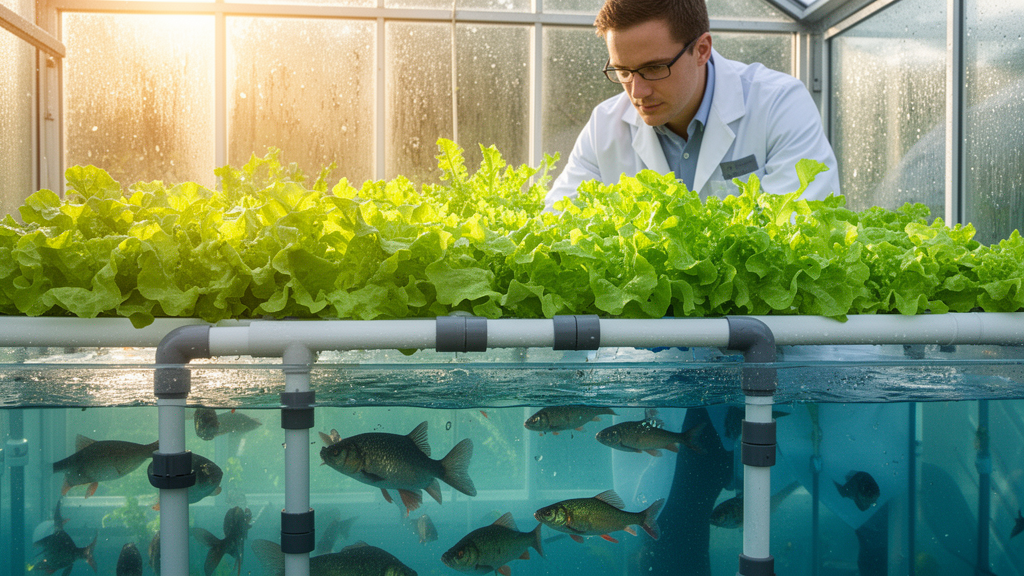
What fish eat could change what your salad is worth. A new study from researchers at the University of Nevada, Reno and York College of Pennsylvania reports that wastewater from tilapia fed a diet in which half of the fishmeal was replaced with mealworm larvae meal produced lettuce that was taller, heavier, greener, and richer in protective pigments than lettuce fed with conventional fish-derived nutrients. The findings, published in Frontiers in Horticulture, suggest that the composition of aquaculture feed ripples all the way through a closed-loop farming system, ending up in the size and nutritional quality of the crops it fertilizes.
Aquaponics and its decoupled cousins are built on a simple premise: fish excrete nitrogen, phosphorus, potassium, and micronutrients derived from their feed and metabolism, and those dissolved nutrients can replace synthetic fertilizers in hydroponic plant production. Rather than discharging nutrient-laden effluent into waterways, where it risks driving eutrophication and algal blooms, growers recycle it. The approach sits squarely within the circular bioeconomy, a framework that treats waste streams from one sector as raw materials for another, cutting both fertilizer costs and environmental damage while conserving water.
But there is a hidden variable in this loop: the feed itself. Conventional aquafeeds rely heavily on fishmeal, a finite marine resource whose production strains wild fish stocks. Insect-derived proteins such as black soldier fly larvae (Hermetia illucens) and mealworm larvae (Tenebrio molitor) have emerged as promising substitutes, and are already approved in many markets for aquaculture. What has been less clear is whether swapping insect meal for fishmeal changes the nutrient profile of the wastewater the fish produce, and whether those changes flow downstream to affect crops.
To find out, the team raised blue tilapia (Oreochromis aureus) on three diets with closely matched protein, fat, fiber, and energy content: a conventional formula with 10 percent fishmeal, one in which half the fishmeal was replaced with black soldier fly larvae meal, and one in which half was replaced with mealworm larvae meal. Wastewater from each fish group was then used, alongside a commercial hydroponic nutrient solution as a control, to grow Romaine lettuce (Lactuca sativa) in deep-water culture. Because the wastewater already carried a substantial nutrient load, the researchers supplemented it with only a half-strength Hoagland solution and held pH at 5.8 and electrical conductivity at 1.85 mS per centimeter throughout the five-week growing period.
The growing conditions were tightly controlled: a growth room at 21 degrees Celsius with a 16-hour photoperiod, a photosynthetic photon flux density of roughly 200 micromoles per square meter per second, and 65 percent relative humidity. Seedlings were germinated in Rockwool cubes under white fluorescent light and transplanted once they reached 4 to 6 centimeters. After five weeks, the plants were harvested and measured for height, leaf number, leaf area, fresh and dry biomass, chlorophyll fluorescence, photosynthetic pigments, and antioxidant capacity using the DPPH radical-scavenging assay.
The results favored the mealworm treatment decisively. Lettuce grown with wastewater from the mealworm-fed fish reached an average height of 15.6 centimeters and a fresh weight of about 38.4 grams, more than double the 10.7 centimeters and 14.3 grams of the control plants, with the greatest leaf area and leaf counts of any treatment. Pigment analysis told a parallel story: total chlorophyll climbed to roughly 875 micrograms per gram of fresh tissue in the mealworm treatment, well above the fishmeal and control groups, indicating enhanced photosynthetic capacity. Chlorophyll fluorescence values, a measure of the maximum quantum efficiency of photosystem II, remained consistent across all treatments, suggesting the plants were healthy rather than stressed.
Black soldier fly larvae wastewater told a different but equally interesting story. While those plants also outperformed the fishmeal-fed group in biomass, the treatment was most strongly associated with carotenoid accumulation, posting the highest total carotenoid content alongside elevated antioxidant scavenging activity compared with the control. Principal component analysis made the divergence explicit: the mealworm treatment clustered tightly with growth parameters including plant height, leaf area, biomass, and chlorophyll content, whereas the black soldier fly treatment aligned with carotenoid traits, and the conventional fishmeal treatment occupied an intermediate position.
Why would insect feed change the plants? The authors point to several plausible mechanisms. Insect meals differ from fishmeal in their mineral composition and digestibility, which can alter what fish excrete and thus what nutrients dissolve into the water. Insect-derived ingredients also contain bioactive compounds such as chitin and chitosan derivatives, which may stimulate microbial communities involved in nutrient transformation within aquaculture systems, indirectly influencing the availability of nitrogen, magnesium, and micronutrients that plants need to synthesize chlorophyll. Enhanced nutrient availability, in turn, drives greater photosynthetic efficiency and biomass accumulation, while secondary metabolite biosynthesis, including phenolics and carotenoids, may account for the observed boost in antioxidant activity.
The broader implications reach beyond one greenhouse experiment. Fishmeal production is a major environmental pressure point for the aquaculture industry, which has expanded rapidly to meet global protein demand. If replacing half of that fishmeal with insect protein can simultaneously sustain fish health, improve wastewater quality, and raise both the yield and the nutritional quality of vegetables grown in aquaponic loops, then feed formulation becomes a management tool not just for fish farmers but for horticulturists as well. The study reframes aquaponics as a system where a dietary decision made at the fish tank propagates through nutrient recycling to the harvest on the plate.
Caveats remain. The researchers note that the precise mechanisms are not yet understood, and they call for future work to characterize the nutrient composition of the different wastewaters, including nitrate, ammonium, phosphorus, and micronutrient levels, along with the microbial community dynamics associated with each diet. Testing different substitution levels beyond the 50 percent used here will be needed to identify inclusion rates that maximize both fish performance and crop productivity. Still, the message is striking enough: in the circular farms of the near future, the path to a better salad may begin with what the fish had for dinner.
Subject of Research: Effects of insect-based fish feed wastewater on hydroponic lettuce growth and phytochemical content in decoupled aquaponic systems
Article Title: Effect of insect-based fish feed wastewater on lettuce growth and phytochemical content in decoupled aquaponic systems
Article References: Naznin, M. T., & Nolan, J. (2026). Effect of insect-based fish feed wastewater on lettuce growth and phytochemical content in decoupled aquaponic systems. Frontiers in Horticulture, 5, Article 1934474. https://doi.org/10.3389/fhort.2026.1934474
Image Credits: AI Generated
DOI: 10.3389/fhort.2026.1934474
Keywords: aquaponics, hydroponics, mealworm larvae, black soldier fly, tilapia, lettuce, fishmeal replacement, chlorophyll, carotenoids, antioxidants, circular bioeconomy, sustainable aquaculture
Cite Scienmag News
Alan Morgan. (October 16, 2026). Mealworm Fish Feed Wastewater Boosts Lettuce Growth and Antioxidants in Aquaponics. Scienmag. https://scienmag.com/mealworm-fish-feed-wastewater-boosts-lettuce-growth-and-antioxidants-in-aquaponics/
Alan Morgan. "Mealworm Fish Feed Wastewater Boosts Lettuce Growth and Antioxidants in Aquaponics." Scienmag, 16 October 2026, https://scienmag.com/mealworm-fish-feed-wastewater-boosts-lettuce-growth-and-antioxidants-in-aquaponics/. Accessed 16 October 2026.
Alan Morgan. "Mealworm Fish Feed Wastewater Boosts Lettuce Growth and Antioxidants in Aquaponics." Scienmag. October 16, 2026. https://scienmag.com/mealworm-fish-feed-wastewater-boosts-lettuce-growth-and-antioxidants-in-aquaponics/


