


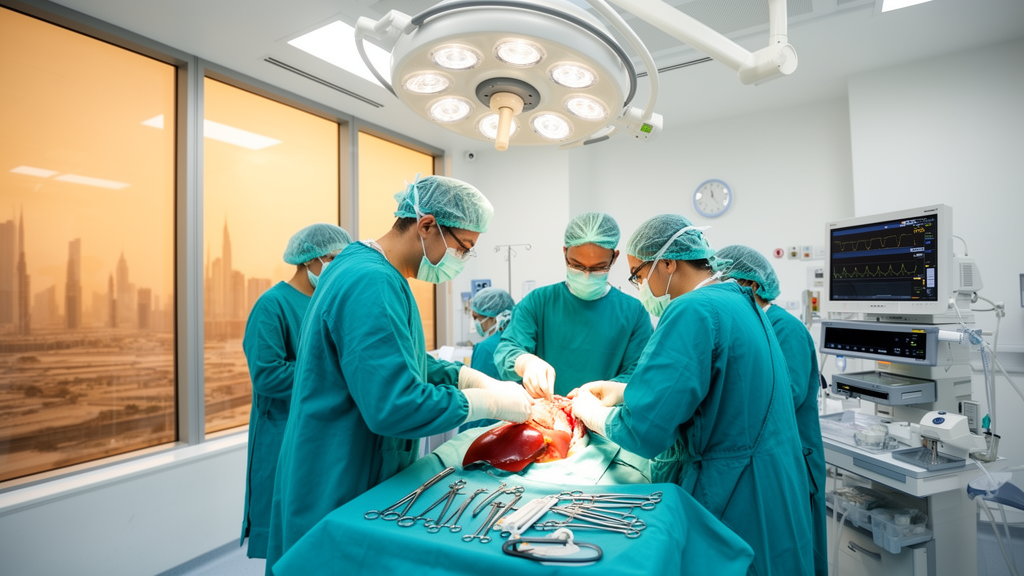
Seven years ago, a patient in the United Arab Emirates with acute liver failure had one realistic option: board a plane. Today, the country performs more liver transplants per capita than most nations in its region, and its deceased organ donation rate has climbed more than tenfold in six years. A new interim report published in Transplant International, led by transplant surgeon Shiva Kumar of Cleveland Clinic Abu Dhabi, dissects how a federation of seven emirates with no pre-existing transplant infrastructure engineered one of the fastest organ donation growth trajectories ever recorded, reaching 11.56 deceased donors per million population in 2024.
The legal foundation was laid in 2016, when UAE Federal Law No. 5 formally recognized brain death, followed by a 2017 ministerial decree from the Ministry of Health and Prevention that clarified the legal definition of death by neurologic criteria. That two-step legislative sequence mattered enormously. Before it, ambiguity over brain death had kept most Gulf countries dependent on living donor transplants or medical tourism, with patients traveling to Europe, North America, or the Kingdom of Saudi Arabia for surgery. Once the definition was codified, the first deceased donor liver transplant in the UAE followed in February 2018, and the first living donor liver transplant in July of the same year.
To evaluate what worked, the authors applied a conceptual framework proposed by Johnston-Webber and colleagues in 2023, which assesses national donation programs across four domains: governance, financing, service provision, and information systems. Their analysis of UAE policy documents, annual reports, and registry data from 2017 to 2024 suggested two extensions to the framework. The first is healthcare workforce trust, treated as an independent enabler rather than an afterthought. The second is international collaboration, elevated to a full fifth domain. In the UAE experience, both proved decisive.
The workforce argument deserves particular attention. Physicians, nurses, and donation coordinators are the people who stand in front of grieving families when the question of organ donation arises. If they do not trust the system, the system stalls. The UAE invested heavily in structured training, including education on the unified global criteria for brain death established by the World Brain Death Project published in JAMA in 2020. Given the diversity of training backgrounds among clinicians in the country, harmonizing diagnostic practice was essential. Collaborative quality assurance programs modeled on high-performing donation systems in the United States and Europe added key performance measures to track donor identification, consent rates, and donor optimization.
Structurally, the pivotal moment came in September 2020 with the creation of the National Center for Regulating Donation and Transplantation of Human Organs and Tissues within the health ministry. The center played a deliberate dual role in its early years, functioning simultaneously as regulator and as the operational arm running the national organ procurement organization. That integration built trust, unified protocols across the hospital network, and provided medicolegal support throughout the donation pathway. The NCDT now maintains donor and waitlist registries, oversees donor eligibility and serologic testing, manages allocation, and tracks performance measures. Organ donation and critical care support units embedded in the country’s largest hospitals identify and manage potential brain-dead donors around the clock.
Notably, the UAE achieved this without the conventional policy levers many countries rely on. There is no opt-out system, and donor registration is not linked to driver licensing. Instead, the program prioritized a health system-centric strategy: embedding donation into routine clinical practice, standardizing national procedures, and cultivating leadership engagement at institutional and governmental levels. Public-facing initiatives, including the national Hayat pledge program, are now being scaled to sustain long-term awareness. The lesson, the authors argue, is that organizational effectiveness and clinical integration can compensate for the absence of large-scale registry infrastructure, at least in a system’s formative years.
Donor evaluation posed a distinctive challenge. Roughly 85 percent of UAE residents are expatriates drawn from regions where tuberculosis, dengue, and malaria are endemic, and complete medical histories are often unavailable for recently arrived or transient populations. The program responded with a three-tier assessment model: comprehensive initial evaluation at the donor hospital, organ-specific risk assessment, and a repeat panel of laboratory and serological tests at the organ recovery center before transplantation. Detailed interviews with relatives supplement the laboratory data. The protocols align with the Council of Europe’s EDQM guide to the quality and safety of organs for transplantation, now in its ninth edition.
The results are striking. Between February 2018 and the end of 2024, the UAE performed 376 liver transplants, 34 of them from living donors. Cleveland Clinic Abu Dhabi, the nation’s only multi-organ thoracic and abdominal transplant center, accounted for 337 of these, including 27 simultaneous liver-kidney transplants. One-year graft and patient survival at CCAD stand at 93 percent and 94.6 percent respectively. The number of organs transplanted per deceased donor reached 3.2 in 2023, reflecting young donor demographics, careful donor management, and policies that keep viable organs from being discarded. Recipients span 34 nationalities, and donors or recipients represent more than 53 nationalities, mirroring a resident population drawn from over 200 countries.
The boldest innovation, however, is regional. In December 2021, the UAE and Kuwait launched a bilateral organ sharing arrangement built on reciprocity. Kuwait, which ranks second in the Middle East Gulf region with 11.16 deceased donors per million in 2024, had established deceased donation in 1996 but historically sent liver candidates abroad. Under the agreement, recipients in both countries share a common waitlist maintained by the NCDT, prioritized by a MELD-based allocation policy modeled on the United Network for Organ Sharing. Through December 2024, 77 livers and 10 kidneys procured in Kuwait were recovered under the arrangement, and 88 patients from Kuwait received transplants at CCAD, 13 of them simultaneous liver-kidney cases. One-year allograft survival among Kuwaiti recipients reached 95.5 percent, with patient survival of 97.8 percent. Making this work required negotiating bilateral regulatory frameworks and operational workflows spanning immigration authorities, law enforcement, and diplomatic missions in both countries.
The model aligns with the 77th World Health Assembly resolution of June 2024, which called for structured, ethical international cooperation to address organ shortages, and with the Declaration of Istanbul’s principles on equitable cross-border allocation. The authors argue that regional self-sufficiency, rather than national self-sufficiency, is the more realistic goal for low-donation settings, citing European precedents such as the FOEDUS-EOEO cross-border exchange platform. Looking forward, the program faces the growing burden of metabolic dysfunction-associated steatotic liver disease, the primary driver of transplant demand in the region, alongside challenges of insurance coverage and reimbursement reform. A federal mandate now requires all insurance policies to cover transplantation, and a draft proposal would legalize donation after circulatory death, supported by machine perfusion technology to extend graft quality. If the UAE’s first seven years are any guide, the next seven may redefine what emerging transplant systems elsewhere in the region can achieve.
,
Subject of Research: Growth of liver transplantation in the United Arab Emirates: lessons from the national deceased organ donation program and international collaboration
Article Title: Growth of liver transplantation in the United Arab Emirates: lessons from the national deceased organ donation program and international collaboration
Article References: Kumar, S., Al Obaidli, A., Gomez, M., Al Mousawi, M., Iuppa, G., & Campos, L. (2026). Growth of liver transplantation in the United Arab Emirates: lessons from the national deceased organ donation program and international collaboration. Transplant International, 39, Article 16160. https://doi.org/10.3389/ti.2026.16160
Image Credits: AI Generated
Keywords: Growth, liver, transplantation, United, Arab, Emirates, lessons, national, deceased, organ, donation, program
Cite Scienmag News
Drew Townsend. (October 16, 2026). How the UAE Built a Liver Transplant Powerhouse in Just Seven Years. Scienmag. https://scienmag.com/how-the-uae-built-a-liver-transplant-powerhouse-in-just-seven-years/
Drew Townsend. "How the UAE Built a Liver Transplant Powerhouse in Just Seven Years." Scienmag, 16 October 2026, https://scienmag.com/how-the-uae-built-a-liver-transplant-powerhouse-in-just-seven-years/. Accessed 16 October 2026.
Drew Townsend. "How the UAE Built a Liver Transplant Powerhouse in Just Seven Years." Scienmag. October 16, 2026. https://scienmag.com/how-the-uae-built-a-liver-transplant-powerhouse-in-just-seven-years/


