

Friday, October 23, 2026
Science
No Result
View All Result
  • Login
  • HOME
  • SCIENCE NEWS
  • CONTACT US
  • HOME
  • SCIENCE NEWS
  • CONTACT US
No Result
View All Result
Scienmag
No Result
View All Result
Home Science News Space

Mathematicians Prove Symmetry and Stability in Five-Body Coorbital Configurations

October 23, 2026
in Space
Grant Pearson
By Grant Pearson Scienmag Editorial Profile - Observational Astronomy
Reading Time: 2 mins read
0
Mathematicians Prove Symmetry and Stability in Five-Body Coorbital Configurations

Mathematicians Prove Symmetry and Stability in Five-Body Coorbital Configurations

65
SHARES
587
VIEWS
Share on FacebookShare on Twitter
ADVERTISEMENT

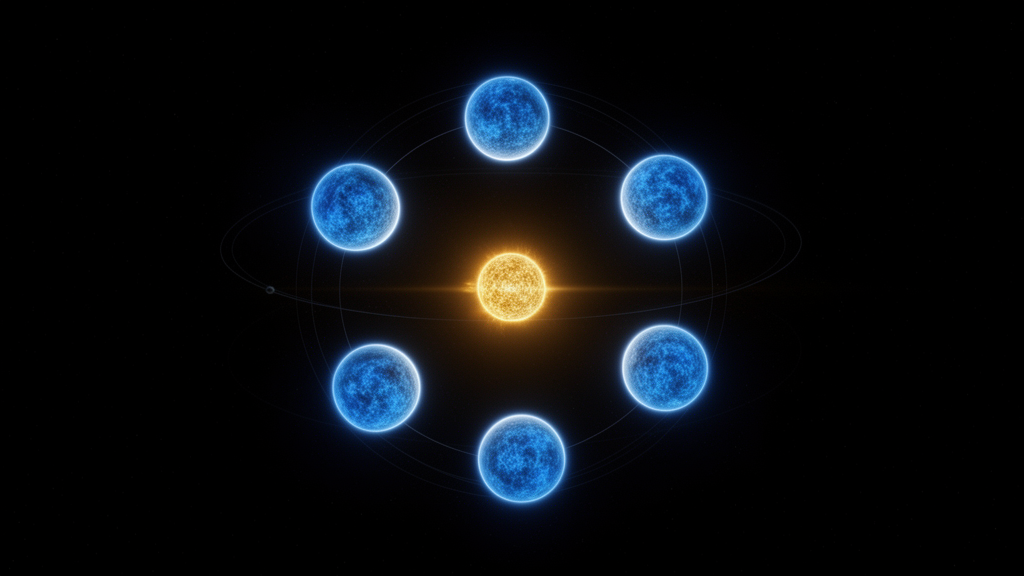
Mathematicians Jiangtao Xu and Yiyang Deng have established that a special class of five-body orbital arrangements must be symmetric, in a study published in Celestial Mechanics and Dynamical Astronomy. The work concerns the planar 1+4-body problem, in which a single massive central body is orbited by four bodies whose masses tend to zero, making them effectively coorbital around the dominant mass. For the convex case, where all five bodies form a convex polygon, the researchers analyzed configurations governed by a homogeneous potential with exponent greater than one.

They proved that when the masses satisfy the symmetric conditions m1 = m4 greater than zero and m2 = m3 greater than zero, any convex coorbital central configuration must possess an axis of symmetry. Beyond the symmetry result, the authors also proved a linear stability statement: under some constraints, the symmetric convex coorbital central configuration with m1 = m4 and m2 = m3 is linearly stable. The findings apply to the mathematical model in which the four smaller masses tend to zero, so they describe a limiting regime rather than a specific planetary system.

The results are proved for the homogeneous potential setting with exponent greater than one, and the stability guarantee holds only under the stated constraints rather than for all symmetric convex configurations.

Subject of Research: Symmetry and linear stability of convex 1+4 coorbital central configurations in the planar five-body problem with homogeneous potential

Article Title: The symmetry of convex 1 + 4 coorbital problem central configurations with homogeneous potential

Article References: Xu, J., & Deng, Y. (2026). The symmetry of convex 1 + 4 coorbital problem central configurations with homogeneous potential. Celestial Mechanics and Dynamical Astronomy, 138(6), 63. https://doi.org/10.1007/s10569-026-10338-7

Image Credits: AI Generated

DOI: 10.1007/s10569-026-10338-7

Keywords: celestial mechanics, central configurations, coorbital problem, five-body problem, relative equilibria, homogeneous potential, linear stability, symmetry, mathematical physics, orbital dynamics, convex, coorbital

Cite Scienmag News

Grant Pearson. (October 23, 2026). Mathematicians Prove Symmetry and Stability in Five-Body Coorbital Configurations. Scienmag. https://scienmag.com/mathematicians-prove-symmetry-and-stability-in-five-body-coorbital-configurations/


Grant Pearson. "Mathematicians Prove Symmetry and Stability in Five-Body Coorbital Configurations." Scienmag, 23 October 2026, https://scienmag.com/mathematicians-prove-symmetry-and-stability-in-five-body-coorbital-configurations/. Accessed 23 October 2026.

Grant Pearson. "Mathematicians Prove Symmetry and Stability in Five-Body Coorbital Configurations." Scienmag. October 23, 2026. https://scienmag.com/mathematicians-prove-symmetry-and-stability-in-five-body-coorbital-configurations/

Tags: celestial mechanicscelestial mechanics research on convex planetary systemscentral configurationsconvexconvex coorbital configuration stabilitycoorbitalcoorbital problemcoorbital stability analysis with zero-mass bodiesFive-body orbital symmetryfive-body problemhomogeneous potentialhomogeneous potential gravitational modelslimit regimes in multi-body gravitational dynamicslinear stabilitylinear stability of coorbital arrangementsmathematical physicsmathematical proof of orbital symmetryorbital dynamicsplanar 1+4-body problem in celestial mechanicsrelative equilibriastability conditions in five-body coorbital configurationssymmetric mass distribution in multi-body systemssymmetrysymmetry constraints in five-body orbital solutions
Share26Tweet16
Previous Post

Rare tau gene variant reshapes brain cell transcriptomes in Alzheimer’s and PSP

Next Post

Adaptive Questionnaire Scheduling Could Lighten the Load of Real-Time Mood Monitoring

Related Posts

Deep Learning Reads Active Region Shape to Forecast Solar Flares
Space

Deep Learning Reads Active Region Shape to Forecast Solar Flares

October 23, 2026
Model of Radioactive Background Sharpens Solar Orbiter’s X-Ray View of Weak Flares
Space

Model of Radioactive Background Sharpens Solar Orbiter’s X-Ray View of Weak Flares

October 23, 2026
A self-shadowing black hole accretion disk at sub-Eddington luminosities
Space

A self-shadowing black hole accretion disk at sub-Eddington luminosities

October 22, 2026
Modeled Lunar Free Oscillations Remain Below TianQin Noise Requirement
Space

Modeled Lunar Free Oscillations Remain Below TianQin Noise Requirement

October 22, 2026
QCD sum rules sharpen Bc decay constants and form-factor bounds
Space

QCD sum rules sharpen Bc decay constants and form-factor bounds

October 22, 2026
Quasar survey finds statistical evidence of recoiling supermassive black holes
Space

Quasar survey finds statistical evidence of recoiling supermassive black holes

October 22, 2026
Next Post
Adaptive Questionnaire Scheduling Could Lighten the Load of Real-Time Mood Monitoring

Adaptive Questionnaire Scheduling Could Lighten the Load of Real-Time Mood Monitoring

  • Mothers who receive childcare support from maternal grandparents show more optimized

    Mothers who receive childcare support from maternal grandparents show more parental warmth, finds NTU Singapore study

    27656 shares
    Share 11059 Tweet 6912
  • University of Seville Breaks 120-Year-Old Mystery, Revises a Key Einstein Concept

    1061 shares
    Share 424 Tweet 265
  • Bee body mass, pathogens and local climate influence heat tolerance

    682 shares
    Share 273 Tweet 171
  • Researchers record first-ever images and data of a shark experiencing a boat strike

    546 shares
    Share 218 Tweet 137
  • Groundbreaking Clinical Trial Reveals Lubiprostone Enhances Kidney Function

    531 shares
    Share 212 Tweet 133
Science

Embark on a thrilling journey of discovery with Scienmag.com—your ultimate source for cutting-edge breakthroughs. Immerse yourself in a world where curiosity knows no limits and tomorrow’s possibilities become today’s reality!

RECENT NEWS

  • Century-old archived tissue samples still yield measurable human DNA
  • Family Physicians Feel Underprepared for Cancer Care Roles, Survey Finds
  • Navy grant funds study of how ocean variability shapes long-range sound travel
  • Eight Weeks of Scratch Coding Failed to Boost Eighth Graders’ Problem-Solving Scores

Categories

  • Agriculture
  • Anthropology
  • Archaeology
  • Athmospheric
  • Biology
  • Biotechnology
  • Blog
  • Bussines
  • Cancer
  • Chemistry
  • Climate
  • Earth Science
  • Editorial Policy
  • Marine
  • Mathematics
  • Medicine
  • Pediatry
  • Policy
  • Psychology & Psychiatry
  • Science Education
  • Science News
  • Social Science
  • Space
  • Technology and Engineering

Subscribe to Blog via Email

Enter your email address to subscribe to this blog and receive notifications of new posts by email.

Join 5,151 other subscribers

© 2025 Scienmag - Science Magazine

Welcome Back!

Login to your account below

Forgotten Password?

Retrieve your password

Please enter your username or email address to reset your password.

Log In
No Result
View All Result
  • HOME
  • SCIENCE NEWS
  • CONTACT US

© 2025 Scienmag - Science Magazine

Discover more from Science

Subscribe now to keep reading and get access to the full archive.

Continue reading