


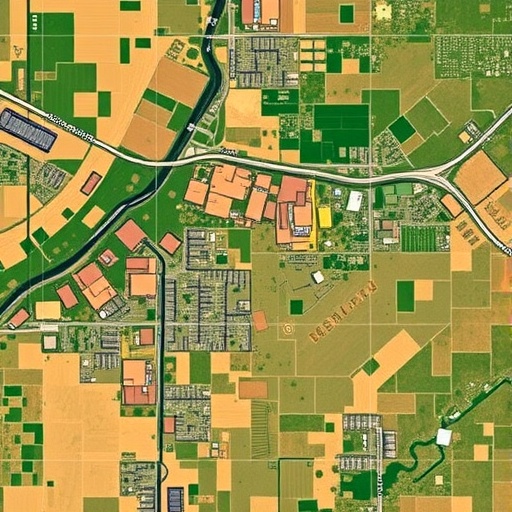
In a groundbreaking study poised to revolutionize the way we understand rural economies, researchers have leveraged satellite imagery to map marketplaces and monitor their activity with unprecedented frequency and detail. This innovative approach underscores the power of combining advanced remote sensing technologies with sophisticated data analytics, opening new horizons for economic monitoring in remote and underserved regions.
Rural marketplaces, often the lifeblood of local economies and community interaction, have historically been challenging to monitor continuously. Traditional methods such as surveys or on-ground data collection are labor-intensive, costly, and prone to delays, hampering timely decision-making. The advent of high-resolution satellite imagery, coupled with the development of machine learning algorithms, has now enabled researchers to overcome these obstacles by offering a scalable, real-time window into marketplace dynamics.
At the core of this research lies the utilization of high-frequency satellite data that capture images of rural marketplaces multiple times per week. This temporal resolution is critical because marketplaces are characterized by dynamic patterns of activity — fluctuating based on harvest seasons, market days, and socio-political events. Static or low-frequency observations previously limited understanding of these patterns. The new methodology, however, allows for the continuous tracking of marketplace vibrancy, vendor presence, and crowd size over time.
The technical backbone of this system involves employing convolutional neural networks (CNNs), an advanced form of deep learning architecture, trained to recognize and classify features specific to rural marketplaces. These models distinguish market stalls, congregations of people, and vehicular movement from other landscape elements like fields, roads, or scattered dwellings. Training the model required assembling a large, diverse dataset of labeled satellite images, capturing marketplaces under varying conditions such as weather variability, time of day, and seasonal changes.
One of the significant challenges addressed by the research team was the heterogeneity of rural marketplaces across different geographic regions. Variations in market size, layout, and structure demanded a highly adaptable model capable of generalizing beyond its training set. To tackle this, the researchers adopted transfer learning techniques, allowing their trained CNNs to fine-tune parameters as they were exposed to new marketplace images from diverse locations worldwide.
Beyond the obvious benefit of marketplace identification, the study explores how changes in marketplace activity serve as proxies for broader socio-economic indicators. For instance, increased vendor turnout and higher foot traffic may correlate with economic recovery after periods of hardship, while declines might signal disruptions caused by natural disasters or conflict. By quantifying these fluctuations accurately, policymakers and humanitarian agencies can tailor their interventions with data-driven precision.
Moreover, this satellite-based approach to economic monitoring offers a non-intrusive means of data collection that respects the privacy and social nuances of rural communities. Unlike surveys, which can sometimes influence local behavior or face resistance, remote sensing accumulates actionable insights without requiring direct contact or consent, thereby reducing potential biases.
Integrating these remote sensing data with ancillary datasets, such as weather patterns and transportation networks, enriches the contextual interpretation of marketplace dynamics. For example, understanding how rainfall patterns affect marketplace activity could inform agricultural planning and supply chain logistics. Similarly, mapping accessibility and connectivity helps elucidate why certain marketplaces thrive while others languish.
Data latency, a common limitation in satellite monitoring, has been mitigated by leveraging emerging constellations of small satellites operating in low Earth orbit. These platforms provide frequent revisit times and high-resolution imagery, enabling near-real-time updates on marketplace status. The convergence of these technological advances enhances the temporal granularity and spatial fidelity critical for effective rural economic analysis.
The implications of this study extend far beyond academic curiosity. By developing a scalable, automated system to monitor rural marketplaces, the research team has created a tool with potent applications for governments, NGOs, and international development agencies. This capability supports targeted economic development programs, rapid assessment during crises, and continuous evaluation of intervention outcomes over time.
Furthermore, as rural economies evolve in the face of urbanization and globalization, tracking marketplaces’ vitality through satellite imagery offers a novel lens on community resilience and adaptation. Detecting subtle shifts in activity patterns reveals how populations respond to policy changes, market forces, or environmental stressors — knowledge vital for sustainable development.
Importantly, the team has emphasized the democratization of this research by making their analytical tools open-source and encouraging collaborative improvements. By fostering a community around the technology, they aim to accelerate innovation and ensure broad accessibility, especially for stakeholders in low-resource settings who stand to benefit most from these insights.
While this research represents a significant leap forward, the authors acknowledge challenges remain. Satellite data costs, cloud cover interference, and the ongoing need for high-quality labeled datasets persist as obstacles to seamless implementation. However, ongoing advancements in satellite technologies and artificial intelligence promise to continually improve data quality and processing capabilities.
In conclusion, by harnessing the power of satellite imagery and machine learning to monitor rural marketplaces at an unprecedented frequency, this study has laid a crucial foundation for transforming how we observe and respond to economic activity in remote areas. The fusion of high-resolution, frequent imaging with cutting-edge analytical models is setting a new standard for data-driven socio-economic insights, holding immense potential for accelerating global efforts toward inclusive development and poverty alleviation.
As this technology matures, it is poised to become an indispensable instrument in the toolkit of policymakers and practitioners aiming to ensure that no rural community remains invisible or unheard in the global dialogue on economic progress. The future of rural economic monitoring looks bright, illuminated from above by the eyes in the sky capturing the pulse of marketplaces and, by extension, the heartbeat of rural livelihoods.
Cite Scienmag News
Denise Maddox. (May 9, 2026). Mapping Rural Marketplaces with High-Frequency Satellite Imagery. Scienmag. https://scienmag.com/mapping-rural-marketplaces-with-high-frequency-satellite-imagery/
Denise Maddox. "Mapping Rural Marketplaces with High-Frequency Satellite Imagery." Scienmag, 9 May 2026, https://scienmag.com/mapping-rural-marketplaces-with-high-frequency-satellite-imagery/. Accessed 4 September 2026.
Denise Maddox. "Mapping Rural Marketplaces with High-Frequency Satellite Imagery." Scienmag. May 9, 2026. https://scienmag.com/mapping-rural-marketplaces-with-high-frequency-satellite-imagery/


