


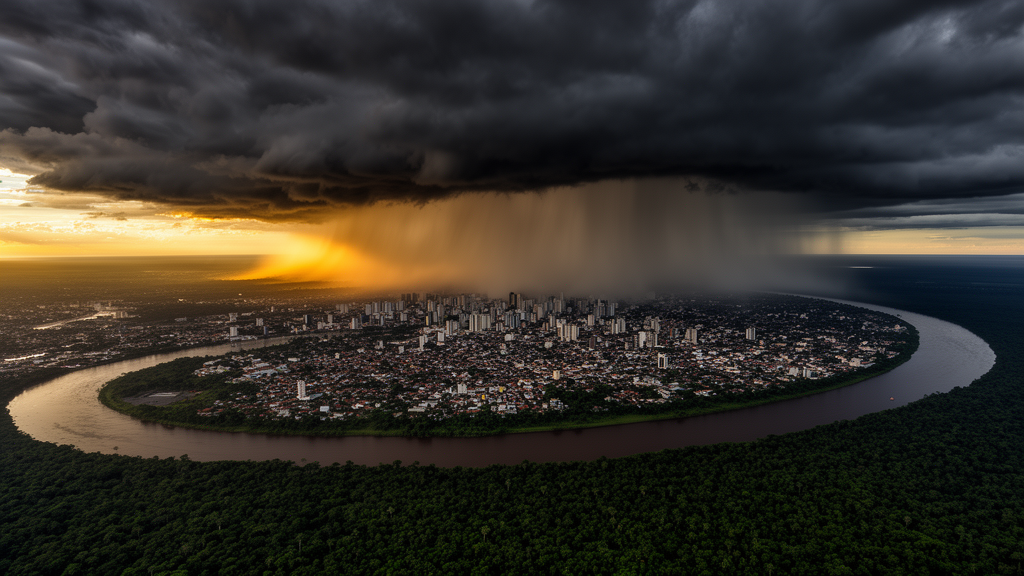
In the heart of the Amazon rainforest, a city of more than two million people may be quietly rewriting its own weather. A new study of Manaus, the largest metropolis in the Amazon basin, suggests that the urban surface itself acts as a powerful amplifier of extreme rainfall, intensifying the very storms that threaten the city with flooding and landslides. The research, published in Theoretical and Applied Climatology, is among the first to move beyond isolated case studies and quantify how a tropical city surrounded by forest and rivers systematically changes the character of its most dangerous downpours.
Scientists led by Carla de Souza Farias of Brazil’s National Institute for Amazonian Research set out to answer a deceptively simple question: does the mere presence of a city in the central Amazon induce more extreme precipitation? Previous work on Manaus had examined single storm events, leaving open whether the urban effect was a one-off curiosity or a robust, repeatable pattern. To settle the matter, the team assembled a decade of observations from 2010 to 2020 and identified 45 extreme precipitation events that appeared in two independent datasets: the IMERG satellite rainfall product and the ERA5 atmospheric reanalysis produced by the European Centre for Medium-Range Weather Forecasts.
The screening was deliberately strict. Of the roughly 177 extreme events flagged by IMERG and 176 by ERA5, only 45 were coincident in both products. This filtering matters because satellite grids and reanalyses often disagree on the exact timing and location of localized convective storms in the Amazon, and the researchers wanted simulations initialized with physically consistent conditions. Extreme days were defined as those exceeding the 97.5th percentile of daily rainfall, and the events clustered in the rainy season from November to May, with February and June showing the highest monthly counts.
For each of the 45 events, the team ran paired simulations with the Weather Research and Forecasting model, or WRF, coupled to the Single Layer Urban Canopy Model. In the urban experiment, Manaus was represented with three district classes: industrial and commercial zones, low-intensity residential areas, and high-intensity residential neighborhoods, with parameters tuned using local street widths, roof dimensions, and census-based population density. In the control experiment, the entire urban footprint was replaced with forest. Ninety simulations in total, each 60 hours long, allowed the researchers to compare the same storms over the same 427 square kilometers with and without the city.
The verdict was striking. In 65 percent of the events, total accumulated rainfall was higher with the city present, and in the urban center the average increase reached 16.8 percent. Hourly rainfall intensity told an even sharper story: about 79.2 percent of hourly values in the urban run exceeded those of the forested control, and the maximum hourly precipitation intensity rose by up to 50 percent. The urban scenario also produced longer-lived storms, with the 90th percentile of event duration reaching 19 hours compared with 16.6 hours without the city, suggesting that urban forcing helps sustain convection once it begins.
The mechanism unfolds in three linked steps. First, the city heats up. Asphalt, concrete, and other high-thermal-inertia materials raised the simulated surface temperature by as much as 2.9 degrees Celsius at midday relative to the forested scenario, with air temperature at two meters rising by about 0.6 to 0.7 degrees Celsius. This warming acts as a thermal trigger: the anomalous surface heating peaks around noon, and the largest precipitation intensification follows in the afternoon between 14:00 and 17:00 local time, exactly the window in which the urban heat island of Manaus has been observed to peak in field measurements.
Second, the heated boundary layer drives the atmosphere upward. The researchers found a statistically significant positive correlation between the precipitation difference and vertical wind speed at the 800 hectopascal level, in the middle troposphere, with a correlation coefficient of 0.39 and a p-value of 0.008. Stronger updrafts over the city lift warm, unstable air toward the level where deep convective clouds form. Third, and perhaps most surprising given the setting, the city imports its own moisture. Although near-surface humidity was actually lower over the urban area than over the forest, because trees pump water into the air through evapotranspiration, specific humidity at 800 hectopascals showed a significant positive correlation with the precipitation increase. The interpretation is that urban heating and the rough, friction-generating canopy converge moist air laterally from the surrounding forest and rivers, drawing it into the urban core where it fuels towering convective cells.
The spatial fingerprint of this process is unmistakable. When the domain was divided into nine geographic sectors, the central quadrant coinciding with the urban area recorded the highest accumulated rainfall, 1,136.1 millimeters across the 45 events, and captured the maximum in 11 cases, or 24.4 percent of the total. The southwest sector followed with 1,101.3 millimeters and nine events, consistent with the prevailing northeast-to-southwest flow that advects storms initiated over the city downwind. In the forested control run, by contrast, the precipitation maxima shifted to the peripheral southeast and east sectors, and the central sector dropped to 972.6 millimeters with only five winning cases. In effect, the city traps and concentrates rainfall that would otherwise be distributed over forest and rivers.
The findings place Manaus within a growing global picture. A 2024 analysis of more than 1,000 cities found that over 60 percent of urban areas act as so-called urban wet islands, where precipitation exceeds that of surrounding rural areas, a phenomenon that has roughly doubled in magnitude over the past two decades. Yet the Amazonian case is distinctive because of its setting: the city sits between the Negro and Solimões rivers, embedded in an atmosphere so humid that near-surface specific humidity exceeds 18 grams per kilogram even during extremes. That abundance of moisture means the urban heat island does not dry out storms, as it can in arid cities such as Phoenix, but instead supercharges them, converting a modest thermal anomaly into a deep convective engine fed by the surrounding rainforest.
The practical implications are sobering. Manaus already suffers recurring flash floods and landslides, aggravated by rapid and often unplanned growth on highly impermeable ground. If urbanization reliably intensifies the heaviest rainfall by double-digit percentages, then the city’s own expansion is compounding its flood risk at precisely the moment climate change is loading the atmosphere with more water vapor. The authors note that their controlled experiments deliberately excluded anthropogenic heat emissions and urban aerosols, both of which could add further complexity, and they call for multi-layer canopy models and coupled chemistry simulations in future work. For now, the message for Amazonian cities is clear: as the forest gives way to pavement, the storms above it grow heavier, and the water that falls has nowhere to go but the streets.
Subject of Research: Urbanization effects on extreme precipitation in the central Amazon city of Manaus
Article Title: Does the urban presence of a city in the central Amazon induce more extreme precipitation?
Article References: de Souza Farias, C., Candido, L. A., de Melo Monte, M. J., Buscioli Capistrano, V., Andreoli, R. V., Holanda Hall, D., de Jesus Machado, J., & Quaresmas Dias-Júnior, C. (2026). Does the urban presence of a city in the central Amazon induce more extreme precipitation?. Theoretical and Applied Climatology, 157(11), Article 722. https://doi.org/10.1007/s00704-026-06646-5
Image Credits: AI Generated
DOI: 10.1007/s00704-026-06646-5
Keywords: Manaus, Amazon, extreme precipitation, urban heat island, WRF model, convection, urbanization, flooding, tropical meteorology, moisture convergence, land-use change, climate modeling
Cite Scienmag News
Violet Maxwell. (October 16, 2026). Manaus Is Making Its Own Storms: Amazon City Supercharges Extreme Rainfall. Scienmag. https://scienmag.com/manaus-is-making-its-own-storms-amazon-city-supercharges-extreme-rainfall/
Violet Maxwell. "Manaus Is Making Its Own Storms: Amazon City Supercharges Extreme Rainfall." Scienmag, 16 October 2026, https://scienmag.com/manaus-is-making-its-own-storms-amazon-city-supercharges-extreme-rainfall/. Accessed 16 October 2026.
Violet Maxwell. "Manaus Is Making Its Own Storms: Amazon City Supercharges Extreme Rainfall." Scienmag. October 16, 2026. https://scienmag.com/manaus-is-making-its-own-storms-amazon-city-supercharges-extreme-rainfall/


