


Radium-226 is one of the most persistent radioactive legacies of mining. Produced continuously by the decay of uranium-238, it carries a half-life of 1,600 years and a specific activity of 3.7 × 10^10 becquerels per gram, and it can leach from uranium mill tailings or slip through treatment systems into rivers and lakes. Because radium behaves chemically like calcium, aquatic organisms can mistake it for an essential nutrient and incorporate it into their tissues, which makes understanding how much dissolved radium actually stays in the water a question of real ecological consequence. A new laboratory study published in Frontiers in Environmental Chemistry now shows that the fate of this radionuclide in sandy freshwater environments hinges on something deceptively mundane: the microscopic clay minerals hiding between grains of quartz sand, and the amount of calcium dissolved in the water.
The research, led by C. L. Proulx of the University of Ottawa and CanmetMINING of Natural Resources Canada, began with a puzzle from earlier toxicity experiments. When freshwater fingernail clams, Sphaerium striatinum, were exposed to radium-226 in beakers containing a sand substrate and algal food, dissolved radium activity concentrations dropped by roughly 90 percent between water renewals every 48 hours. The clams burrowed in the sand and fed on algae, so the loss could have come from uptake by the animals, adsorption onto mineral grains, binding to organic matter, or some combination of all three. The team designed a tiered set of experiments to disentangle these possibilities, deliberately excluding the clams so that the chemistry of the substrate and the water could be examined on its own.
The experimental design was meticulous. The researchers prepared reconstituted soft water at four calcium levels, 0.9, 7, 35, and 70 milligrams per litre, spanning conditions found in freshwaters both with and without metal-mining effluent, and dosed each with radium-226 at nominal activities of 1, 5, and 50 becquerels per litre. They then ran three tiers of treatments: solution only, solution plus sand, and solution plus sand plus a mixture of algal cells representing organic matter. Across four calcium experiments and three radium levels, with three replicates each, 108 test vessels were monitored over 48 hours, with dissolved radium measured by alpha spectrometry at seven time points. Water quality stayed stable throughout, with temperatures between 21 and 22 degrees Celsius, high dissolved oxygen, and circumneutral pH, ensuring that any changes in radium concentration reflected adsorption rather than shifting chemistry.
The first striking result was what did not happen. In the solution-only treatments, dissolved radium remained completely stable across all calcium and radium combinations for the full 48 hours. Calcium alone, in other words, does not affect radium solubility or speciation. Geochemical modelling with PHREEQC confirmed this picture: roughly 70 percent of dissolved radium existed as the free divalent cation Ra2+, with about 20 percent as RaHCO3+ and 6 percent as RaSO4, and this distribution barely changed across the entire range of tested conditions. Modelling with the Windemere Humic Acid Model likewise predicted negligible interaction, less than 0.001 percent, between radium and dissolved humic or fulvic acids. Whatever removed radium from solution, it was not precipitation or organic complexation in the water column itself.
Adding sand changed everything. In the low-calcium treatments, dissolved radium plummeted, with 46 percent removed within the first hour at 0.9 milligrams per litre calcium and 25 percent within the first hour at 7 milligrams per litre. By 48 hours, removal reached 83 percent under the lowest calcium conditions and up to 86 percent across the full experiment depending on radium and calcium levels. Statistical comparison against the solution-only controls confirmed the effect was highly significant, with the sand increasing radium removal by a median of 38.4 percent across matched conditions. But the effect weakened dramatically as calcium rose: at 35 milligrams per litre, only 61 percent was removed by 48 hours, and at 70 milligrams per litre, just 58 percent. The pattern pointed squarely at competition, with abundant Ca2+ ions muscling Ra2+ off the limited binding sites on mineral surfaces.
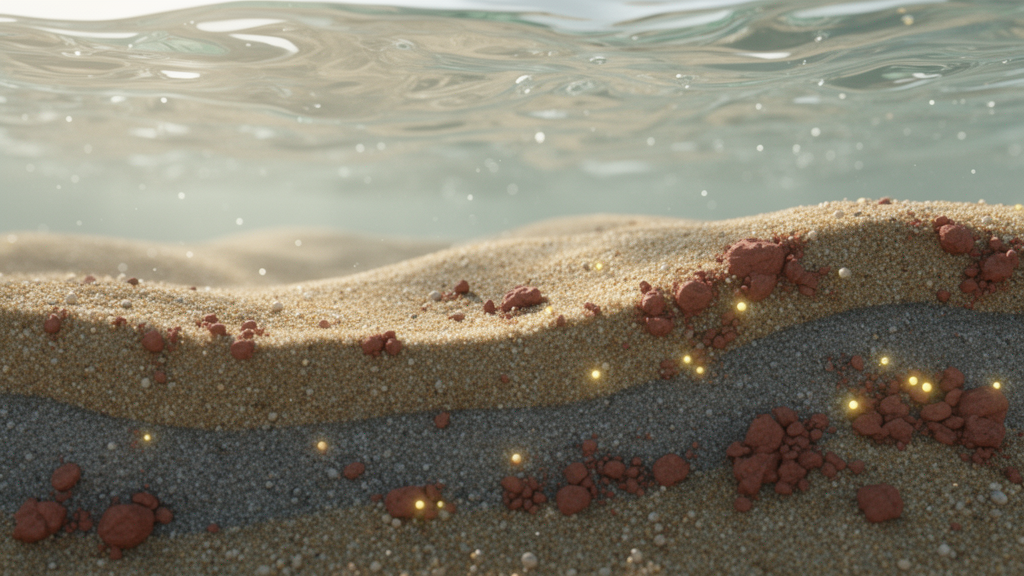
To identify which minerals were doing the binding, the team characterized the aquarium sand under a field-emission scanning electron microscope. The sand was overwhelmingly quartz, with a mean grain size of 219 micrometres, but crucially, its grains were pitted and fractured, and those microfractures were filled with an aluminosilicate clay. Energy-dispersive X-ray analysis identified it as kaolinite, a low-cation clay with high aluminum and little potassium or magnesium. There were no significant iron or manganese oxide coatings, which are otherwise important radium sorbents, only trace ilmenite grains. This mineralogical fingerprint guided the decisive follow-up: batch sorption experiments comparing pure quartz against pure kaolinite under the same conditions.
The contrast between the two minerals was stark. Kaolinite stripped more than 90 percent of dissolved radium from solution within just 6 hours, averaging 96 percent removal plus or minus 2 percent, with distribution coefficients between 49 and 62 litres per kilogram. Quartz, by contrast, barely adsorbed any radium at all: removal averaged only 10 percent plus or minus 9 percent at 48 hours, with distribution coefficients between 0 and 0.55 litres per kilogram, roughly a hundredfold weaker than the clay. Geochemical models echoed the experiments. A cation exchange model for kaolinite predicted about 95 percent of radium would partition onto exchange sites, matching the observed 95 to 98 percent removal almost perfectly, while a surface complexation model for quartz overpredicted sorption at around 27 percent but still correctly ranked it far below the clay. The message was unambiguous: a small amount of reactive clay tucked into an otherwise inert quartz sand can dominate the entire partitioning behaviour of radium in the system.
Organic matter, surprisingly, played only a supporting role. Adding algal cells to the sand treatments produced a small but statistically consistent extra removal of about 6 percent, significant across matched conditions but trivial next to the mineral effects. This fits with radium’s chemistry: its large ionic radius, low tendency to hydrolyze, and preference for inorganic exchange sites mean it does not form strong bonds with the carboxyl and phenolic groups that bind transition metals in organic matter. The authors note a broader ecological wrinkle, however. In natural sediments rich in organic matter, microbial activity can create reducing conditions that dissolve iron oxides and radium-bearing barite, indirectly releasing radium back into the water, so organic matter may matter more as a redox driver than as a direct sorbent.
The calcium story carried its own subtlety. Distribution coefficients and sorption rate constants both responded non-linearly to calcium, generally declining as calcium rose, with the clearest inhibition at the lowest radium loading. Yet the total mass of radium sorbed to the solid phase did not change significantly with calcium, suggesting calcium primarily shifted the balance between dissolved and adsorbed radium rather than the overall capacity of the substrate. Even more puzzling, sorption kinetics slowed sharply at 35 milligrams per litre calcium but partially recovered at 70 milligrams per litre, possibly because higher ionic strength compresses the electrical double layer around mineral surfaces and speeds ion transport, even as competition ultimately caps the extent of adsorption. The authors flag this non-linear kinetic response as an open question warranting further study.
The practical implications reach well beyond the laboratory. Sandy sediments laced with reactive clays will sequester dissolved radium, potentially lowering the bioavailable fraction for benthic creatures like fingernail clams that live in and ingest sediment, while quartz-dominated sands with little clay offer little protection and may allow radium to travel freely through the water column. For regulators assessing uranium mining and milling operations, the findings suggest that predictions of radium mobility need to account for sediment mineralogy and water hardness, not just total concentrations. And because adsorption onto clays and oxides is at least partly reversible under changing geochemical conditions, a sediment that binds radium today could release it tomorrow if pH drops or chemistry shifts. In the quiet competition between a radioactive cation, a common dissolved nutrient, and a few specks of clay, the study shows that the smallest players often control the largest outcomes.
Subject of Research: Adsorption and mobility of radium-226 in sandy freshwater sediments as controlled by clay minerals, calcium, and organic matter
Article Title: Mineral-dependent and calcium-inhibited adsorption of radium-226 onto quartz and kaolinite in a natural sand substrate
Article References: Proulx, C. L., Cadieux, C., Knaack, D. R., Fortin, D., & Goulet, R. R. (2026). Mineral-dependent and calcium-inhibited adsorption of radium-226 onto quartz and kaolinite in a natural sand substrate. Frontiers in Environmental Chemistry, 7, Article 1912040. https://doi.org/10.3389/fenvc.2026.1912040
Image Credits: AI Generated
DOI: 10.3389/fenvc.2026.1912040
Keywords: radium-226, kaolinite, quartz, adsorption, cation exchange, calcium, uranium mining, freshwater sediments, radioecology, clay minerals, surface complexation, bioavailability
Cite Scienmag News
Violet Maxwell. (October 16, 2026). Tiny Clay Particles Decide Where Radium Goes in Sandy Riverbeds. Scienmag. https://scienmag.com/tiny-clay-particles-decide-where-radium-goes-in-sandy-riverbeds/
Violet Maxwell. "Tiny Clay Particles Decide Where Radium Goes in Sandy Riverbeds." Scienmag, 16 October 2026, https://scienmag.com/tiny-clay-particles-decide-where-radium-goes-in-sandy-riverbeds/. Accessed 16 October 2026.
Violet Maxwell. "Tiny Clay Particles Decide Where Radium Goes in Sandy Riverbeds." Scienmag. October 16, 2026. https://scienmag.com/tiny-clay-particles-decide-where-radium-goes-in-sandy-riverbeds/


