


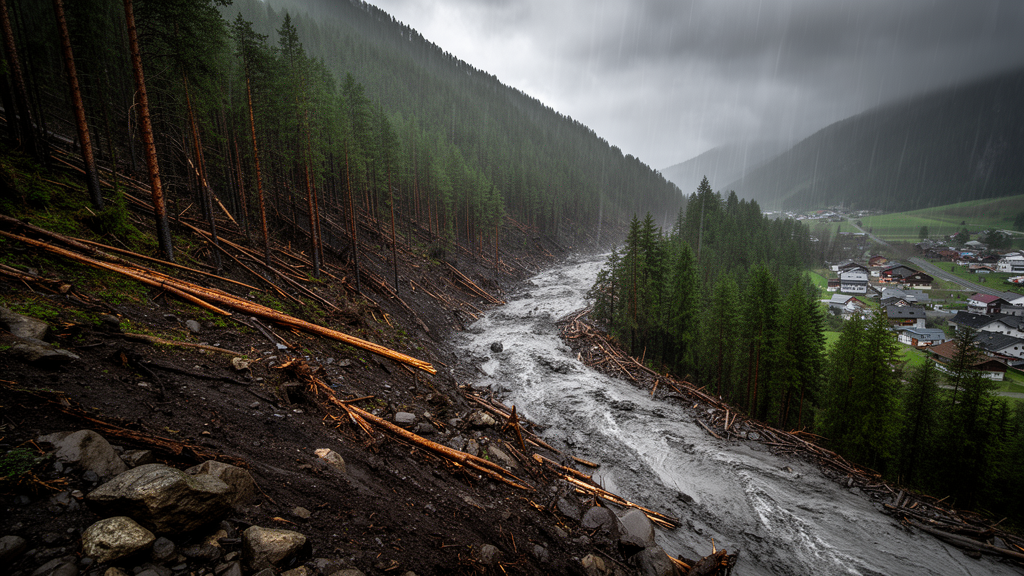
When extreme rain struck the northern slopes of Maxian Mountain in China’s Gansu Province on August 7 and 8, 2025, the disaster that unfolded defied conventional expectations. The catchment was cloaked in more than 90 percent vegetation coverage—terrain that engineers and hazard planners typically regard as protective. Yet the slopes failed catastrophically. Hundreds of shallow landslides ripped through the forested hillsides, and the material they released coalesced into debris flows of extraordinary destructive power. A new study published in the journal Natural Hazards dissects this event, known as the 2025 Yuzhong event, and reveals a chain of mechanisms in which the very vegetation that should have stabilized the slopes instead helped amplify the disaster.
The research team, led by Fuyun Guo, Yan Zhao and Xingmin Meng of Lanzhou University together with colleagues from Gansu geological institutions, combined field surveys, remote sensing analysis and hydrological modeling to reconstruct the disaster from beginning to end. Their investigation documented 280 shallow landslides triggered across the catchment during the storm. The spatial pattern of these failures was primarily controlled by terrain morphology—the shape and steepness of the slopes determined where the ground gave way. But terrain alone could not explain why slopes that had held firm for decades suddenly collapsed en masse under a single rainfall event.
The answer, the researchers found, lay beneath the surface, in the geological composition of the slopes and in the history of freezing and thawing they had endured. Many of the failed slopes consisted of soil and glacial deposits resting on bedrock. Repeated freeze-thaw cycles had progressively weakened the interface between this surficial material and the underlying rock, a process the team describes as freeze-thaw shear displacement. As water infiltrated during the freeze-thaw transitions, it expanded and contracted, gradually shearing and loosening the bond between soil and bedrock. When the intense August rainfall arrived, the preconditioned slopes failed rapidly, with water pressure building along the weakened interface until the entire shallow layer detached.
What happened next transformed a landslide event into something far more dangerous. The landslide materials did not simply come to rest on the hillslopes. Instead, they mobilized into debris flows—fast-moving mixtures of water, mud, rock and vegetation that surged down the drainage channels. In the Maliantan catchment, the peak discharge of the debris flow reached 978.7 cubic meters per second. To appreciate how extraordinary that figure is, the researchers compared it with the modeled clear-water flood discharge for the same catchment under the same rainfall: just 63.3 cubic meters per second. The debris flow was 15.5 times more voluminous and powerful than the flood of clear water alone, a dramatic amplification effect produced entirely by the cascading hazard chain.
The team traced this amplification to a cascading mechanism operating within the channels. As landslide debris poured into the drainage network, it initially formed natural dams that impounded water and sediment. These dams then breached, releasing sudden pulses of water and debris that picked up additional material along the way. Meanwhile, large volumes of woody debris—trees, branches and root material torn from the forested slopes—became lodged at narrow choke points in the channels, causing blockages that concentrated the flow’s energy. Each impoundment and release cycle added momentum and volume, so that by the time the flow reached lower elevations it carried vastly more destructive power than the initial rainfall could have generated on its own.
Perhaps the most counterintuitive finding concerns the role of the dense vegetation itself. The researchers identified what they call a root-moraine coupling effect, a dual mechanism by which forest cover actively contributed to the disaster. Shallow root networks, rather than binding the soil into a stable mat, created preferential infiltration pathways—channels along roots through which rainwater could penetrate rapidly into the subsurface. This accelerated moisture accumulation precisely at the root-moraine interface, the critical boundary where failure ultimately occurred. In effect, the roots acted as plumbing that delivered storm water directly to the weakest layer of the slope, hastening the onset of failure during intense rainfall.
The second half of the coupling effect concerns the debris itself. When the slopes failed, the shallow root networks supplied large volumes of woody material to the moving mass. This woody debris, rather than dissipating the flow’s energy, became a destructive agent in its own right, lodging at channel constrictions and contributing to the damming and blockage processes that amplified the discharge. The study thus demonstrates that dense vegetation, long assumed to be a universal safeguard against slope hazards, can paradoxically serve as both an accelerant of landslide initiation and a fuel source for debris flow amplification in certain geological and climatic settings.
The findings carry significant implications for hazard assessment in alpine and high-altitude regions worldwide. Conventional susceptibility models often weight vegetation coverage as a stabilizing factor, and many mapping schemes treat densely forested catchments as low-priority zones. The Yuzhong event shows that such assumptions can be dangerously wrong where shallow soils and glacial deposits overlie bedrock, where freeze-thaw cycling degrades the soil-bedrock interface, and where root systems create fast infiltration pathways. The researchers argue that hazard evaluations for similar environments must account for the preconditioning effects of freeze-thaw cycles and the potential for vegetation to amplify, rather than dampen, cascading geohazards.
The study also underscores the importance of understanding hazard chains as integrated systems rather than isolated events. The 15.5-fold amplification between clear-water flood discharge and debris flow discharge in the Maliantan catchment illustrates how a modest hydrological trigger can be transformed into a catastrophic geomorphic event through cascading processes—landslide initiation, dam formation and breach, woody debris blockage and flow concentration. Early warning systems that monitor rainfall alone may therefore underestimate the true hazard, because the destructive potential of the resulting debris flow depends on the state of the slopes and channels through which it passes, not merely on the intensity of the storm that initiates it.
As climate change intensifies extreme rainfall events and alters freeze-thaw regimes in mountain regions, the mechanisms identified in the Yuzhong event are likely to become increasingly relevant. The researchers suggest that their findings are critical for assessing similar cascading geohazards in alpine regions, where the combination of dense vegetation, glacial deposits and seasonal freezing creates conditions ripe for precisely the kind of disaster chain that struck Maxian Mountain. Recognizing that a green mountainside is not always a safe mountainside may prove to be one of the most important lessons of the 2025 Yuzhong event.
Subject of Research: Mechanisms of rainfall-triggered shallow landslides and debris flow amplification in densely vegetated alpine terrain
Article Title: Causes of mass shallow landslides in densely vegetated areas and their amplifying effect on debris flows: insights from the 2025 Yuzhong event
Article References: Causes of mass shallow landslides in densely vegetated areas and their amplifying effect on debris flows: insights from the 2025 Yuzhong event. (n.d.). https://doi.org/10.1007/s11069-026-08455-5
Image Credits: AI Generated
DOI: 10.1007/s11069-026-08455-5
Keywords: shallow landslides, debris flows, freeze-thaw cycles, vegetation effects, cascading hazards, Maxian Mountain, Yuzhong event, root-moraine coupling, landslide dams, alpine geohazards, hydrological modeling, Gansu Province
Cite Scienmag News
Courtney Benton. (October 16, 2026). How a Forested Mountain Turned Rain Into a Deadly Debris Flow Machine. Scienmag. https://scienmag.com/how-a-forested-mountain-turned-rain-into-a-deadly-debris-flow-machine/
Courtney Benton. "How a Forested Mountain Turned Rain Into a Deadly Debris Flow Machine." Scienmag, 16 October 2026, https://scienmag.com/how-a-forested-mountain-turned-rain-into-a-deadly-debris-flow-machine/. Accessed 16 October 2026.
Courtney Benton. "How a Forested Mountain Turned Rain Into a Deadly Debris Flow Machine." Scienmag. October 16, 2026. https://scienmag.com/how-a-forested-mountain-turned-rain-into-a-deadly-debris-flow-machine/


