


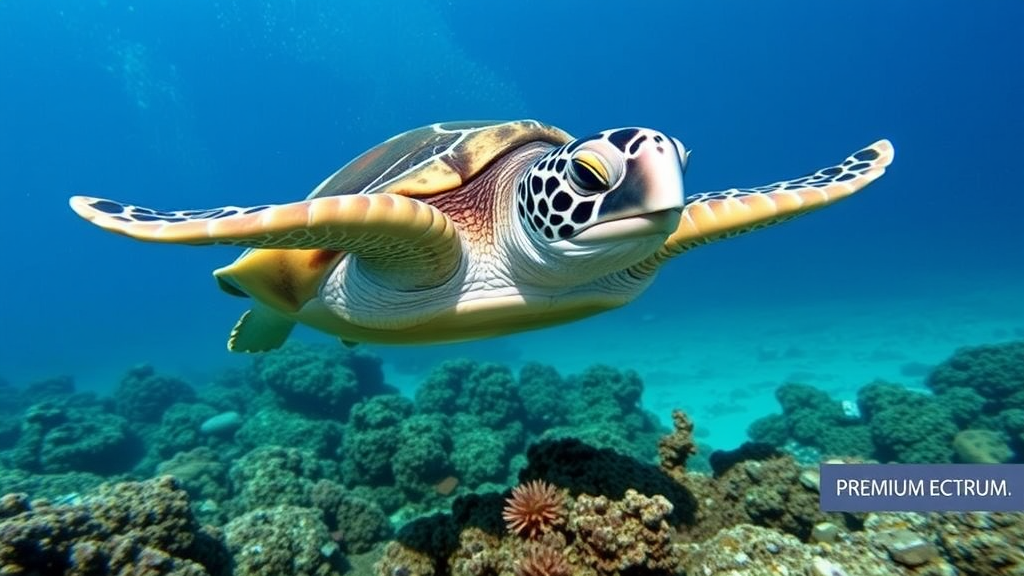
For decades, scientists studying the Mediterranean’s loggerhead sea turtles have focused overwhelmingly on females, because nesting beaches make them easy to find and monitor. Males, which never come ashore after maturity, have remained an enigma, particularly when it comes to how they use the vertical world beneath the waves. Now, a team led by Alan F. Rees of Turtles from Above, working with colleagues from Greek conservation institutions, has shed light on this hidden life. By attaching satellite tags to three breeding adult males captured in Kyparissia Bay, Greece, the largest loggerhead breeding aggregation in the Mediterranean, the researchers followed the turtles to their distant foraging grounds while continuously recording the depths they occupied and the temperatures they experienced. The results, published in Discover Conservation, offer the most detailed picture yet of how adult male loggerheads distribute themselves through the water column, and the findings carry direct consequences for reducing one of the species’ greatest threats: accidental capture in fishing gear.
The technical challenge of studying diving animals at sea is formidable. Sea turtles are air-breathing reptiles, and although they can remain submerged for extended periods, they must return to the surface to breathe. That dependency means they occupy much of the vertical space in coastal and neritic habitats, putting them in harm’s way wherever fishing gear is set, from surface longlines to bottom trawls. The lungs of a turtle play a dual role, storing oxygen and controlling buoyancy, which shapes how the animals dive and rest. To untangle these behaviours, the team used Wildlife Computers SPLASH10-385 C transmitters, instruments capable of logging depth at 0.1 metre resolution and temperature to within 0.1 degrees Celsius at five-second intervals. The onboard data were compressed and transmitted in hour-long snapshots through the low-bandwidth Argos satellite system, with tags limited to 250 transmissions per day, producing a stream of time-series depth and temperature records spanning the turtles’ migrations.
The three turtles, labelled I, J and K, were captured in May 2023 in Kyparissia harbour using the established turtle rodeo technique. To guarantee that only actively breeding adult males were tagged, the researchers targeted individuals observed mounted upon or attempting to mount other turtles, a reliable behavioural indicator of breeding males. Once ashore, each turtle’s carapace was sanded, cleaned with acetone and fitted with an epoxy-and-fibreglass transmitter attachment. The tags then recorded each animal’s post-breeding movements: turtle I migrated east into the northern Aegean Sea near Thasos Island, turtle K settled in the Argolic Gulf on the eastern Peloponnese, and turtle J travelled north through the Ionian Sea before establishing two sequential foraging sites in the Adriatic. Transmission durations ranged from 98 days for turtle I to an impressive 547 days for turtle J, the only individual tracked long enough to reveal a full seasonal cycle.
The depth data revealed a striking pattern: despite differences in destination, all three turtles overwhelmingly favoured shallow water. Turtle I spent 98.6 percent of its time shallower than 10 metres and over 99 percent shallower than 20 metres. Turtle K and turtle J were more adventurous, spending 55.3 and 62.3 percent of their time above 10 metres respectively, yet both still exceeded 99 percent of their time within the top 80 metres. Even turtle J, the deepest diver of the trio, which twice plunged beyond 200 metres, reaching 201.5 metres in August 2023 and a remarkable 288 metres in September 2023, spent 95 percent of its life above 70 metres. For fisheries managers, this is the crucial message: turtles concentrate their lives in narrow vertical bands, and gear positioned away from those bands is far less likely to intercept them.
Temperature proved to be a powerful driver of behaviour. Summer sea surface temperatures peaked near 29 degrees Celsius in July and August, and the turtles registered short-term spikes well above ambient values, occasionally approaching 45 degrees, which the authors interpret as surface basking rather than true water temperature. More intriguing were the thermal structures the turtles swam through. The time-series data captured shallow thermoclines at around 9 metres and deeper ones near 35 metres, and when a distinct deep thermocline was present, the turtles altered their diving, executing multi-depth dives that clearly separated warmer shallow phases from colder deep phases. Turtle J lived in waters with a notable deep thermocline for more than 30 consecutive days, sometimes rising above the boundary to hold steady at about 30 metres for 20 to 30 minutes, behaviour that may represent warming up after foraging in colder water below, or movement along the seafloor between thermal layers. Such responses to thermoclines have never previously been reported for Mediterranean sea turtles.
Daily rhythms also shaped the animals’ vertical lives. During warm periods, the turtles showed classic diel patterns: relatively active, erratic diving by day and longer, quieter resting dives at night, or in some cases the reverse, with one turtle performing nocturnal resting dives at 30 metres and deeper daytime dives beyond 70 metres. These patterns likely reflect shifts between nocturnal refuge and daytime foraging, though the available tracking resolution cannot fully separate behavioural change from movement between sites. The study classified the dives using a standard lettered nomenclature for sea turtle dive profiles: steady Type A dives suggesting rest, variable-bottom Type B dives indicating activity, Type E profiles associated with thermoclines, and the rare Type C plunge, a rapid straight descent followed by an immediate ascent, exemplified by turtle J’s 288-metre excursion. The purpose of such extreme dives remains uncertain; comparable dives elsewhere have been interpreted as exploratory, navigational or prey-searching, but the authors candidly note that without direct observation, much interpretation rests on what they describe as speculation and guesswork.
Winter transformed the picture entirely. As waters cooled through November into April, turtle J, the only animal still transmitting, shifted to spending far more time at depth, with dives regularly exceeding one hour and the longest, repeated dives surpassing three hours between 19 and 21 February 2024, with no clear day-night rhythm. This is consistent with cold-induced dormancy: cooler water slows reptilian metabolism, reducing oxygen demand and allowing extraordinary breath-holding. Loggerheads are the champions of cheloniid endurance, with reported winter dives of up to 614 minutes. Yet a subtle finding complicates the dormancy story. Even when diving deeper than 50 metres in midwinter, turtle J rarely encountered water below about 15 degrees Celsius, recording values below that threshold on only three days, with a minimum of 14.2 degrees. The 15-degree mark has long been proposed as a trigger for overwintering behaviour in sea turtles, though empirical support has been lacking, and the authors note that deeper waters are thermally buffered from surface variability, a stability visible even in slight nocturnal thermal inversions where the surface was about one degree cooler than the water below.
The conservation implications are immediate and practical. Fishing activity in the Mediterranean is estimated to catch around 132,000 turtles annually, killing roughly 44,000 as bycatch or through entanglement in lost ghost gear. Because turtle depth use varies with season and temperature, the authors argue that management tools such as depth limits and soak-time restrictions should evolve dynamically with seasonal sea temperatures rather than remaining static. In colder months, quiescent turtles resting on the seafloor become especially vulnerable to bottom trawling, while in warmer periods most of a turtle’s time is spent in the top few metres, suggesting that deeper-set nets and hooks could dramatically reduce encounters. Similar depth-based strategies have informed longline management in the Pacific, and tracking of loggerheads from Crete has already suggested that setting gear below 5 metres could cut bycatch, though outcomes remain untested. Beyond fisheries, knowing what fraction of time turtles spend at the surface is essential for correcting aerial and boat survey counts for availability bias, adjustments that can inflate abundance estimates nearly twentyfold.
There is also an unexpected bonus: the turtles themselves are ocean observers. Their tags returned depth-linked temperature profiles reaching down to about 80 metres, echoing findings from loggerheads in the northwest Atlantic, and such animal-borne data can refine remotely sensed sea-surface temperature products and contribute to climate forecasting. The authors acknowledge the limits of their study; with winter data from a single individual, they deliberately avoided quantitative analysis, and two of the three tags stopped transmitting early, probably dislodged or damaged rather than a sign of turtle injury. But the 2,426 hours of paired depth and temperature data from turtle J alone demonstrate what is possible. Future work with more tracked males and finer-scale sensors should disentangle the effects of temperature, season, time of day and seabed depth on behaviour, enabling better predictions of how these animals will redistribute their lives as the Mediterranean warms. For now, the message from three roaming males is clear: protect the narrow, shallow, temperature-shaped band where they actually live, and one of the sea’s most iconic survivors gains a fighting chance.
Subject of Research: Depth use and thermal environment of adult male Mediterranean loggerhead sea turtles tracked by satellite
Article Title: Depth use and thermal environment of adult male Mediterranean loggerhead sea turtles
Article References: Rees, A. F., Batzios, P., Dendrinos, P., Dimalexis, T., Mikoniatis, G., Paxinos, O., & Vavassis, Y. (2026). Depth use and thermal environment of adult male Mediterranean loggerhead sea turtles. Discover Conservation, 3(1), Article 22. https://doi.org/10.1007/s44353-026-00091-1
Image Credits: AI Generated
DOI: 10.1007/s44353-026-00091-1
Keywords: loggerhead turtle, Caretta caretta, Mediterranean Sea, satellite tracking, diving behaviour, thermocline, bycatch, fisheries management, Kyparissia Bay, sea temperature, conservation, Argos telemetry
Cite Scienmag News
Sloane Callahan. (September 23, 2026). Male Loggerhead Turtles Reveal Hidden Dive Secrets Across the Mediterranean. Scienmag. https://scienmag.com/male-loggerhead-turtles-reveal-hidden-dive-secrets-across-the-mediterranean/
Sloane Callahan. "Male Loggerhead Turtles Reveal Hidden Dive Secrets Across the Mediterranean." Scienmag, 23 September 2026, https://scienmag.com/male-loggerhead-turtles-reveal-hidden-dive-secrets-across-the-mediterranean/. Accessed 5 October 2026.
Sloane Callahan. "Male Loggerhead Turtles Reveal Hidden Dive Secrets Across the Mediterranean." Scienmag. September 23, 2026. https://scienmag.com/male-loggerhead-turtles-reveal-hidden-dive-secrets-across-the-mediterranean/


