


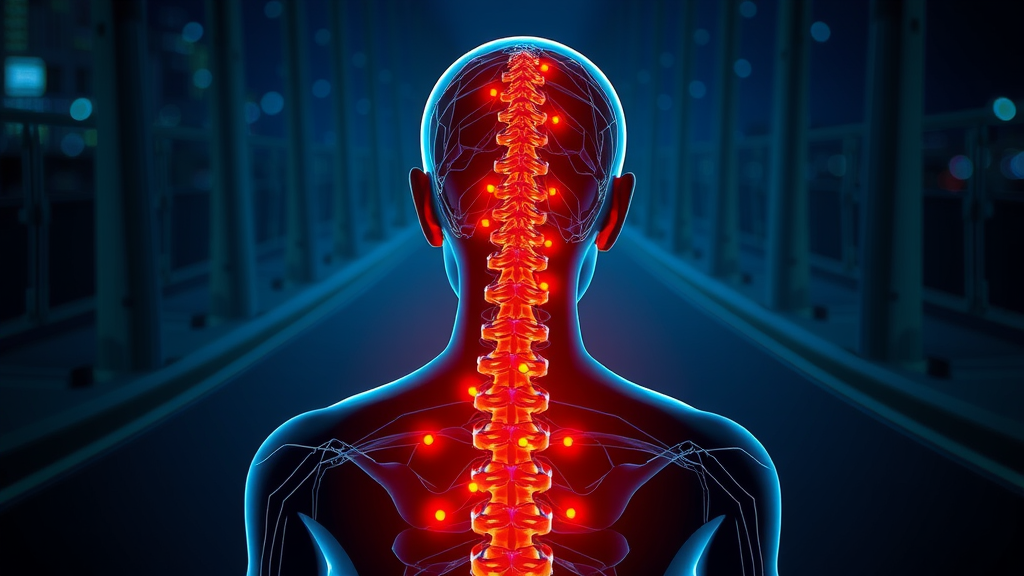
For decades, the search for better depression treatments has focused almost exclusively on the brain: neurotransmitters, neural circuits, deep brain stimulation targets. But a growing body of researchers argues that one of the most promising and overlooked entry points into the biology of mood lies below the brain—in the spinal cord. A new perspective article published in Discover Mental Health, led by Francisco Romo-Nava of the Lindner Center of Hope and the University of Cincinnati College of Medicine, makes the case that spinal interoceptive pathways, the routes by which the nervous system senses the internal state of the body, deserve serious attention as therapeutic targets in major depressive disorder. The paper, co-authored by researchers from the University of Cincinnati, the University of Virginia, the University of California, Los Angeles, and the Laureate Institute for Brain Research, synthesizes converging theoretical frameworks that link bodily signaling to emotional experience and proposes concrete next steps for turning that theory into neuromodulation-based interventions.
Interoception, the central concept in the new analysis, is commonly defined as the process by which the nervous system senses, interprets, and integrates signals arising from within the body. Heartbeat, breathing rhythm, temperature, visceral tension, and the constellation of internal sensations that color every waking moment all travel upward through dedicated neural channels. The authors emphasize that a substantial portion of this traffic passes through the spinal cord, forming what they call spinal interoceptive pathways. These pathways deliver continuous updates about bodily states to a distributed interoceptive system in the brain, where they inform and constrain predictive models of what the body will experience next. In this framework, the brain is not a passive receiver but an active forecaster, constantly generating predictions about upcoming bodily states and comparing them against incoming signals.
The predictive dimension is where interoception connects most directly to emotion. According to the theoretical models reviewed by Romo-Nava and his colleagues, the brain uses its predictions about bodily states to adjust physiology through descending projections, a closed-loop architecture that maintains homeostasis—the finely tuned internal equilibrium on which survival depends. Emotional experience, in this view, is inseparable from the quality and accuracy of the bodily signals feeding the loop. When the ascending traffic is distorted, dampened, or amplified, the brain’s predictive models drift out of alignment with actual bodily conditions, and the subjective result may be the persistent malaise, heaviness, and dysphoria characteristic of depression. The authors argue that dysregulated signaling in spinal interoceptive pathways and the resulting interoceptive processing errors may play a genuine role in the depressive syndrome rather than being a mere byproduct of it.
What makes this proposal more than a philosophical reframing is its therapeutic implication. If the spinal cord carries a continuous stream of body-to-brain information that shapes mood, then the spinal cord is a physically accessible target. Unlike dispersed cortical networks buried deep within the brain, spinal pathways run through an anatomically well-mapped structure that clinicians already know how to stimulate, record from, and modulate. Neuromodulation technologies—devices and techniques that alter nerve activity through targeted electrical or other stimulation—are routinely applied to the spinal cord in other areas of medicine, most famously for pain management. The perspective article argues that the same general strategy could, in principle, be redirected toward the interoceptive traffic that informs emotional state, opening a novel route for studying and eventually treating major depressive disorder.
The scale of the unmet need gives the proposal urgency. Major depressive disorder affects hundreds of millions of people worldwide, and a large fraction of patients do not achieve lasting relief from available medications and psychotherapies. Existing neuromodulation treatments for depression, such as transcranial magnetic stimulation and implanted brain stimulation devices, work from the top of the loop, targeting the brain directly. An approach that intervenes from the bottom of the loop, at the spinal gateway where bodily signals enter, would represent a fundamentally different mechanistic strategy—one that could complement rather than compete with brain-focused therapies. The authors position spinal interoceptive modulation not as a replacement for existing care but as an additional lever on a system that current treatments leave largely untouched.
Yet the researchers are candid about a major obstacle: a substantial knowledge gap. Despite the theoretical appeal of the framework, the role of spinal interoceptive pathways in major depressive disorder remains poorly characterized. It is not yet established which specific spinal mechanisms are altered in depression, how those alterations propagate to the distributed interoceptive system in the brain, or how changes in spinal signaling correlate with changes in mood. The perspective article frames this gap as the central scientific challenge of the field and argues that closing it requires deliberate experimentation rather than assumption. The authors present their work as emerging evidence supporting the exploration of spinal interoceptive pathways as novel and feasible targets—emphasizing both words, novelty and feasibility, to signal that the approach is grounded in existing technology while pointing toward unexplored biology.
A key methodological problem the article confronts is how to prove that a spinal intervention is actually doing what it claims to do. In clinical neuroscience, this is the problem of target engagement: demonstrating that a treatment measurably modifies the biological mechanism it is designed to influence. Without reliable markers of spinal interoceptive target engagement, any clinical trial of spinal neuromodulation for depression would be flying blind, unable to distinguish between a therapy that failed because the mechanism was wrong and one that failed because the delivery was imprecise. The authors therefore devote significant attention to candidate experimental models and the critical next steps needed to identify markers that would show whether a given intervention is genuinely changing spinal interoceptive signaling. Such markers would be the measurement backbone for future studies, allowing researchers to connect stimulation parameters to physiological changes and physiological changes to clinical outcomes.
The research program described in the article is already backed by institutional investment. The work was supported by the Lindner Center of Hope and the University of Cincinnati, as well as by the National Institute of Mental Health, which funded the effort in part through grant 1R61MH133770-01A1. The breadth of the author team reflects the interdisciplinary demands of the project: the collaboration includes psychiatrists, neurologists, neurosurgeons, a biostatistician, and interoception specialists from the Laureate Institute for Brain Research and UCLA’s Semel Institute for Neuroscience and Human Behavior. Bringing together expertise in spine-level intervention, brain imaging, psychiatric assessment, and trial design is a prerequisite for a program that spans the length of the neuraxis—from peripheral bodily sensors through spinal relay stations to cortical interoceptive networks.
The broader scientific context makes the timing of this proposal notable. Across neuroscience, interoception has moved from a niche topic to a central framework for understanding psychiatric illness, with conditions including anxiety, eating disorders, and depression increasingly interpreted as disorders of bodily signal processing. Predictive processing models of the brain have given the field a common theoretical language, describing perception and emotion as consequences of prediction and prediction error rather than simple stimulus response. The spinal cord, in this emerging picture, is no longer a mere cable between brain and body but an active processing station that shapes the information it transmits. The Romo-Nava perspective extends that shift by insisting that the clinical implications run in both directions: just as the brain constrains the body through descending projections, the body constrains the brain through ascending spinal channels, and either side of the loop can be an intervention point.
If the research program succeeds, the consequences could extend well beyond depression. Spinal interoceptive pathways plausibly contribute to the physical symptoms that accompany many psychiatric conditions—chronic pain, fatigue, autonomic dysregulation—and a validated method for measuring and modulating spinal interoceptive signaling could illuminate all of them. For now, the authors’ contribution is a roadmap: a reasoned case that the spinal cord is a feasible, mechanistically motivated target for depression research, an honest account of what remains unknown, and a set of candidate models and engagement markers to guide the experiments ahead. As the field confronts the limits of treatments aimed solely at the brain, the message of this perspective is that mood may be built, in part, from signals that begin their journey in the body—and that the gateway through which those signals travel may one day become a place where depression is treated.
Subject of Research: The role of spinal interoceptive pathways in major depressive disorder and their potential as neuromodulation targets
Article Title: Spinal interoceptive pathways as therapeutic targets in depression
Article References: Romo-Nava, F., Awosika, O. O., Phan, P., Basu, I., Liu, J. C., Charnas, C., Georgiev, G., Mori, N. N., Welge, J., Blom, T., Fleck, D. E., Cao, X., Khalsa, S., Paulus, M., & McElroy, S. L. (2026). Spinal interoceptive pathways as therapeutic targets in depression. Discover Mental Health. https://doi.org/10.1007/s44192-026-00597-z
Image Credits: AI Generated
DOI: 10.1007/s44192-026-00597-z
Keywords: interoception, spinal cord, major depressive disorder, neuromodulation, predictive processing, homeostasis, psychiatry, spinal interoceptive pathways, target engagement, neuroscience, Spinal, interoceptive
Cite Scienmag News
Glenn Wilkins. (September 23, 2026). The Body’s Hidden Highway: Why Scientists Are Looking to the Spine to Treat Depression. Scienmag. https://scienmag.com/the-bodys-hidden-highway-why-scientists-are-looking-to-the-spine-to-treat-depression/
Glenn Wilkins. "The Body’s Hidden Highway: Why Scientists Are Looking to the Spine to Treat Depression." Scienmag, 23 September 2026, https://scienmag.com/the-bodys-hidden-highway-why-scientists-are-looking-to-the-spine-to-treat-depression/. Accessed 5 October 2026.
Glenn Wilkins. "The Body’s Hidden Highway: Why Scientists Are Looking to the Spine to Treat Depression." Scienmag. September 23, 2026. https://scienmag.com/the-bodys-hidden-highway-why-scientists-are-looking-to-the-spine-to-treat-depression/


