


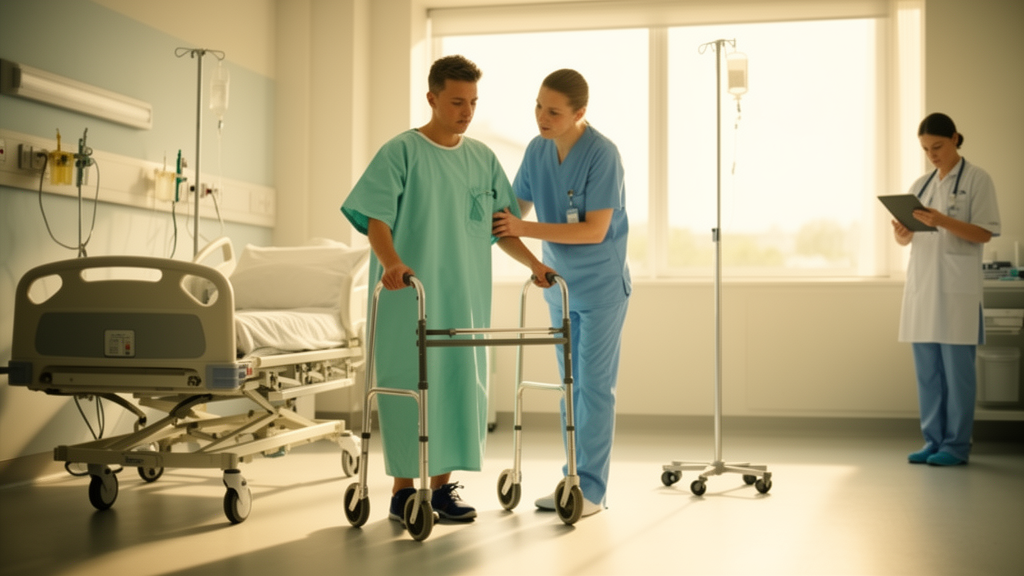
When hospitals send hip and knee replacement patients home on the same day as surgery, the single factor most strongly associated with that outcome is not the patient’s age, fitness or the type of anaesthetic they received, but how quickly they got out of bed and took their first steps. That is the central finding of a new study published in the journal Arthroplasty, which used supervised machine learning to dissect a universal, non-selective enhanced recovery after surgery (ERAS) pathway at a high-volume tertiary orthopaedic centre.
Unlike most previous work on day-case joint replacement, which has focused on selecting healthy, low-risk patients in advance, this study deliberately included everyone. All patients undergoing primary total hip arthroplasty, total knee arthroplasty or partial knee replacement under the pathway between April 2024 and May 2025 were included, with no exclusions on the basis of age, comorbidity or anticipated suitability for day-case surgery. The cohort of 3,025 patients therefore spanned the full range of surgical risk, including 540 patients, or 19.0 percent, of ASA grade 3 or 4, and 410 patients, or 13.6 percent, aged 80 or older.
The results were striking for an unselected population. Same-day discharge was achieved in 811 patients, or 26.8 percent, and discharge by Day 0 or Day 1 in 2,481 patients, or 82.0 percent. The median length of stay was one day overall, with a median time to discharge of 29 hours. The authors note that their same-day rate sits well above the 15 percent reported in unselected practice by other researchers, while remaining below the rates achieved when patients are pre-screened for ambulatory suitability.
Five machine learning models were developed in Python: logistic regression, random forest, gradient boosting, support vector machine and decision tree. Two outcomes were modelled as markers of pathway performance: failure to discharge at Day 0 or Day 1, and failure of same-day discharge. The models incorporated the full set of preoperative, anaesthetic and postoperative pathway variables, including demographics, ASA grade, anaesthetic technique, spinal drug type and volume, dexamethasone dose, nerve block use, postoperative radiography, pain severity, blood transfusion, time to first mobilisation, nutritional supplementation and mobiliser designation. SHAP, or SHapley Additive exPlanations, analysis was used to interpret which features drove the predictions.
Model performance differed between the two outcomes. For failure of Day 0 or Day 1 discharge, discrimination was moderate, with ROC-AUC between 0.66 and 0.76 against a baseline failure prevalence of 18 percent. For failure of same-day discharge, performance was higher, with ROC-AUC between 0.76 and 0.82, although the authors caution that the high PR-AUC of 0.89 to 0.93 partly reflects the high baseline prevalence of the positive class, at 73 percent, and should be read against it. Logistic regression achieved the best performance for the Day 0 or Day 1 outcome, while gradient boosting performed best for same-day discharge. Logistic regression and the support vector machine generalised best, whereas the tree-based models showed larger falls in performance from training to test data, consistent with overfitting.
The SHAP analysis delivered a clear message about mobilisation. For same-day discharge, time to mobilisation was the dominant factor, ranking first with a mean absolute SHAP value four times that of the next variable, followed by postoperative radiography on return to the ward and the designation of the first mobilising practitioner. For Day 0 or Day 1 discharge, fixed patient characteristics ranked highest, with ASA grade first, sex second and operative side third, and time to mobilisation fourth. The association with mobilisation timing was steep and graded: same-day discharge fell from 48.2 percent among patients mobilised within two hours of returning to the ward, to 32.2 percent at two to four hours, 16.5 percent at four to six hours, 1.3 percent at six to twelve hours, and none beyond twelve hours.
Several other pathway factors showed strong associations. Patients who had radiography on return to the ward were far more likely to be discharged the same day than those who did not, at 32.4 percent versus 3.0 percent, and those whose first mobilisation was led by a physiotherapist or enhanced-recovery practitioner rather than nursing staff were also more likely to go home the same day, at 31.9 percent versus 2.5 percent. Spinal anaesthesia alone was associated with earlier discharge than combined spinal and general anaesthesia or general anaesthesia alone, and prilocaine was associated with higher discharge rates than bupivacaine. Within knee replacement, the motor-sparing adductor canal block specified by the pathway was associated with higher discharge rates and a shorter time to mobilisation, whereas fascia iliaca blockade showed the opposite pattern, with a longer time to mobilisation despite comparable Day 0 analgesia. The authors suggest this dissociation between pain control and mobility is consistent with the quadriceps weakness that fascia iliaca blockade can produce, and that anaesthetic choices are best judged not by analgesia alone but by whether they preserve the ability to mobilise early.
The study has important limitations, which the authors set out candidly. Many of the top-ranked variables were recorded during the pathway itself and are unavailable before surgery, limiting their use for preoperative risk assessment. In a sensitivity analysis using only preoperative and intraoperative variables, discrimination for same-day discharge fell from approximately 0.82 to 0.64. Several key predictors may therefore reflect the discharge process rather than preceding causal factors, and the authors emphasise that several are measured concurrently with discharge and require prospective confirmation before being treated as causal. SHAP rankings were also model-dependent, particularly for lower-ranked features, and the routinely collected data did not record postoperative complications such as nausea and vomiting, orthostatic intolerance, urinary retention and haematoma, so some associations may reflect unmeasured complications. Finally, as a single-centre study, external validation is required before wider application.
Temporal validation using a chronological split, with 2024 patients for training and 2025 patients as an independent test set, showed only modest performance declines for most models. Case mix and discharge outcomes remained stable between the two years, although four process measures shifted towards greater compliance, suggesting the pathway matured while its outputs stayed steady. The authors note that any deployed model would need periodic refitting, with logistic regression or the support vector machine preferable to the tree-based models. Hip-specific models discriminated better than the pooled model, suggesting that pooling joint types obscures joint-specific structure, although time to mobilisation ranked first in both joint-specific models.
The study’s authors conclude that supervised machine learning is an effective framework for evaluating a non-selective ERAS pathway, and that time to first mobilisation, which dominated same-day discharge and remained a leading factor for Day 0 or Day 1 discharge, warrants prospective confirmation as a modifiable target. By evaluating the whole pathway rather than pre-screening patients, the analysis identifies where an unselected ERAS programme can be strengthened, offering a template for service-level decision-making in centres facing rising demand for elective joint replacement and pressure on inpatient bed capacity.
Subject of Research: Machine learning evaluation of a non-selective ERAS pathway for hip and knee arthroplasty
Article Title: Using machine learning to evaluate a non-selective enhanced recovery pathway for hip and knee arthroplasty: perioperative factors associated with same-day and early discharge
Article References: Selim, A., Ibrahim, A., Gomaa, A.-R., Graham, N., & Thomas, G. (2026). Using machine learning to evaluate a non-selective enhanced recovery pathway for hip and knee arthroplasty: perioperative factors associated with same-day and early discharge. Arthroplasty, 8(1), Article 76. https://doi.org/10.1186/s42836-026-00435-1
Image Credits: AI Generated
DOI: 10.1186/s42836-026-00435-1
Keywords: arthroplasty, ERAS, machine learning, same-day discharge, hip replacement, knee replacement, SHAP, time to mobilisation, enhanced recovery, perioperative care, tertiary centre, predictive modelling
Cite Scienmag News
Teresa Odom. (October 28, 2026). Machine learning pinpoints early mobilisation as key to same-day joint replacement discharge. Scienmag. https://scienmag.com/machine-learning-pinpoints-early-mobilisation-as-key-to-same-day-joint-replacement-discharge/
Teresa Odom. "Machine learning pinpoints early mobilisation as key to same-day joint replacement discharge." Scienmag, 28 October 2026, https://scienmag.com/machine-learning-pinpoints-early-mobilisation-as-key-to-same-day-joint-replacement-discharge/. Accessed 1 November 2026.
Teresa Odom. "Machine learning pinpoints early mobilisation as key to same-day joint replacement discharge." Scienmag. October 28, 2026. https://scienmag.com/machine-learning-pinpoints-early-mobilisation-as-key-to-same-day-joint-replacement-discharge/









