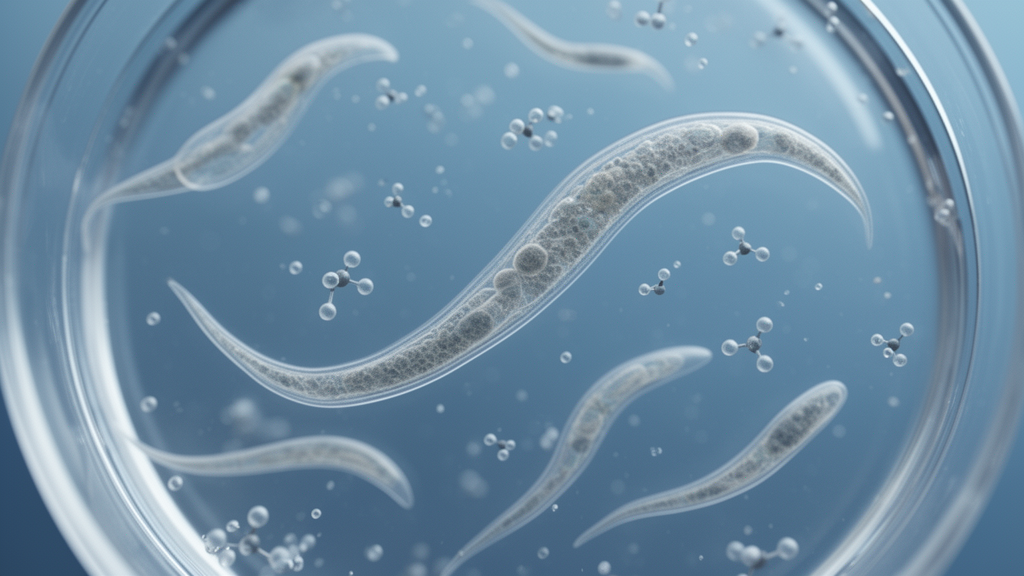
In a laboratory study of the nematode Caenorhabditis elegans, researchers report that chronic exposure to nanomolar concentrations of lysergic acid diethylamide, or LSD, increased lifespan by as much as 17.6% and reduced the accumulation of lipofuscin, a fluorescent pigment associated with cellular aging. The experiments indicate that the response varies with serotonin-receptor status, food availability and other genetic factors. They do not establish that LSD extends human life or that it directly activates a particular longevity pathway.
The researchers began with a dose-response experiment in wild-type nematodes continuously exposed to 100, 200 or 250 nanomolar LSD from young adulthood. Each concentration was associated with longer survival than the vehicle control, with reported lifespan increases of 12.4%, 13.2% and 17.6%, respectively. The researchers selected 250 nanomolar for most subsequent experiments. Survival was analyzed with Kaplan–Meier curves and log-rank tests, with repeated independent experiments and at least approximately 120 to 180 animals per condition in the principal assays. The percentages describe survival in this laboratory model; they are not estimates of a human effect or clinical benefit.
Because longer survival does not necessarily mean that age-related deterioration has slowed, the team also measured lipofuscin, a fluorescent pigment that accumulates when cellular components are incompletely degraded. At day 10, treated animals had lipofuscin levels close to controls, but by day 15 the treated group showed a marked reduction. Fluorescence in the LSD group was 49.8% of the corresponding control value, with a reported p<0.0001. The observation is consistent with the authors’ interpretation that LSD delayed at least one age-associated accumulation in worms, although the study did not evaluate a complete set of healthspan measures or test whether the response would occur in mammals.
Genetic experiments indicated that serotonin-receptor pathways were associated with the different survival responses. LSD failed to extend lifespan in animals lacking the serotonin GPCRs SER-1 or SER-5. In contrast, it shortened lifespan in ser-4 mutants by 7.7% and in ser-7 mutants by 3.3%. These outcomes show that disruption of individual receptors can abolish or reverse the measured benefit. In tph-1 animals, which lack tryptophan hydroxylase and are therefore deficient in serotonin synthesis, LSD still extended lifespan by 9.3%, although the effect was smaller than in wild type. Thus, endogenous serotonin production was not strictly required in the tested animals, while the integrity of multiple serotonin receptors influenced the response.
Several traits measured in LSD-treated worms resembled phenotypes associated with caloric restriction. Treated animals laid fewer eggs during the reproductive period, were shorter than controls on both day 1 and day 10, and showed delayed vulval development. At the end of the L4 larval stage, 31.7% of treated animals had fully developed vulvas, compared with 68.3% of controls. The developmental result is consistent with altered timing of growth, and the body-size and reproductive changes overlap with features reported for caloric restriction in C. elegans. However, the experiments did not demonstrate that LSD directly reduced TORC1 activity or that TORC1 was the mediator of the lifespan effect.
Nutritional context was decisive. In the eat-2 mutant strain, a genetic model of dietary restriction used in C. elegans, LSD produced no difference in survival compared with controls. When the researchers reduced bacterial food availability by diluting the standard bacterial suspension tenfold, LSD not only failed to extend lifespan relative to the restricted control group but shortened it by 9.2%. The lifespan benefit was therefore absent in both tested forms of dietary restriction, and became detrimental under the diluted-food condition. These findings show that the response observed in well-fed wild-type animals cannot be generalized to all nutritional or genetic contexts.
The results also did not appear to arise from a simple reduction in feeding. Pharyngeal pumping was not reduced on day 1; by day 5, treated worms pumped more frequently than controls, reaching 209.2 contractions per minute compared with 159.4 in the untreated group. Direct food-consumption assays, which quantified bacterial biomass remaining on plates, found no significant difference between treated and control groups on day 1 or day 5. The authors interpret the higher day-5 pumping rate as compatible with preservation of feeding capacity during aging rather than reduced appetite, because the treated value remained close to the day-1 level measured in control animals. The assays support that interpretation under the conditions tested but do not exclude changes in feeding behavior at other times.
Molecular and metabolic readouts changed over time rather than remaining fixed. PHA-4::GFP fluorescence, a reporter for a transcription factor downstream of TOR signaling, was elevated on day 1, reduced on day 5 and similar to control by day 10. Lipid staining followed a comparable trajectory: total lipid content increased to 125.7% of the day-1 control value, fell to 70.2% of the corresponding control on day 5 and was near baseline on day 10. Nuclear localization of HLH-30, a transcription factor associated with reduced TOR activity, increased from 21% in controls to 53% in treated animals on day 10. In raga-1 mutants, which lack a Rag GTPase needed for TORC1 activation, LSD shortened lifespan by 11.6% instead of extending it. Together, these observations are consistent with time-dependent remodeling involving nutrient-sensing processes, but they do not resolve the precise molecular mechanism.
Continuous exposure was not required for the measured survival benefit. Researchers treated young adults with 250 nanomolar LSD for 24, 48, 72, 96 or 120 hours and then removed the compound for the remainder of their lives. Every exposure interval was associated with a benefit, with reported lifespan increases ranging from 5.6% to 12.1%. The finding indicates that exposure during early adulthood was sufficient to produce a lasting survival effect in this model. The authors also noted that direct clearance controls would be needed to exclude residual exposure, and that the benefit was detectable across multiple portions of the survival curve rather than being restricted to late survival alone.
Several limitations constrain what can be concluded. Most longevity assays used 5-fluorouracil to prevent eggs from hatching and reduce the influence of progeny on lifespan measurements. Although it was applied identically to treated and control groups, pharmacological suppression of reproduction can introduce confounding effects, including possible interactions with LSD treatment or the reduced-food condition. The authors said confirming the findings without 5-fluorouracil, with progeny controlled manually, would be an important next step. The experiments also involved one species, laboratory growth conditions and outcomes that depended on genotype and food availability. Within those limits, the study identifies LSD as a useful experimental probe for examining how serotonin-receptor signaling and nutrient-sensing readouts may relate to lifespan and age-associated traits in C. elegans, not as evidence of a human anti-aging treatment or a reason for self-experimentation.
Subject of Research: Experimental effects of LSD on lifespan and age-associated traits in Caenorhabditis elegans.
Article Title: Lysergic acid diethylamide extends lifespan in Caenorhabditis elegans
Article References: S. Carrilho, B., Teixeira Duarte Silva, A., Martins, I., Moura, A., Vilas, M., C. Ventura, M. A. V., Moll, F., Aguilaniu, H., Domith, I., & Rehen, S. (2026). Lysergic acid diethylamide extends lifespan in Caenorhabditis elegans. Biogerontology, 27(6), Article 184. https://doi.org/10.1007/s10522-026-10521-1
Image Credits: AI Generated
DOI: 10.1007/s10522-026-10521-1
Keywords: LSD, Caenorhabditis elegans, longevity, serotonin receptors, lipofuscin, caloric restriction, nutrient sensing, metabolic remodeling, TOR signaling, Lysergic, acid, diethylamide
Cite Scienmag News
Beatrice Stafford. (October 22, 2026). LSD Extends Lifespan in C. elegans in a Context-Dependent, Serotonin-Associated Response. Scienmag. https://scienmag.com/lsd-extends-lifespan-in-c-elegans-in-a-context-dependent-serotonin-associated-response/
Beatrice Stafford. "LSD Extends Lifespan in C. elegans in a Context-Dependent, Serotonin-Associated Response." Scienmag, 22 October 2026, https://scienmag.com/lsd-extends-lifespan-in-c-elegans-in-a-context-dependent-serotonin-associated-response/. Accessed 22 October 2026.
Beatrice Stafford. "LSD Extends Lifespan in C. elegans in a Context-Dependent, Serotonin-Associated Response." Scienmag. October 22, 2026. https://scienmag.com/lsd-extends-lifespan-in-c-elegans-in-a-context-dependent-serotonin-associated-response/