


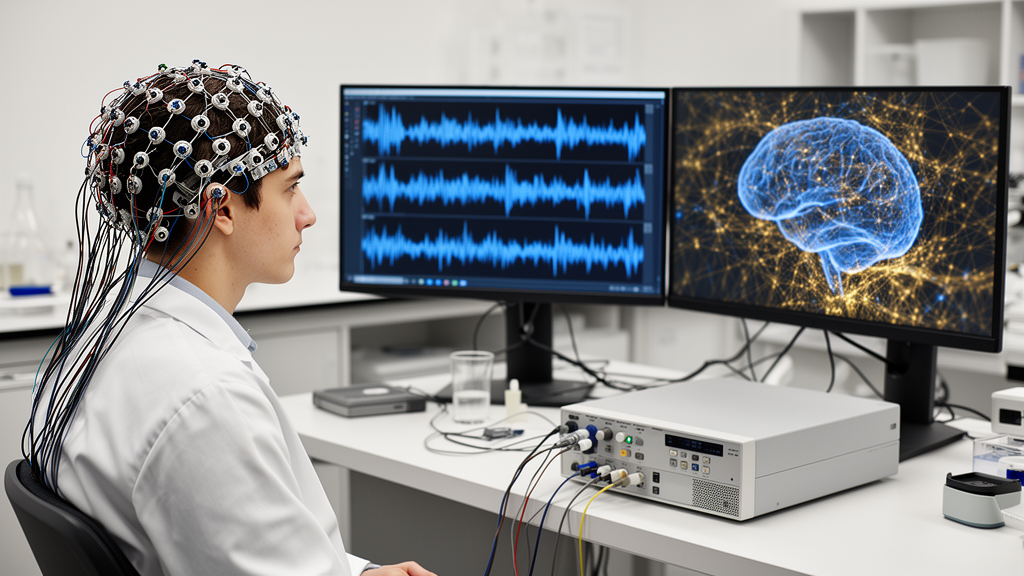
A computational study of two public P300 brain-computer-interface datasets found that a deep-learning framework improved decoding by adapting to differences among participants. The system, called SQ_EMoE, routes each EEG trial either to a model specialized for the person who produced it or to a general model trained across multiple people. In experiments involving eight randomly selected participants from each dataset, the framework achieved mean receiver operating characteristic area under the curve, or ROC-AUC, values of approximately 0.86 on BNCI Horizon 2020 and 0.89 on P300-LINI.
It outperformed a pooled EEGNet baseline and an architecture-matched pooled P300MCNN baseline. Subject variability is a central challenge for P300-based brain-computer interfaces, which the study identifies as potential tools for assistive communication, neurorehabilitation and cognitive monitoring. SQ_EMoE treats this trade-off as a trial-by-trial routing problem.
Its subject-identification network produces a confidence value that the authors use as a practical proxy for how distinctive a trial is for its individual source. High-confidence trials are sent to subject-specific experts, whereas trials with uncertain identification are redirected to a pooled general expert. The design therefore combines individual specialization with cross-subject generalization without requiring one fixed model for every trial.
The framework also learns latent subject representations, which the researchers visualized to examine how separable the participants appeared and how that structure related to routing behavior. Those experiments indicated that redirecting uncertain trials to the general expert contributed to the reported results. The principal evaluations used eight random subjects from BNCI Horizon 2020 and eight from P300-LINI.
To examine scalability, the researchers expanded the evaluation to all 22 participants in P300-LINI. Using the original subject-identification network, SQ_EMoE produced a mean ROC-AUC of 0.8518. After the subject representation and identification network was strengthened, its mean ROC-AUC increased to 0.8760.
The enhanced result exceeded the pooled P300MCNN baseline of 0.8482 and was slightly higher than both oracle routing and within-subject decoding, for which the reported mean was 0.8744. The study did not explain the oracle condition in the supplied abstract, so its result can be reported as a benchmark but not characterized further. Separate leave-one-subject-out experiments assessed behavior when participant data were entirely unseen during training.
In those tests, SQ_EMoE conservatively redirected most trials from completely unseen subjects to the general expert when reliable subject-specific routing was unavailable. Overall, the experiments support uncertainty-aware routing as a way to combine shared and subject-specific EEG representations. The model does not force every trial through the same decoder: it uses subject-specific models when identification is sufficiently confident and falls back on pooled information when it is not.
Subject of Research: Deep mixture-of-experts routing for subject-variable P300 EEG decoding
Article Title: Overcoming subject variability in P300 decoding based on quantification by deep learning
Article References: Liu, M., & Beyette, F. R., Jr. (2026). Overcoming subject variability in P300 decoding based on quantification by deep learning. Frontiers in Neuroscience, 20, Article 1940267. https://doi.org/10.3389/fnins.2026.1940267
Image Credits: AI Generated
DOI: 10.3389/fnins.2026.1940267
Keywords: P300 decoding, brain-computer interfaces, electroencephalography, subject variability, deep learning, mixture of experts, EEG classification, neural decoding, subject identification, Overcoming, subject, variability
Cite Scienmag News
Blake Davidson. (October 22, 2026). Deep learning improves subject-adaptive P300 EEG decoding in computational study. Scienmag. https://scienmag.com/deep-learning-improves-subject-adaptive-p300-eeg-decoding-in-computational-study/
Blake Davidson. "Deep learning improves subject-adaptive P300 EEG decoding in computational study." Scienmag, 22 October 2026, https://scienmag.com/deep-learning-improves-subject-adaptive-p300-eeg-decoding-in-computational-study/. Accessed 22 October 2026.
Blake Davidson. "Deep learning improves subject-adaptive P300 EEG decoding in computational study." Scienmag. October 22, 2026. https://scienmag.com/deep-learning-improves-subject-adaptive-p300-eeg-decoding-in-computational-study/


