

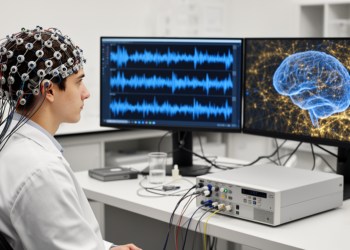
Deep learning improves subject-adaptive P300 EEG decoding in computational study
A computational study found that confidence-based routing between subject-specific and pooled decoders improved P300 EEG decoding in two public datasets.
A computational study found that confidence-based routing between subject-specific and pooled decoders improved P300 EEG decoding in two public datasets.

A seven-degree-of-freedom robotic arm completed all 30 trials with familiar objects and 52.9% of trials with seven unseen household objects ...
A hybrid AI recommendation system that combines specialized expert routing with neural modeling of reading behavior reached 81.23% recall for ...
A physics-guided digital-twin framework estimates electric vehicle battery energy minute by minute and is stress-tested across route, operating-regime, vehicle, and ...
Researchers at the Chinese Academy of Sciences have developed a factorized-gating mixture-of-experts framework that blends regime-specific turbulence specialists to deliver ...
Researchers in China have built a deep-learning model that fuses CT, MRI, and 3D radiation dose data to predict which ...
Researchers have developed ValuePEFT, a parameter-efficient fine-tuning method that steers large language models toward explicitly specified human values with measurable ...
Researchers at Keio University have developed H-PLE, a hierarchical multi-task recommendation framework that stabilizes expert routing and improves prediction of ...
Researchers at the University of Pittsburgh have developed THINKERS-GI, a mixture-of-experts artificial intelligence framework that predicts local failure and toxicity ...
A new commentary in Frontiers of Digital Education argues that open-weight large language models such as DeepSeek could extend personalized, ...

Embark on a thrilling journey of discovery with Scienmag.com—your ultimate source for cutting-edge breakthroughs. Immerse yourself in a world where curiosity knows no limits and tomorrow’s possibilities become today’s reality!