

Sunday, July 26, 2026
Science
No Result
View All Result
  • Login
  • HOME
  • SCIENCE NEWS
  • CONTACT US
  • HOME
  • SCIENCE NEWS
  • CONTACT US
No Result
View All Result
Scienmag
No Result
View All Result
Home Science News Athmospheric

Local rules reshape global emissions: unintended carbon costs of livestock-free zones

July 26, 2026
in Athmospheric
Reading Time: 2 mins read
0
Local rules reshape global emissions: unintended carbon costs of livestock-free zones

Local rules reshape global emissions: unintended carbon costs of livestock-free zones

65
SHARES
587
VIEWS
Share on FacebookShare on Twitter
ADVERTISEMENT

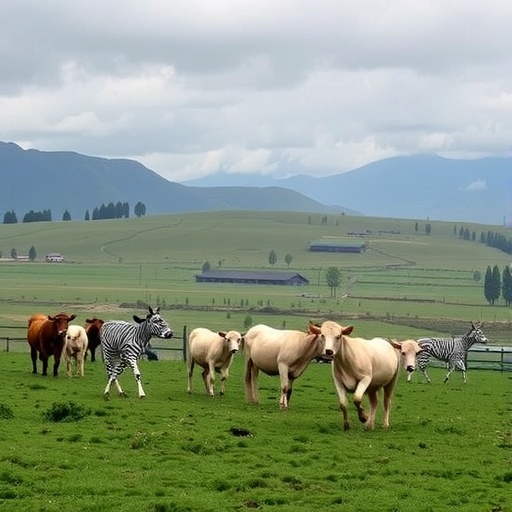
China’s “Dual Carbon” agenda demands deep cuts in greenhouse gases across every sector, yet agriculture—especially livestock—remains a high-stakes source of methane (CH₄) and nitrous oxide (N₂O). In response, local governments have rolled out land-based environmental controls, including “Livestock-Free Zones,” aiming to curb pollution at its source. But do these targeted moves actually reduce emissions overall, or simply relocate them?

A new study examines this question in Guangdong Province, China’s most economically powerful region. Using county-level panel data from 2014–2023, researchers evaluate how the Livestock-Free Zone policy alters emissions within regulated areas and whether that impact propagates into neighboring jurisdictions.

The team applies an integrated econometric toolkit: spatial Durbin models to quantify cross-county spillovers, continuous difference-in-differences designs to capture treatment intensity over time, and network analysis to map how emissions influence travel along regional connections. This combination is intended to address a key gap in policy evaluation for land-intensive livestock systems at subnational scales.

Results reveal a sharp “carbon leakage” paradox. Although Livestock-Free Zones reduce local carbon emissions, the study finds a much larger displaced burden: for every unit of carbon cut locally, about 3.14 units are emitted in surrounding regions. Rather than solving the problem, the policy appears to shift it—supporting the “Pollution Haven Hypothesis” in an agricultural context.

The spillover structure is not random. Cities in the highly developed Pearl River Delta—regions with stronger environmental regulation—act as major origin points for emission transfers. Meanwhile, less developed northern and western Guangdong function as major absorption zones.

Western Guangdong exhibits high total emissions paired with relatively low carbon-emission intensity, suggesting a different efficiency profile than the northern corridor. Northern Guangdong, however, faces an “efficiency dilemma”: it absorbs production capacity without sufficient technological upgrading, which amplifies environmental risk and creates a development trap.

The implications extend beyond one province. Fragmented regulations that ignore spatial feedback can produce a “spatial squeeze” effect—cutting emissions in one area while exporting environmental costs to peripheral regions with weaker governance and fewer abatement technologies.

The study argues for coordinated governance that prioritizes efficiency gains rather than relying solely on location-based restrictions. It recommends regional coordination mechanisms, ecological compensation, joint technology investment, and shared industrial planning to align capital and advanced methods across spillover destinations.

While the findings are robust, the authors note constraints, including possible measurement error in policy intensity inferred from imagery recognition, reliance on IPCC Tier 1 emission factors, and the use of statistical correlations rather than direct livestock-flow observations. Future work could trace farm migration decisions and assess multi-pollutant transfer dynamics for more complete sustainability pathways.

Subject of Research: Livestock carbon emissions and environmental policy leakage
Article Title: Spatial transfer and policy leakage of livestock carbon emissions driven by local livestock-free zone policies
News Publication Date: 22-Jul-2026
Web References: http://dx.doi.org/10.1007/s44246-026-00283-3
References:
– 10.1007/s44246-026-00283-3
Image Credits: Zhiyi Ye, Xunan Yang & Yadong Cao

Keywords: carbon leakage; livestock; greenhouse gases; policy spillover; spatial Durbin model; difference-in-differences; agricultural emissions; coordinated governance; Pollution Haven Hypothesis; Guangdong

Tags: carbon leakageChina's dual carbon goalscross-county emission dynamicsland-based environmental controlslivestock-free zonesmethane and nitrous oxide reductionregional climate policy effectivenessregional emissions spilloverregional policy impact assessmentspatial econometric modelingsubnational greenhouse gas mitigationunintended consequences of livestock bans
Share26Tweet16
Previous Post

JMIR News Highlights Health Tech Industry Trends and Innovations

Next Post

Ceramic Vessels Show Social Inequality Was Baked into 19th-Century Brazil

Related Posts

Farmers’ Trust Crucial for Scaling Climate-Smart Innovations
Athmospheric

Farmers’ Trust Crucial for Scaling Climate-Smart Innovations

July 26, 2026
Study shows climate change alters cooling efficiency and increases energy demand
Athmospheric

Study shows climate change alters cooling efficiency and increases energy demand

July 26, 2026
Recycling Helps, but Climate Change Still Requires Stronger Action
Athmospheric

Recycling Helps, but Climate Change Still Requires Stronger Action

July 26, 2026
Map Reveals Whether Neighborhoods Face Climate-Driven Gentrification Risk
Athmospheric

Map Reveals Whether Neighborhoods Face Climate-Driven Gentrification Risk

July 17, 2026
New thermal analysis shows earthquakes and storms reshape Earth’s carbon cycle
Athmospheric

New thermal analysis shows earthquakes and storms reshape Earth’s carbon cycle

July 17, 2026
Peking University Researchers Review Satellite Radar Advances for Tracking Glacier Movement
Athmospheric

Peking University Researchers Review Satellite Radar Advances for Tracking Glacier Movement

July 17, 2026
Next Post
Ceramic Vessels Show Social Inequality Was Baked into 19th-Century Brazil

Ceramic Vessels Show Social Inequality Was Baked into 19th-Century Brazil

  • Mothers who receive childcare support from maternal grandparents show more

    Mothers who receive childcare support from maternal grandparents show more parental warmth, finds NTU Singapore study

    27656 shares
    Share 11059 Tweet 6912
  • University of Seville Breaks 120-Year-Old Mystery, Revises a Key Einstein Concept

    1061 shares
    Share 424 Tweet 265
  • Bee body mass, pathogens and local climate influence heat tolerance

    682 shares
    Share 273 Tweet 171
  • Researchers record first-ever images and data of a shark experiencing a boat strike

    546 shares
    Share 218 Tweet 137
  • Groundbreaking Clinical Trial Reveals Lubiprostone Enhances Kidney Function

    531 shares
    Share 212 Tweet 133
Science

Embark on a thrilling journey of discovery with Scienmag.com—your ultimate source for cutting-edge breakthroughs. Immerse yourself in a world where curiosity knows no limits and tomorrow’s possibilities become today’s reality!

RECENT NEWS

  • Nonreproductive Tumor Progression Disrupts Ovarian Function via CXCL10–IL18R1 Signaling
  • UK Leads NASA Mission to Build Instrument for Finding Earth-like Worlds
  • Kogakuin and IIT (ISM) Dhanbad launch research on multifunctional energy glass-ceramics
  • Discovering what shapes white blood cells may enable new cancer therapies

Categories

  • Agriculture
  • Anthropology
  • Archaeology
  • Athmospheric
  • Biology
  • Biotechnology
  • Blog
  • Bussines
  • Cancer
  • Chemistry
  • Climate
  • Earth Science
  • Editorial Policy
  • Marine
  • Mathematics
  • Medicine
  • Pediatry
  • Policy
  • Psychology & Psychiatry
  • Science Education
  • Social Science
  • Space
  • Technology and Engineering

Subscribe to Blog via Email

Enter your email address to subscribe to this blog and receive notifications of new posts by email.

Join 5,146 other subscribers

© 2025 Scienmag - Science Magazine

Welcome Back!

Login to your account below

Forgotten Password?

Retrieve your password

Please enter your username or email address to reset your password.

Log In
No Result
View All Result
  • HOME
  • SCIENCE NEWS
  • CONTACT US

© 2025 Scienmag - Science Magazine

Discover more from Science

Subscribe now to keep reading and get access to the full archive.

Continue reading
