


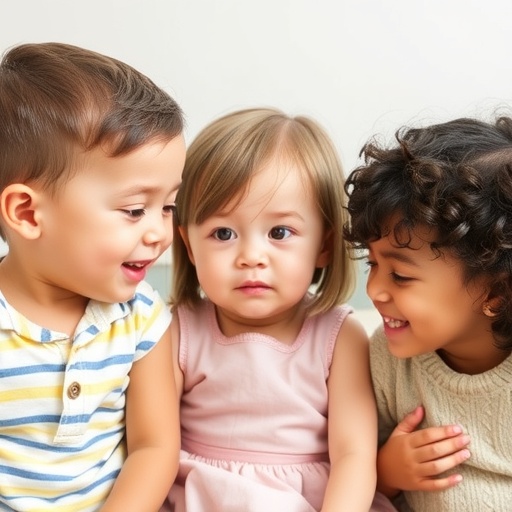
Recent research published in the “Early Childhood Education Journal” sheds light on the intricate relationship between attachment security and social competence in preschool-aged children. This groundbreaking study, conducted by Liu, Hu, and Ren, offers compelling evidence of how emotional understanding and regulation serve as vital mediators in this developmental process. As we navigate through the growing field of childhood psychology, the implications of such findings are far-reaching and significant for educators, parents, and mental health professionals.
Attachment theory posits that the bonds formed between children and their primary caregivers are crucial to emotional and social development. When these attachment bonds are secure, children are more likely to develop essential social skills that enable them to navigate interpersonal relationships successfully. The study highlights how securely attached preschoolers exhibit higher instances of social competence than their insecurely attached peers, establishing a clear link between attachment styles and social outcomes.
The researchers designed a robust methodology to explore this connection more deeply. They utilized a comprehensive set of assessments focused on evaluating the children’s emotional understanding—essentially their ability to recognize and interpret emotions in themselves and others. Additionally, the study examined emotion regulation, which refers to the strategies children employ to manage their emotional experiences. These two elements emerged as critical chain mediators in linking attachment security to social competence.
The findings reveal that preschoolers with a secure attachment to their caregivers demonstrated superior emotional understanding. This understanding is not merely about recognizing emotions but encompasses the ability to empathize with others’ feelings, predicting emotional responses, and navigating social cues. The study emphasizes that this heightened emotional understanding is foundational for effective communication and relationship building, essential components of social competence.
Furthermore, children’s ability to regulate their emotions plays a pivotal role in this dynamic. Emotion regulation allows children to manage their feelings in various social contexts, promoting adaptive responses to challenges and conflicts. It serves as a buffer, enabling securely attached children to engage positively with their peers, fostering resilience in social interactions. The researchers assert that without robust emotion regulation skills, even children who understand emotions may struggle with social integration.
The significance of this research cannot be overstated. It underscores the need for caregivers and educators to foster secure attachments within preschool environments. By nurturing these bonds, adults can lay the groundwork for emotional intelligence, which is increasingly recognized as a core competency in our ever-evolving social landscape. The study suggests practical applications for early childhood education, highlighting the importance of emotional learning curriculums that teach children how to identify and manage emotions.
The implications also extend to the field of parenting and caregiver strategies. The research prompts a reevaluation of approaches toward emotional support in early childhood. Activities that promote secure attachment, such as responsive caregiving and emotional validation, can have lasting effects on children’s social development. This evidence serves as a call to action for parents to prioritize emotional connectivity, recognizing its long-term benefits.
In a broader societal context, understanding the interplay of attachment, emotion, and social competence may inform interventions aimed at improving social outcomes for vulnerable populations. By addressing attachment-related issues early on, we can mitigate barriers faced by children who may struggle with peer relationships, thereby enhancing their educational experiences and psychological well-being.
Moreover, the study sheds light on potential pathways for future research. By investigating additional factors that affect emotional understanding and regulation, researchers can delve deeper into the nuances of social competence development. The exploration of cultural variations in attachment can also enrich our understanding of how different environments influence emotional and social outcomes, thereby broadening the scope of early childhood studies.
This study represents a significant contribution to the literature on child psychology. By elucidating the connection between attachment security, emotional understanding, and social competence, it serves as a critical resource for professionals in education and mental health. Understanding these relationships can guide practitioners in developing targeted interventions that promote positive social outcomes within diverse populations.
In conclusion, the research by Liu, Hu, and Ren offers valuable insights into how early attachment experiences shape emotional and social development in preschool-aged children. With attachment security acting as a precursor to emotional understanding and regulation, this study highlights the importance of fostering strong emotional bonds during formative years. As we continue to unravel the complexities of childhood development, the findings present not only a roadmap for further investigation but also practical implications for nurturing the next generation’s social competencies.
In a world where social skills are increasingly essential, this research provides an evidence-based framework for understanding how the foundational elements of attachment influence children’s future interactions. Establishing secure attachments and promoting emotional literacy from an early age may just be the keys to unlocking a child’s full potential.
Liu, X., Hu, B.Y., Ren, L. et al. Attachment Security and Preschoolers’ Social Competence: Children’s Emotion Understanding and Emotion Regulation as Chain Mediators.
Early Childhood Educ J (2025). https://doi.org/10.1007/s10643-025-02067-7
Cite Scienmag News
Glenn Wilkins. (November 26, 2025). Linking Emotion Skills to Preschoolers’ Attachment Security. Scienmag. https://scienmag.com/linking-emotion-skills-to-preschoolers-attachment-security/
Glenn Wilkins. "Linking Emotion Skills to Preschoolers’ Attachment Security." Scienmag, 26 November 2025, https://scienmag.com/linking-emotion-skills-to-preschoolers-attachment-security/. Accessed 4 September 2026.
Glenn Wilkins. "Linking Emotion Skills to Preschoolers’ Attachment Security." Scienmag. November 26, 2025. https://scienmag.com/linking-emotion-skills-to-preschoolers-attachment-security/


