


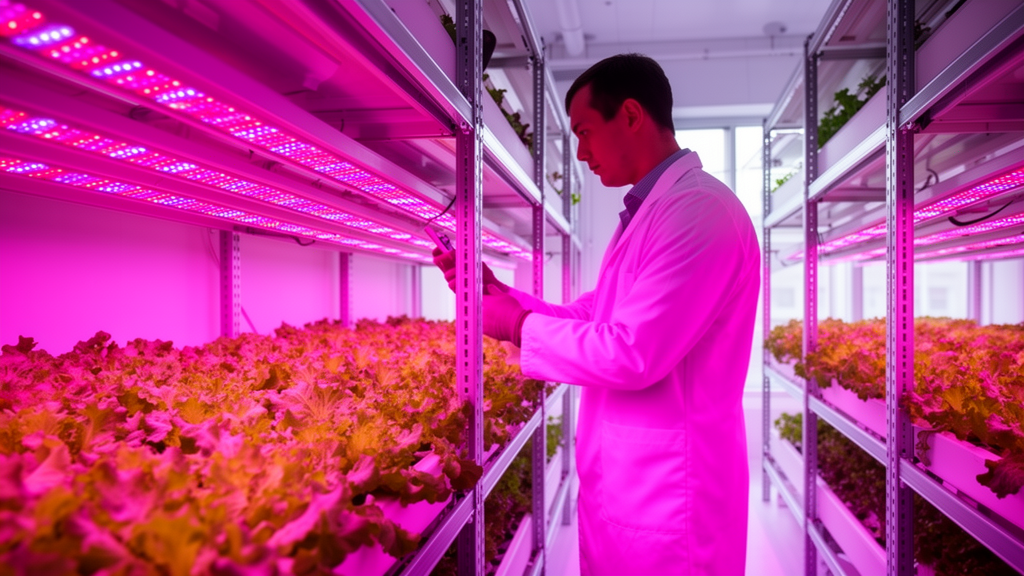
Inside windowless warehouses and gleaming glass greenhouses, a quiet revolution is underway. Plants no longer depend on the sun for their daily dose of photons. Instead, engineers and plant scientists dial in precise combinations of red, blue, white and far-red light from LED fixtures, treating illumination as a programmable input as controllable as water or fertilizer. A new editorial published in Frontiers in Horticulture argues that this shift, from simply maximizing biomass to actively regulating plant metabolism, marks the defining transformation of controlled environment horticulture, or CEH, in the coming decade.
The editorial, written by Oksana Lastochkina of the Ufa Federal Research Centre in Russia and Stefano Marino of the University of Molise in Italy, frames a special collection of studies on light application in CEH. The authors trace the field’s origins to NASA research in the early 1990s, when light-emitting diodes were first proposed as a radiation source for growing plants in space. What began as an experimental curiosity has since matured into large-scale plant factories with artificial lighting in Japan and into precision light recipes for commercial greenhouse crops worldwide. According to the editorial, the research focus has moved decisively from producing more plant matter to modulating phenotype, secondary metabolites and nutritional value, with LEDs recognized not merely as sources of photosynthetic photons but as tools for steering plant biochemistry.
Yet significant gaps remain. Lastochkina and Marino point out that cost-effective lighting regimes and canopy-level light management are still poorly developed and rarely implemented at commercial scale, limiting improvements in both crop yield and quality. The special issue was initiated by Dr. Sasan Aliniaeifard, a pioneering Iranian researcher who trained at Wageningen University and founded a leading research centre for controlled environment agriculture at Tehran University. His work on stomatal conductance, photosynthesis and photomorphogenesis under LEDs, along with spectral optimization for greenhouse crops and secondary metabolite manipulation, laid the foundation for many of today’s light recipes. The issue is dedicated to his memory.
Beyond single-plant experiments, the editorial emphasizes a systems-based approach. The four studies in the collection reveal how light recipes interact with alternative substrates, how light programs non-photosynthetic organisms such as mushrooms, and how lighting scales within circular production platforms like aquaponics. Together, they sketch a framework for next-generation horticulture that links fundamental regulatory mechanisms with sustainable, closed-loop ecosystems.
The first study, by Azad and Naznin, examined supplemental red and far-red light against a white LED background in indoor-grown lettuce and kale. The results were striking and species-specific. In lettuce, red light accelerated vegetative growth, increasing leaf area by 56.5 percent and dry weight by 18.8 percent, while far-red raised plant height, fresh weight and chlorophyll content by roughly 35 percent. In kale, the combined white, red and far-red spectrum triggered a dramatic 572 percent increase in anthocyanins, the pigments responsible for deep red and purple coloration, while white plus red boosted phenolic compounds by 10.7 percent. The authors concluded that the combined red and far-red spectrum layered over white light produced the most significant enhancement in biomass, pigments and antioxidant activity for both species, underscoring the power of spectrum optimization for producing antioxidant-rich functional foods.
But these benefits come with a physiological catch. Red and far-red supplementation also raised leaf nitrate levels by up to 69.1 percent in kale and 53.6 percent in lettuce. Because dietary nitrate is a concern for human health, the finding highlights a critical need for further research into light-regulated nitrogen metabolism. The editorial suggests that dynamic preharvest lighting strategies designed to minimize nitrate accumulation should be a priority research direction for the field.
The second study extended photobiology to organisms that cannot photosynthesize at all. De Bonis and colleagues showed that monochromatic LED light applied during cultivation, not merely after harvest, alters morphology and quality in the oyster mushroom Pleurotus ostreatus. Blue light increased cap size and glutamic acid content, the amino acid behind the savory umami taste, while red light, especially combined with a mixed substrate of wheat straw and cottonseed hulls, delivered a pronounced biofortification effect, achieving the highest vitamin D2 biosynthesis at up to 123 micrograms per kilogram of dry weight. Blue and white light, as well as the red plus blue combination, maximized fruiting body yields above 0.300 kilograms per kilogram, and blue light enhanced essential amino acids such as histidine and valine linked to the umami flavor profile. These findings point toward a new biofortification protocol for producing nutritionally dense mushrooms in protected conditions and underscore the decisive role of substrate composition in optimizing mushroom production systems.
Managing such intricate light scenarios requires non-invasive phenotyping tools. Balasus and colleagues proposed reliable visible-spectrum reflectance metrics for monitoring cucumber leaf development, establishing precise optical markers associated with leaf ontogeny, with particularly strong correlations on the abaxial leaf surface. This work lays the foundation for smart horticulture in which light spectra can be dynamically adjusted based on real-time plant spectral reflectance. Such an approach could reduce the need for destructive sampling, enabling automated phenotyping and adaptive lighting management in commercial greenhouses and indoor farms.
The final study, by Heo and colleagues, presented a comparative analysis of resource efficiency between a conventional hydroponic system and an aquaponic system stocked with catfish for growing five leafy vegetables and herbs: white leaf beets, hooker chives, basil, lemon balm and spearmint, all cultivated in an indoor greenhouse facility. Under identical light inputs, the aquaponic system demonstrated a significant advantage, increasing plant yields thanks to the natural organic nitrogen supplied by aquaculture waste. Leaf yield increases ranged between 60 and 70 percent for basil and lemon balm, and reached a remarkable 200 percent for chives. The system maintained an optimal nitrate-nitrogen concentration of 64 milligrams per liter, demonstrating aquaponics as a highly efficient, organic and climate-smart alternative to conventional hydroponics.
Collectively, the studies show that controlled environment horticulture is evolving toward an integrated framework in which LED light spectra, substrate composition and biological symbiosis among plants, fish and mushrooms are managed as interconnected variables rather than isolated factors. This systems-level perspective can enable more precise control over crop phenotype and nutritional quality while improving overall resource efficiency. Key advancements include non-invasive optical monitoring for real-time plant development assessment, zero-waste aquaponic cultivation platforms and species-specific light recipes for functional food production. Looking ahead, the editorial identifies AI-driven integration of phenotyping data with adaptive lighting control and comprehensive economic assessments of hybrid system scalability as priority directions. In a broader context, the authors argue these technologies hold promise not only for urban agriculture but also for autonomous life-support systems in space exploration, closing the loop on a vision that began with NASA’s first LED experiments more than three decades ago.
Subject of Research: Editorial: Light application in controlled environment horticulture
Article Title: Editorial: Light application in controlled environment horticulture
Article References: Editorial: Light application in controlled environment horticulture. (n.d.). https://doi.org/10.3389/fhort.2026.1980079
Image Credits: AI Generated
DOI: 10.3389/fhort.2026.1980079
Keywords: controlled environment horticulture, LED lighting, vertical farming, light recipes, aquaponics, plant science, Editorial, Light, application, controlled, environment, horticulture
Cite Scienmag News
Alan Morgan. (October 16, 2026). Light recipes reshape the future of controlled environment horticulture. Scienmag. https://scienmag.com/light-recipes-reshape-the-future-of-controlled-environment-horticulture/
Alan Morgan. "Light recipes reshape the future of controlled environment horticulture." Scienmag, 16 October 2026, https://scienmag.com/light-recipes-reshape-the-future-of-controlled-environment-horticulture/. Accessed 16 October 2026.
Alan Morgan. "Light recipes reshape the future of controlled environment horticulture." Scienmag. October 16, 2026. https://scienmag.com/light-recipes-reshape-the-future-of-controlled-environment-horticulture/


