


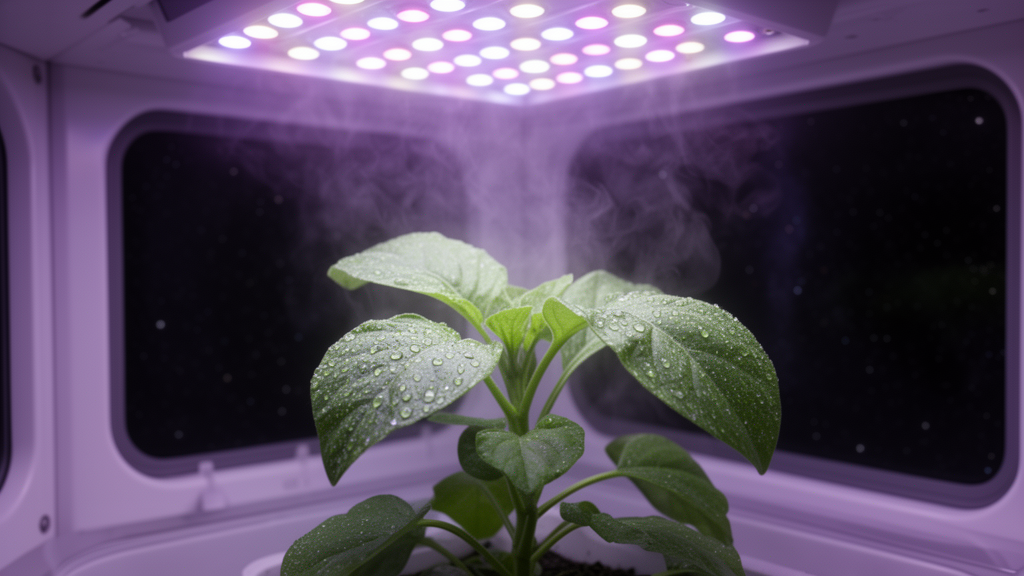
When the lights go out in a growth chamber, it is tempting to assume the plants inside simply clock off too. A new study from Utah State University shows that this assumption is dangerously wrong for the closed-loop farming systems being designed to feed astronauts on the International Space Station. Growing mizuna, a peppery Japanese mustard green that has already been cultivated aboard the ISS, the researchers found that nighttime water loss ran at nearly half the rate of daytime water loss once the numbers were corrected for the unequal length of light and dark periods. The finding, published in Smart Agricultural Technology, has direct consequences for how engineers budget water and manage humidity in spacecraft greenhouses where every drop must be recycled.
The research team, led by Claudia Garrido-Ruiz together with Bruce Bugbee, Juan D. González-Teruel, Sarah Schreck and Scott B. Jones, worked with the Utah Reusable Root Module, or URRM, a zero-discharge plant growth system under development for future deployment in orbit. The prototype consists of five independent root modules filled with long-fiber peat moss, each instrumented with electromagnetic moisture sensors that track volumetric water content, electrical conductivity, matric potential and temperature around the clock. In the closed-loop architecture envisioned for the space station, water lost by crops through evapotranspiration must be captured from the cabin air by condensation, collected and recycled, which makes the timing of that water loss just as important as its total.
Evapotranspiration combines evaporation from the growing surface with transpiration through the plant, and once a canopy closes, transpiration dominates, often accounting for more than 90 percent of the total. Light is the master control, driving stomatal opening, photosynthesis and the vapor-pressure deficit that pulls water from leaves. That is why nighttime fluxes have historically been dismissed as negligible. Yet decades of physiological work show that stomata do not slam shut at dusk. Residual conductance persists in darkness, circadian rhythms modulate pore opening through the night, and sap flow and leaf gas-exchange measurements across many species confirm that water keeps moving through the soil-plant-atmosphere continuum long after sunset.
The catch, the authors argue, is that most studies report nighttime evapotranspiration as a fraction of daily totals, without accounting for the fact that controlled environments often run strongly asymmetric photoperiods. The URRM experiment used 16 hours of light and only 8 hours of darkness, so even a modest hourly nighttime rate accumulates into a seemingly small daily share. To separate intensity from duration, the team calculated a time-normalized ratio comparing mean hourly nighttime and daytime rates during stable periods, excluding the two hours after lights-off and after lights-on, when rapid temperature swings and lagging physiological responses distort the signal.
The measurements themselves came from a water-balance approach. Each root module held 6,684 cubic centimeters of media, and moisture sensors recorded water content every 20 seconds. Hourly water loss was computed from the decline in water content between interval boundaries, then corrected using regression slopes calibrated against the known output of a syringe pump that delivered nutrient solution in discrete 60-milliliter pulses whenever the substrate dried below a set threshold. Daily totals derived this way matched cumulative irrigation inputs with a coefficient of determination of at least 0.99 across all five modules, giving the team confidence in the underlying signal.
The results were striking. During the rapid-growth phase, when the five modules together were transpiring more than 3 liters per day across just 0.4 square meters of growing area, the upper sensor showed nighttime water loss averaging 46 percent of the daytime hourly rate. The same sensor’s cumulative daily ratio was only 0.28, meaning nighttime fluxes contributed roughly 22 percent of total daily water use. Time normalization therefore inflated the apparent intensity of nighttime loss by about 60 percent, revealing that dark-period water loss is far more aggressive per hour than daily accounting suggests. The lower sensor, positioned near the base of the root zone, produced even higher ratios, likely because internal water redistribution within the media masquerades as atmospheric loss at that depth.
Sensor placement turned out to matter enormously. The lower TEROS ONE sensor yielded stage-level cumulative ratios as high as 0.75 early in the crop cycle, when total fluxes were small and redistribution effects were proportionally large, before converging toward the upper sensor’s values as transpiration took over. The upper CS650 sensor, spanning 30 centimeters of the upper profile, remained stable across all developmental stages and was treated as the better proxy for canopy-scale dynamics. The discrepancy between the two positions provided qualitative evidence of deeper water movement, but because sensor model and depth varied together, the individual contributions could not be disentangled.
The team also ran scenario projections, applying the measured hourly rates to shorter photoperiods. Cutting the light period from 16 hours to 14, 12, 10 or 8 hours reduced projected daily water use by 5.5, 11.0, 16.6 and 22.1 percent respectively, assuming the hourly rates held constant. But even the most aggressive scenario left substantial nighttime loss in place, and the authors caution that these are first-order engineering estimates, not demonstrated plant responses. Shorter days would likely alter canopy development, biomass accumulation and the very shape of the daily evapotranspiration curve, and none of those feedbacks were tested.
For mission planners, the implications are concrete. If atmospheric moisture from crops outpaces the capacity of condensation and dehumidification hardware, relative humidity could remain elevated for extended periods, raising risks of microbial growth and hardware corrosion in a sealed spacecraft. Simply dimming the lights may not deliver the savings hoped for, because the dark hours keep draining the water budget. The authors point to complementary strategies with experimental support: partial leaf harvests of mizuna cut evapotranspiration by roughly 40 percent at peak demand, and staggering crop cycles across modules spreads out the periods of maximum water use rather than letting every plant hit peak thirst simultaneously.
The study has limits. It covered a single species, one photoperiod and one 17-day crop cycle, and the five root modules differed in surface-containment design in ways that could not be statistically separated from their positions in the system. Growth-media moisture dynamics can also reflect internal redistribution as well as genuine atmospheric loss, a caveat most evident early in the cycle. Still, the central message stands and resonates beyond spaceflight: whenever day and night periods differ in length, cumulative ratios quietly understate how hard plants work after dark. For greenhouses on Earth and habitats beyond it, water accounting that ignores the night is accounting that will run dry.
Subject of Research: Time-normalized evapotranspiration reveals substantial nighttime water loss in a controlled-environment system
Article Title: Time-normalized evapotranspiration reveals substantial nighttime water loss in a controlled-environment system
Article References: Time-normalized evapotranspiration reveals substantial nighttime water loss in a controlled-environment system. (n.d.). Original publication
Image Credits: AI Generated
DOI: Not provided
Keywords: evapotranspiration, nighttime transpiration, controlled environment agriculture, International Space Station, space crop production, mizuna, water recycling, root module, photoperiod, humidity control, soil moisture sensing, water use efficiency
Cite Scienmag News
Alan Morgan. (October 16, 2026). Plants Keep Losing Water at Night, and Space Farming Can’t Afford to Ignore It. Scienmag. https://scienmag.com/plants-keep-losing-water-at-night-and-space-farming-cant-afford-to-ignore-it/
Alan Morgan. "Plants Keep Losing Water at Night, and Space Farming Can’t Afford to Ignore It." Scienmag, 16 October 2026, https://scienmag.com/plants-keep-losing-water-at-night-and-space-farming-cant-afford-to-ignore-it/. Accessed 16 October 2026.
Alan Morgan. "Plants Keep Losing Water at Night, and Space Farming Can’t Afford to Ignore It." Scienmag. October 16, 2026. https://scienmag.com/plants-keep-losing-water-at-night-and-space-farming-cant-afford-to-ignore-it/


