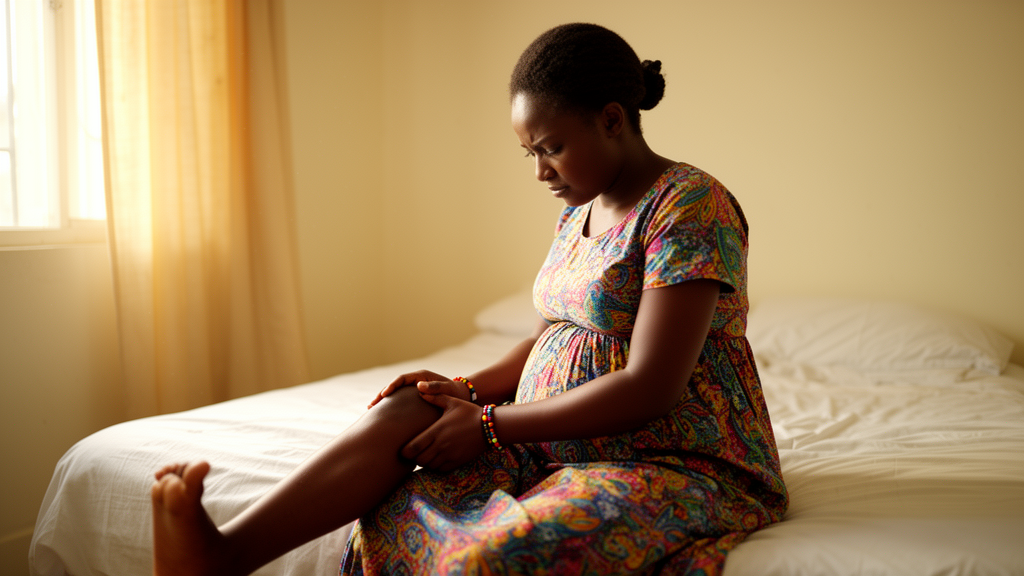
Restless legs syndrome, the uncomfortable and often maddening urge to move the legs that strikes when the body is trying to rest, affects roughly one in ten women in the final months of pregnancy in northern Ethiopia, according to a new study published in PLOS One. The research, conducted among 422 third-trimester pregnant women attending antenatal care clinics in public hospitals across the North Wollo Zone, found that 11.61 percent met the criteria for the condition, a prevalence that researchers say deserves far more clinical attention than it currently receives in the region.
Restless legs syndrome is a sensory-motor neurological disorder characterized by uncomfortable sensations deep in the legs, typically described as crawling, pulling, or throbbing feelings, that intensify during periods of rest or inactivity, particularly at night. The symptoms are partially or completely relieved by movement, which is precisely what makes the condition so disruptive: sufferers feel compelled to walk, stretch, or shift their legs constantly, often at the expense of sleep. During pregnancy, when quality sleep is already elusive, the syndrome can compound fatigue, stress, and emotional strain, and previous research has linked it to adverse maternal and fetal outcomes.
Despite its burden, restless legs syndrome remains chronically underdiagnosed and poorly understood, both by clinicians and by the general public. Many women who experience the symptoms never report them, assuming the sensations are simply a normal part of pregnancy, and many health providers do not routinely screen for the condition during antenatal visits. In Ethiopia specifically, reliable data on the prevalence of restless legs syndrome among pregnant women and the factors that influence it have been scarce, leaving a significant gap in the evidence base needed to guide clinical practice and public health planning.
To address that gap, a team of researchers led by Esuyawkal Mislu and colleagues designed an institution-based cross-sectional study conducted from November 2023 to February 2024. The study population consisted of third-trimester pregnant women receiving antenatal care at public hospitals in the North Wollo Zone of the Amhara Region. Using a systematic random sampling method, the researchers enrolled 422 eligible participants, achieving a 100 percent response rate, a detail that strengthens the representativeness of the findings for the population studied.
Data collection relied on two complementary approaches. Trained interviewers administered a structured and pretested questionnaire to gather information on sociodemographic characteristics, obstetric history, lifestyle factors, and clinical variables. In parallel, the researchers extracted relevant medical information from the participants’ charts, allowing them to verify key clinical details. The collected data were coded and entered using EPI DATA software, and the analysis was performed with STATA version 16. The researchers employed both bi-variable and multivariable logistic regression to identify factors independently associated with restless legs syndrome, declaring statistical significance at a p-value below 0.05.
The headline result was a prevalence of 11.61 percent, meaning approximately one out of every ten third-trimester pregnant women in the study experienced restless legs syndrome. While this figure may appear modest compared to some global estimates, which in various populations have ranged considerably higher, it represents a substantial burden of preventable suffering when multiplied across the thousands of women who pass through antenatal clinics in the region each year. The researchers emphasize that even this level of prevalence warrants routine screening and clinical awareness among antenatal care providers.
The multivariable analysis revealed five factors significantly associated with the condition. Women living in urban areas had nearly six times higher odds of experiencing restless legs syndrome compared to their rural counterparts, with an adjusted odds ratio of 5.781 and a 95 percent confidence interval spanning 1.172 to 28.501. The reasons behind this urban-rural divide remain speculative, but the researchers suggest that differences in lifestyle, physical activity patterns, occupational demands, and possibly dietary habits could play contributing roles.
Gestational age emerged as another powerful predictor. Women at 37 weeks of gestation or beyond had nearly eight times higher odds of restless legs syndrome compared to those earlier in the third trimester, with an adjusted odds ratio of 7.789 and a 95 percent confidence interval of 3.027 to 20.039. This finding aligns with the biological understanding that the syndrome tends to worsen as pregnancy progresses, possibly due to increasing iron demands, hormonal shifts, expanding uterine pressure on pelvic nerves, and growing physical discomfort that disrupts rest.
A history of abortion also doubled the odds of the syndrome, with an adjusted odds ratio of 2.381 and a 95 percent confidence interval of 1.081 to 5.246. This association may reflect cumulative physiological stress, nutritional depletion, or underlying health conditions that predispose women who have experienced pregnancy loss to neurological and sleep-related disturbances. Conversely, women who took iron supplementation during pregnancy had significantly lower odds of restless legs syndrome, with an adjusted odds ratio of 0.267 and a 95 percent confidence interval of 0.094 to 0.754, a finding consistent with the well-established role of iron deficiency in the pathophysiology of the syndrome. Iron is a cofactor for tyrosine hydroxylase, the rate-limiting enzyme in dopamine synthesis, and depleted iron stores in the brain are thought to impair dopaminergic signaling, the central mechanism implicated in restless legs syndrome.
Alcohol consumption during pregnancy was the final significant factor, associated with more than double the odds of the syndrome, with an adjusted odds ratio of 2.289 and a 95 percent confidence interval of 1.049 to 4.995. Alcohol is known to disrupt sleep architecture and may exacerbate the sensory symptoms of restless legs syndrome, and its consumption during pregnancy carries additional well-documented risks to fetal development. Taken together, the researchers conclude that attention to restless legs syndrome during pregnancy is essential, and they recommend that antenatal care programs prioritize ensuring pregnant women receive the recommended iron supplements and refrain from alcohol. They also call for greater awareness among clinicians and the public, so that women experiencing these symptoms are identified early and supported rather than left to suffer in silence during one of the most physically demanding periods of their lives.
Subject of Research: Restless legs syndrome among third-trimester pregnant women attending ANC Clinic in public hospitals in North Wollo Zone, Ethiopia
Article Title: Restless legs syndrome among third-trimester pregnant women attending ANC Clinic in public hospitals in North Wollo Zone, Ethiopia
Article References: Restless legs syndrome among third-trimester pregnant women attending ANC Clinic in public hospitals in North Wollo Zone, Ethiopia. (n.d.). https://doi.org/10.1371/journal.pone.0360405
Image Credits: AI Generated
DOI: 10.1371/journal.pone.0360405
Keywords: restless legs syndrome, pregnancy, Ethiopia, antenatal care, iron supplementation, maternal health, sleep disorder, PLOS One, Restless, legs, syndrome, third-trimester
Cite Scienmag News
Harold Sullivan. (October 16, 2026). One in Ten Pregnant Women in Ethiopia’s Third Trimester Suffers Restless Legs Syndrome, Study Finds. Scienmag. https://scienmag.com/one-in-ten-pregnant-women-in-ethiopias-third-trimester-suffers-restless-legs-syndrome-study-finds/
Harold Sullivan. "One in Ten Pregnant Women in Ethiopia’s Third Trimester Suffers Restless Legs Syndrome, Study Finds." Scienmag, 16 October 2026, https://scienmag.com/one-in-ten-pregnant-women-in-ethiopias-third-trimester-suffers-restless-legs-syndrome-study-finds/. Accessed 16 October 2026.
Harold Sullivan. "One in Ten Pregnant Women in Ethiopia’s Third Trimester Suffers Restless Legs Syndrome, Study Finds." Scienmag. October 16, 2026. https://scienmag.com/one-in-ten-pregnant-women-in-ethiopias-third-trimester-suffers-restless-legs-syndrome-study-finds/