


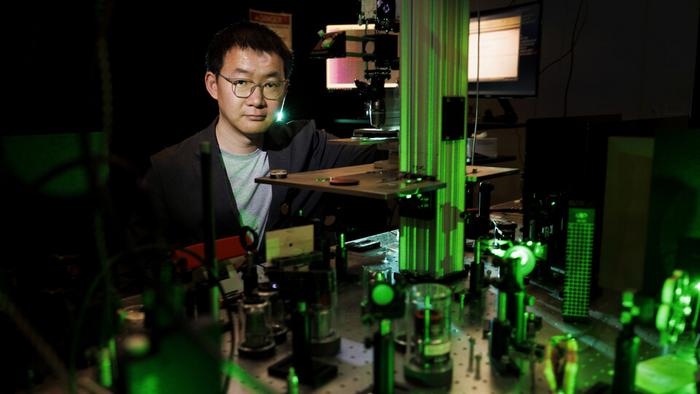
Metal halide perovskites have emerged in recent years as a low-cost, highly efficient semiconducting material for solar energy, solid-state lighting and more. Despite their growing use, a fundamental understanding of the origins of their outstanding properties is still lacking. A Husker scientist is aiming to find answers that could lead to the development of new materials and new applications.

Credit: Craig Chandler/University Communication & Marketing/University of Nebraska-Lincoln
Metal halide perovskites have emerged in recent years as a low-cost, highly efficient semiconducting material for solar energy, solid-state lighting and more. Despite their growing use, a fundamental understanding of the origins of their outstanding properties is still lacking. A Husker scientist is aiming to find answers that could lead to the development of new materials and new applications.
Yinsheng Guo, assistant professor of chemistry at the University of Nebraska–Lincoln, also wants to transform how physical chemistry is taught to undergraduate and graduate students, who often struggle to understand and apply what they have learned in class to the laboratory and STEM workplace.
Guo’s research and teaching project is funded by a five-year, $648,335 grant from the National Science Foundation’s Faculty Early Career Development Program.
“The importance of photovoltaic technology in the energy portfolio will continue to grow globally and in the U.S.,” Guo said. “Such growth is fueled by the continuous investment and innovation in new technologies.”
Metal halide perovskites (or MHPs), which “have become a star material in the last decade,” represent a major branch of these technologies. Perovskites are a group of materials that have distinctive crystal structures of interconnected octahedral units made of metal and oxide or halide ions. The broadly defined perovskite family is known for its superconducting and ferroelectric properties, drawing interest in both fundamental science and materials engineering. As scientists have learned more about MHPs’ ability to absorb and emit photons of light and be used for harvesting electricity, perovskites have emerged as a much less expensive, easier to scale up alternative to silicon for use in energy technologies.
MHPs can be used as semiconducting materials in a variety of applications, including solar energy, solid-state lighting, lasers, photodetectors and general optoelectronic applications, Guo said.
However, Guo said, “a comprehensive and consistent understanding of the origin of the many outstanding optoelectronic properties is still lacking despite being intensively pursued.” His research goal is to answer fundamental questions about MHPs.
MHPs’ exceptional performance is surprising, given that they are defect-prone, low-temperature, solution-processed materials, Guo said. He and his research team will work to quantify and control MHPs’ unique structural dynamics to better understand their exceptional electronic properties so they can be further developed and commercialized.
Ultimately, a better understanding of MHPs’ design principles could be useful in developing other emerging materials.
Guo also aims to change how students approach physical chemistry.
“Chemistry is the central science and serves as the physical foundation for advancements in both biomedical and material fields,” Guo said. “A good conceptual understanding of the physical and chemical principles enables and empowers a future science, technology, engineering and mathematics workforce.”
As a teacher, Guo said, he has observed that both undergraduate and graduate students struggle with that conceptual understanding, which may be exacerbated by differences in how students learned about physical sciences earlier on.
“Students’ learning is often compartmentalized,” Guo said. “Undergraduate students often assume an exam-oriented mentality and do not find the course content and skills transferrable in their career and life; graduate students often are challenged to transfer course content into research skills.”
Through his CAREER project, Guo will develop a computational and experiential approach to address the challenges of teaching and learning physical chemistry. Guo said he will harness readily available computational resources to break down the learning barrier and bring students toward better conceptual understanding through active, experiential learning.
Computational literacy is also an important element for the next generation entering the STEM workforce at a time when machine intelligence plays an indispensable role. Having built a computational skillset, students will be guided to further explore scientific data, including mapping spectra — a visual representation of the intensity of light — to musical notes. The idea is to produce molecularly encoded music as a bridge between science and art.
The National Science Foundation’s CAREER award supports pre-tenure faculty who exemplify the role of teacher-scholars through outstanding research, excellent education and the integration of education and research.
Cite Scienmag News
Bethany Barker. (May 14, 2024). Lessons in chemistry: Guo aims at fundamental understanding of emerging semiconductor material. Scienmag. https://scienmag.com/lessons-in-chemistry-guo-aims-at-fundamental-understanding-of-emerging-semiconductor-material/
Bethany Barker. "Lessons in chemistry: Guo aims at fundamental understanding of emerging semiconductor material." Scienmag, 14 May 2024, https://scienmag.com/lessons-in-chemistry-guo-aims-at-fundamental-understanding-of-emerging-semiconductor-material/. Accessed 4 September 2026.
Bethany Barker. "Lessons in chemistry: Guo aims at fundamental understanding of emerging semiconductor material." Scienmag. May 14, 2024. https://scienmag.com/lessons-in-chemistry-guo-aims-at-fundamental-understanding-of-emerging-semiconductor-material/

