


“In this study, we first obtained evidence that, in mouse, aging primarily reduced the number of active sweat glands.”

Credit: 2024 Zonnefeld et al.
“In this study, we first obtained evidence that, in mouse, aging primarily reduced the number of active sweat glands.”
BUFFALO, NY- May 14, 2024 – A new research paper was published in Aging (listed by MEDLINE/PubMed as “Aging (Albany NY)” and “Aging-US” by Web of Science) Volume 16, Issue 8, entitled, “Characterization of age-associated gene expression changes in mouse sweat glands.”
Evaporation of sweat on the skin surface is the major mechanism for dissipating heat in humans. The secretory capacity of sweat glands (SWGs) declines during aging, leading to heat intolerance in the elderly, but the mechanisms responsible for this decline are poorly understood. In this new study, researchers Alexandra G. Zonnefeld, Chang-Yi Cui, Dimitrios Tsitsipatis, Yulan Piao, Jinshui Fan, Krystyna Mazan-Mamczarz, Yutong Xue, Fred E. Indig, Supriyo De, and Myriam Gorospe from the National Institutes of Health’s National Institute on Aging investigated the molecular changes accompanying SWG aging in mice, where sweat tests confirmed a significant reduction of active SWGs in old mice relative to young mice.
“We first identified SWG-enriched mRNAs by comparing the skin transcriptome of Eda mutant Tabby male mice, which lack SWGs, with that of wild-type control mice by RNA-sequencing analysis.”
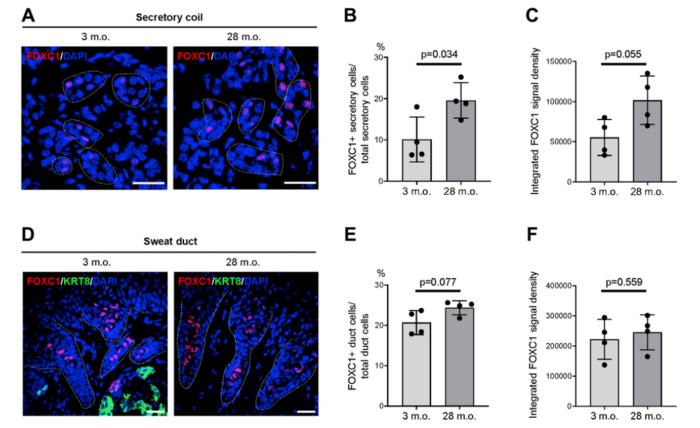
This comparison revealed 171 mRNAs enriched in SWGs, including 47 mRNAs encoding ‘core secretory’ proteins such as transcription factors, ion channels, ion transporters, and trans-synaptic signaling proteins. Among these, 28 SWG-enriched mRNAs showed significantly altered abundance in the aged male footpad skin, and 11 of them, including Foxa1, Best2, Chrm3, and Foxc1 mRNAs, were found in the ‘core secretory’ category. Consistent with the changes in mRNA expression levels, immunohistology revealed that higher numbers of secretory cells from old SWGs express the transcription factor FOXC1, the protein product of Foxc1 mRNA.
“In sum, our study identified mRNAs enriched in SWGs, including those that encode core secretory proteins, and altered abundance of these mRNAs and proteins with aging in mouse SWGs.”
Read the full paper: DOI: https://doi.org/10.18632/aging.205776
Corresponding Authors: Chang-Yi Cui, Myriam Gorospe
Corresponding Emails: cuic@mail.nih.gov, gorospem@grc.nia.nih.gov
Go Behind the Study with the author interview.
Click here to sign up for free Altmetric alerts about this article.
About Aging:
Aging publishes research papers in all fields of aging research including but not limited, aging from yeast to mammals, cellular senescence, age-related diseases such as cancer and Alzheimer’s diseases and their prevention and treatment, anti-aging strategies and drug development and especially the role of signal transduction pathways such as mTOR in aging and potential approaches to modulate these signaling pathways to extend lifespan. The journal aims to promote treatment of age-related diseases by slowing down aging, validation of anti-aging drugs by treating age-related diseases, prevention of cancer by inhibiting aging. Cancer and COVID-19 are age-related diseases.
Aging is indexed by PubMed/Medline (abbreviated as “Aging (Albany NY)”), PubMed Central, Web of Science: Science Citation Index Expanded (abbreviated as “Aging‐US” and listed in the Cell Biology and Geriatrics & Gerontology categories), Scopus (abbreviated as “Aging” and listed in the Cell Biology and Aging categories), Biological Abstracts, BIOSIS Previews, EMBASE, META (Chan Zuckerberg Initiative) (2018-2022), and Dimensions (Digital Science).
Please visit our website at www.Aging-US.com and connect with us:
- X, formerly Twitter
- YouTube
- Spotify, and available wherever you listen to podcasts
Click here to subscribe to Aging publication updates.
For media inquiries, please contact media@impactjournals.com.
Aging (Aging-US) Journal Office
6666 E. Quaker Str., Suite 1B
Orchard Park, NY 14127
Phone: 1-800-922-0957, option 1
###
Journal
Aging-US
Method of Research
Observational study
Subject of Research
Animals
Article Title
Characterization of age-associated gene expression changes in mouse sweat glands
Article Publication Date
17-Apr-2024
Cite Scienmag News
Juliet Wilcox. (May 14, 2024). Age-associated gene expression changes in mouse sweat glands. Scienmag. https://scienmag.com/age-associated-gene-expression-changes-in-mouse-sweat-glands/
Juliet Wilcox. "Age-associated gene expression changes in mouse sweat glands." Scienmag, 14 May 2024, https://scienmag.com/age-associated-gene-expression-changes-in-mouse-sweat-glands/. Accessed 3 September 2026.
Juliet Wilcox. "Age-associated gene expression changes in mouse sweat glands." Scienmag. May 14, 2024. https://scienmag.com/age-associated-gene-expression-changes-in-mouse-sweat-glands/

